01Facts
On 04.10.2008, a quarrel broke out between the families of the deceased Babloo and Uma Shankar over garbage thrown onto a vacant plot.
¶ 3–4When Satbir Verma (PW-4), Babloo's father, intervened, the appellant and his younger brothers, Yogesh and Dipesh @ Nanki, assaulted Satbir.
¶ 3–4When Babloo intervened, Yogesh struck him repeatedly on the waist and abdomen with a wooden thapi, and the appellant and Dipesh also allegedly beat him.
¶ 4, 18Babloo's condition deteriorated around noon. His mother (PW-6) and sister-in-law (PW-8) first told the attending doctor (PW-5) that he had fallen from a height; around 6:46 PM they orally disclosed an assault.
¶ 14–15Babloo died on 05.10.2008 from blunt-trauma abdominal injury causing haemorrhagic shock.
¶ 17, 36The FIR was registered shortly after midnight on 04/05.10.2008, about 16 hours after the occurrence.
¶ 23Yogesh (a juvenile) was apprehended and the thapi was recovered at his instance; no fingerprints were lifted.
¶ 5, 29The appellant was charged under ss. 304, 323 and 34 IPC. The Trial Court convicted him under s. 304 Part II IPC (7 years' RI, fine of ₹60,000) and s. 323 IPC (6 months' RI, fine of ₹1,000), both concurrent.
¶ 2, 5The defence (DW-1) asserted that Babloo fell while descending the stairs.
¶ 5, 26–2702Issues
i.1. Whether the prosecution established that Babloo's fatal injury was caused by assault rather than by a fall, notwithstanding the initial medical history of a fall.
¶ 7–8, 14–17, 30ii.2. Whether the appellant shared a common intention under s. 34 IPC with Yogesh and actively participated in the assault upon Babloo, such that he is liable for the fatal injury.
¶ 6, 10, 40, 44–47, 50–51iii.3. Whether the knowledge required under s. 304 Part II IPC (knowledge that the act is likely to cause death) can be attributed to the appellant.
¶ 48–52iv.4. Whether the conviction under s. 323 read with s. 34 IPC for hurt caused to Satbir Verma is sustainable.
¶ 38–3903Law Applied
The court applied s. 299 IPC (culpable homicide) and s. 304 Part II IPC, which applies where death is caused with knowledge that the act is likely to cause death, without intention to cause death.
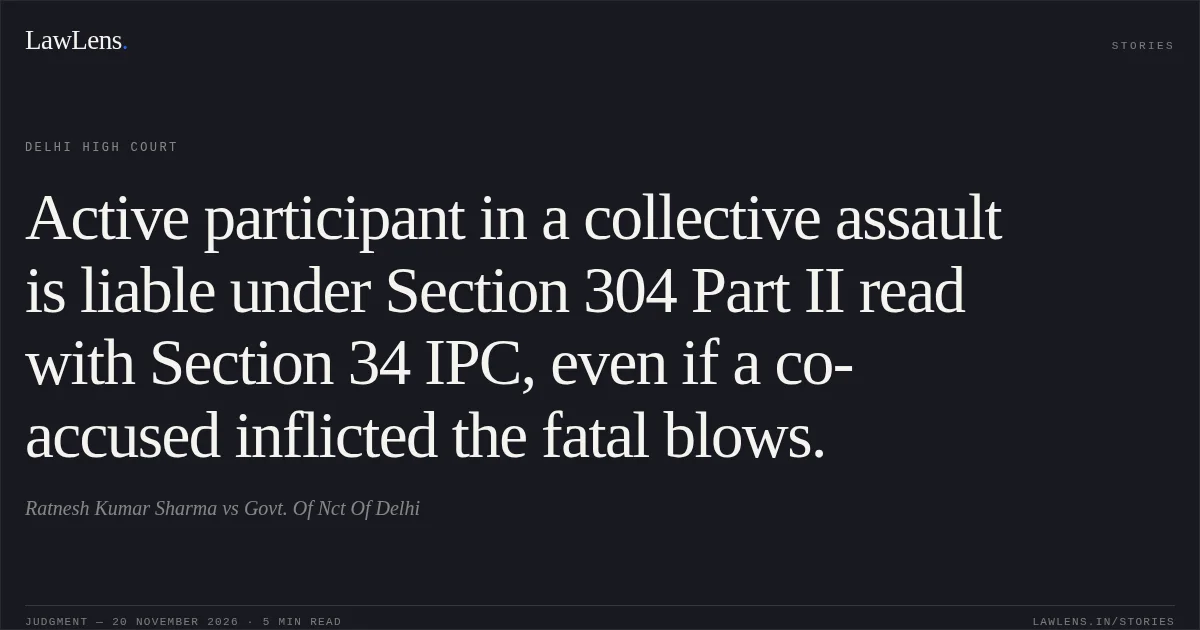
¶ 40The court applied s. 34 IPC, which creates joint liability for a criminal act done in furtherance of a common intention; participation, not identical acts or individual infliction of the fatal injury, is required, and mere presence, relationship, or unrelated violence is insufficient.
¶ 41Under Jasdeep Singh v. State of Punjab (2022) 2 SCC 545, common intention is a question of fact proved by cumulative assessment, may develop at the spot, must be accompanied by action in furtherance, and cannot be presumed from presence alone.
¶ 42Under Krishnamurthy v. State of Karnataka (2022) 7 SCC 521, s. 34 may apply where knowledge is the mental element, but a co-accused is not automatically liable for every act of the principal offender; the final act must be connected with or a reasonably possible outcome of the common purpose.
¶ 43The court relied on Bhagwan Jagannath Markad v. State of Maharashtra (2016) 10 SCC 537 for the principle that related witnesses are assessed on merits and not discarded on relationship alone.
¶ 20The court relied on Manoj Suryavanshi v. State of Chhattisgarh (2020) 4 SCC 451 that non-material discrepancies and "mathematical niceties" do not defeat credible evidence.
¶ 21The court relied on State of H.P. v. Gian Chand (2001) 6 SCC 71 that delay in lodging an FIR is not by itself fatal where unexplained delay does not indicate fabrication.
¶ 24Provisions in the judgment · 7 · Linked ones open on LawLens
Indian Penal Code, 1860 Section 34Section 299Section 304Section 308Section 323
Code of Criminal Procedure, 1973 Section 313Section 428
04Reasoning
The court first assessed the medical evidence and found it does not conclusively distinguish a fall from an assault; the thapi was capable of causing the fatal injury, and the absence of external abrasions does not make the ocular version impossible.
¶ 17, 28The initial history of a fall was explained by the shock of the women, and the assault disclosure was made the same evening before the FIR, which weakened the suggestion of later fabrication.
¶ 14–16DW-1's account of a stair fall was discounted because she did not disclose it at the time, and PW-8 specifically denied a stair fall; DW-1 did not identify any object causing the abdominal injury.
¶ 26–27The ocular testimony of PW-4, PW-6 and PW-8 was held reliable despite relationship and minor variations on weapon attribution.
¶ 19–22The 16-hour FIR delay and the inconsistency between PW-11 and PW-13 regarding the names disclosed by Satbir were weighed in the appellant's favour to that extent, but did not displace the eyewitness identification.
¶ 23–25The absence of fingerprints on the thapi was noted, but the recovery and medical evidence were held to corroborate the weapon's capability, not the appellant's participation.
¶ 29On s. 34, the court distinguished the appellant's role from a passive presence: PW-6 and PW-8 placed him among the assailants during the second phase of the occurrence, after Babloo intervened, and no witness suggested he withdrew when Yogesh took up the thapi.
¶ 44–47The common intention to assault Babloo was therefore inferred at the point of the collective assault.
¶ 47On knowledge, the court held it could not be inferred from death alone, but from the collective assault by three persons using blunt implements, repeated blows to the waist and abdomen, and the appellant's own active participation.
¶ 48–49, 52Krishnamurthy was distinguished because there the co-accused had only held the deceased, whereas here the appellant participated in the same assault as the fatal blows.
¶ 51The s. 323 r/w s. 34 conviction was upheld on the direct evidence of PW-4 and PW-6 and the corroborating MLC of Satbir.
¶ 38–3905Holding
The prosecution established beyond reasonable doubt that Babloo's fatal injury resulted from assault, that the appellant actively participated in the assault upon him in furtherance of a common intention shared with the other assailants, and that he possessed the knowledge required under s. 304 Part II read with s. 34 IPC.
¶ 30, 47, 52–53The appeal is dismissed and the impugned judgment dated 29.04.2009 and order on sentence dated 30.04.2009 are upheld.
¶ 54–55The appellant, whose sentence had been suspended on 30.07.2009, must surrender before the Trial Court within one week to serve the remaining sentence, with set-off under s. 428 CrPC as admissible; his bail and surety bonds stand cancelled upon surrender.
¶ 56A copy is to be transmitted to the Trial Court and prison authorities.
¶ 58Original Court PDF
Ratnesh Kumar SharmavsGovt. Of Nct Of Delhi
Click to open original judgment
Original judgment, available to read, download and summarize on LawLens.in