Facts
The Petitioner originally sold the suit land (Survey No. 235/B) to Respondent No. 1 via a registered sale deed in 1975
Source reference: p. 3He later claimed that Respondent No. 1 executed a Bataipatra (crop-sharing agreement) on June 1, 2001, creating a "contractual tenancy" in his favor
Source reference: p. 3Dispute arose when Respondent No. 1 sold the property to third parties (Respondents 2-4), leading to Civil Suit No. 288/2001 for injunction
Source reference: p. 3Following a series of litigations regarding illegal dispossession and restoration of possession, the Civil Court referred the issue of tenancy to the Revenue Authorities under Section 99-A of the Hyderabad Tenancy and Agricultural Lands Act, 1950 ("the Act")
Source reference: p. 4The Tahsildar, Deputy Collector, and Maharashtra Revenue Tribunal (MRT) all rejected the Petitioner’s claim, holding that a Bataipatra does not confer tenancy rights and no revenue records supported the status
Source reference: p. 5Issues
1. Whether the Bataipatra dated 01.06.2001 executed by the landowner creates a valid tenancy recognized under the Hyderabad Tenancy and Agricultural Lands Act, 1950
Source reference: p. 2; para. 32. Whether Section 4-A of the Act of 1950 recognizes the concept of "contractual tenancy" through a crop-sharing agreement
Source reference: p. 7; para. 7Law Applied
Hyderabad Tenancy and Agricultural Lands Act, 1950, specifically Section 4-A (applicability of Transfer of Property Act), Sections 38-E and 38-G (protected and ordinary tenancy), and Section 99-A (reference of tenancy issues to authorities)
Source reference: p. 2, 6, 7The court followed the principle that a Bataipatra is a mutually agreed contractual engagement for the limited purpose of sharing crops and does not equate to the transfer of tenancy rights under agricultural statutes
Source reference: p. 7-8Reasoning
The Court examined the nature of the Bataipatra relied upon by the Petitioner. It held that the document is merely a crop-sharing contract where possession is handed over solely for growing crops, rather than establishing a landlord-tenant relationship as contemplated by the Act
Source reference: p. 7-8The Court rejected the Petitioner's interpretation of Section 4-A, clarifying that the Act of 1950 recognizes only specific categories like "protected" and "ordinary" tenants, and does not contain a concept of "contractual tenancy" arising from a Bataipatra
Source reference: p. 7Furthermore, the lack of revenue entries for the period between 1954 and 2001—nor any subsequent to the alleged document—undermined the Petitioner’s claim
Source reference: p. 5, 7The Court concluded that the Revenue Authorities correctly appreciated the evidence in finding that the agreement did not confer statutory tenancy rights
Source reference: p. 8Holding
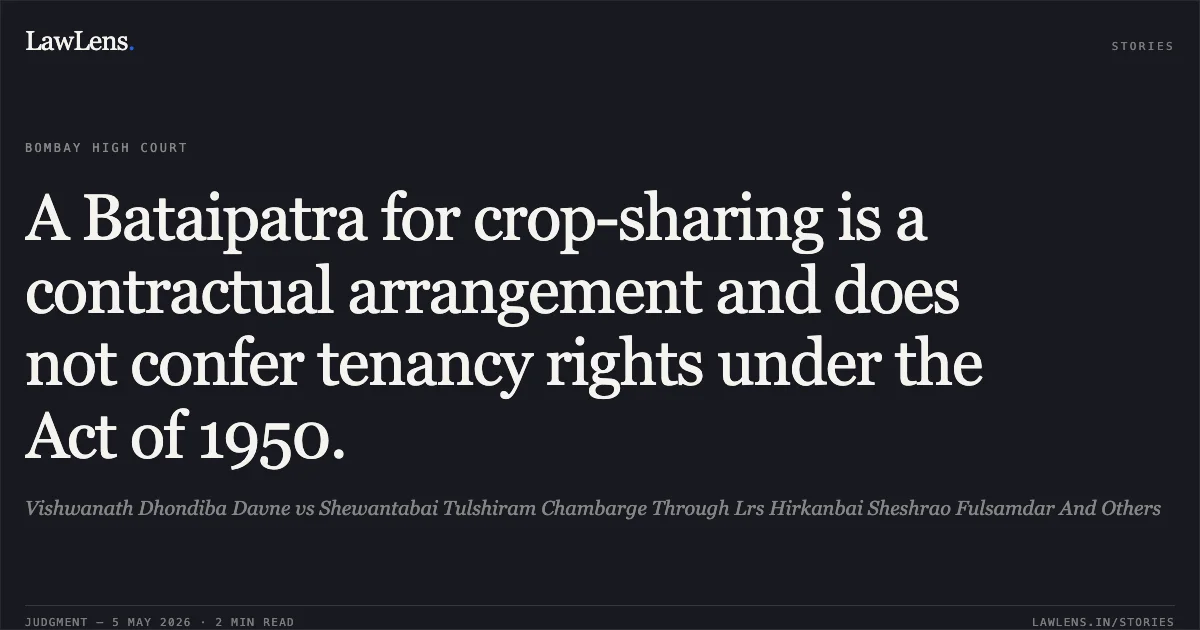
The Court answered the issues in the negative, holding that a Bataipatra is a crop-sharing arrangement and does not confer tenancy rights under the Act of 1950
The Writ Petition was dismissed, and the orders passed by the Tahsildar, Deputy Collector, and Maharashtra Revenue Tribunal were upheld. Rule was discharged with no order as to costs
Source reference: p. 8Acts & Sections Cited
4 provisions across 1 statute referred to in this judgment. Each provision opens on LawLens.
Ajmer Tenancy and Land Records Act, 19504
Original Court PDF
Vishwanath Dhondiba DavnevsShewantabai Tulshiram Chambarge Through Lrs Hirkanbai Sheshrao Fulsamdar And Others
Click to open original judgment
Original judgment, available to read, download and summarize on LawLens.in