Facts
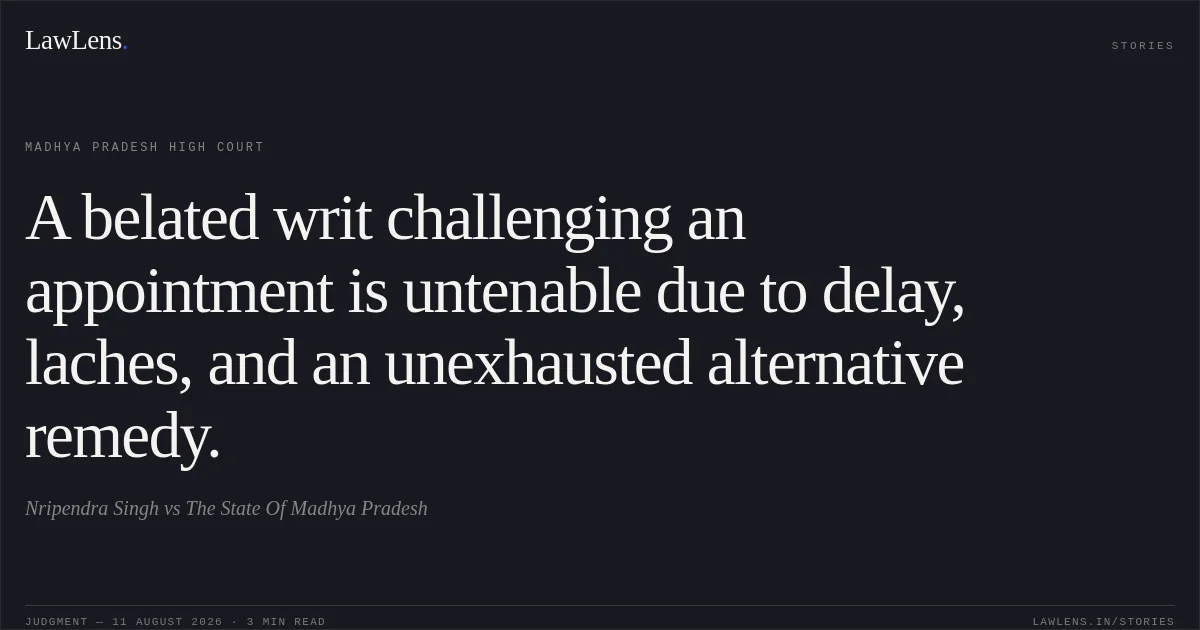
The petitioner challenged the Gram Panchayat’s resolution dated 22 February 2014 appointing respondent No. 7 as Panchayat Karmi.
Source reference: para. 2–4In 2019, the powers of Panchayat Secretary were conferred upon respondent No. 7 by order dated 5 February 2019, following which the petitioner instituted the writ petition under Article 226 of the Constitution.
Source reference: para. 1–4The State opposed the petition on the grounds of delay and laches and availability of an alternative statutory remedy by way of appeal under the Madhya Pradesh Panchayat Raj Evam Gram Swaraj Adhiniyam, 1993.
Source reference: para. 5Respondent No. 7 had continued working since 2014, whereas the petitioner challenged the appointment for the first time through the present proceedings.
Source reference: para. 16–17Issues
Whether the writ petition challenging the appointment of respondent No. 7 as Panchayat Karmi was liable to be rejected on the ground of delay and laches?
Source reference: para. 16–17Whether the writ petition was maintainable when the petitioner had an alternative statutory remedy of appeal against the Gram Panchayat’s resolution under the 1993 Act?
Source reference: para. 5, 18Whether the petitioner could treat the 2019 conferment of Panchayat Secretary powers as giving rise to a fresh cause of action, despite the underlying appointment having been made in 2014?
Source reference: para. 16Law Applied
The Court exercised its discretionary jurisdiction under Article 226 of the Constitution, applying the doctrines of delay and laches and the rule that writ jurisdiction may ordinarily be declined where an efficacious alternative statutory remedy exists.
Source reference: para. 5, 16, 18Relying on State of Orissa v. Mamata Mohanty, (2011) 3 SCC 436, Karnataka Power Corpn. Ltd. v. K. Thangappan, (2006) 4 SCC 322, M.P. Ram Mohan Raja v. State of T.N., (2007) 9 SCC 78, Shiv Dass v. Union of India, (2007) 9 SCC 274, Nadia District Primary School Council v. Sristidhar Biswas, (2007) 12 SCC 779, U.P. Jal Nigam v. Jaswant Singh, (2006) 11 SCC 464, Jagdish Lal v. State of Haryana, (1997) 6 SCC 538, and NDMC v. Pan Singh, (2007) 9 SCC 278, the Court held that unexplained and inordinate delay, acquiescence, and the creation of third-party or settled rights may disentitle a litigant to equitable relief under Article 226.
Source reference: para. 7–15The Court further applied the remedy of appeal available against the Gram Panchayat’s resolution under the Madhya Pradesh Panchayat Raj Evam Gram Swaraj Adhiniyam, 1993.
Source reference: para. 5, 18Reasoning
The Court held that the petitioner’s cause of action arose when respondent No. 7 was appointed Panchayat Karmi in 2014, because the subsequent conferment of Panchayat Secretary powers in 2019 was dependent upon that appointment.
Source reference: para. 16The petitioner neither challenged the 2014 resolution within the prescribed framework nor pursued the statutory appellate remedy; therefore, the 2019 order could not revive or create a fresh challenge to the original appointment.
Source reference: para. 16, 18The prolonged inaction was particularly significant because respondent No. 7 had been working since 2014, thereby creating a settled position and weakening any equitable claim for intervention in 2026.
Source reference: para. 17Applying the cited authorities, the Court found that the petition was an impermissibly belated attempt by a non-vigilant litigant and that the existence of an alternative statutory remedy independently weighed against exercising writ jurisdiction.
Source reference: para. 16–18Holding
The Court answered both issues against the petitioner.
It held that the petition was barred by delay and laches and was also not maintainable because the petitioner had failed to avail the statutory appellate remedy against the 2014 Gram Panchayat resolution.
Source reference: para. 16–18The writ petition challenging respondent No. 7’s appointment and subsequent conferment of Panchayat Secretary powers was accordingly dismissed.
Source reference: para. 19Original Court PDF
Nripendra SinghvsThe State Of Madhya Pradesh
Click to open original judgment
Original judgment, available to read, download and summarize on LawLens.in