Facts
Mahesh Kumar, the deceased, was allegedly travelling by EMU train from Sikandarpur to Aligarh on 24 February 2019 when he accidentally fell from the train and suffered fatal injuries; his body was subsequently found alongside the railway track.
Source reference: p.3, para. 2His legal representatives filed a claim before the Railway Claims Tribunal, Principal Bench, Delhi, in Claim Application No. OA/II(u)/DLI/4/2021.
Source reference: p.3, para. 3The Tribunal dismissed the claim, holding that the deceased was not proved to be a bona fide passenger and that his death was not established as having resulted from an “untoward incident” under the Railways Act, 1989.
Source reference: p.3, para. 3The appellants challenged that decision under Section 23 of the Railway Claims Tribunal Act, 1987.
Source reference: p.3, para. 1The High Court first condoned the 883-day delay in filing the appeal, considering the appellants’ economic hardship and the beneficial nature of the legislation.
Source reference: pp.1–2, paras. 1–7Before the High Court, the appellants relied on the testimony of AW-2/Danveer, who stated that he had accompanied the deceased to the station and seen him board the train, and on the panchnama recording recovery of a blood-stained railway ticket from the deceased.
Source reference: p.4, para. 4; p.4, para. 7The Railways relied on its records and an RPF inquiry suggesting that the deceased had been walking on the track and was run over by an unknown train.
Source reference: p.4, para. 5Issues
Whether the appellants established that the deceased was a bona fide passenger travelling by train despite the non-production of the physical railway ticket.
Source reference: p.3, para. 3; p.4, paras. 7–8Whether the deceased’s death resulted from an “untoward incident,” namely an accidental fall from the train, within the meaning of the Railways Act, 1989, rather than from walking upon and being run over on the railway track.
Source reference: p.3, para. 3; pp.5–7, paras. 9–14Whether the appellants had shown sufficient cause for condonation of the 883-day delay in filing the appeal.
Source reference: pp.1–2, paras. 1–6Law Applied
The appeal was maintainable under Section 23 of the Railway Claims Tribunal Act, 1987.
Source reference: p.3, para. 1The Court applied the statutory scheme concerning compensation for “untoward incidents” under Section 124-A of the Railways Act, 1989, which imposes strict liability and is not defeated merely by negligence or contributory negligence of the victim, as held in Union of India v. Prabhakaran Vijaya Kumar, (2008) 9 SCC 527.
Source reference: p.6, para. 13Under Union of India v. Rina Devi, (2019) 3 SCC 572, mere absence or non-production of a railway ticket does not, by itself, disprove bona fide passenger status; the claimant may initially discharge the burden through an affidavit and surrounding circumstances, after which the burden shifts to the Railways.
Source reference: p.5, para. 8The Court also relied on Lata v. Union of India, 2026 SCC OnLine SC 1350, which reiterated this principle.
Source reference: p.5, para. 8For condonation of delay, the Court applied a liberal and justice-oriented approach appropriate to beneficial and social-welfare legislation, relying on Mohsina v. Union of India, 2017 SCC OnLine Del 10003, and Brijesh Kumar & Ors. v. Union of India, FAO 49/2022, decided on 4 April 2026.
Source reference: p.2, paras. 3–5Reasoning
The Court found that AW-2/Danveer’s testimony was based on personal observation: he had accompanied the deceased to Sikandarpur Railway Station and witnessed him board the EMU train.
Source reference: p.4, para. 7That evidence was materially corroborated by the panchnama recording recovery of a blood-stained railway ticket from the deceased. Consequently, the later non-production of the physical ticket was insufficient to displace the appellants’ claim, particularly in light of the rule in Rina Devi.
Source reference: p.5, para. 8As to the manner of death, AW-3/Ram Babu did not support the version attributed to him during the RPF inquiry; before the Tribunal, he stated that he had seen the deceased fall from the train and questioned whether his prior statement had been correctly recorded or read over to him.
Source reference: p.5, para. 9The Enquiry Officer, who could have clarified the recording and authenticity of that statement, was not examined, nor were the relevant train drivers examined.
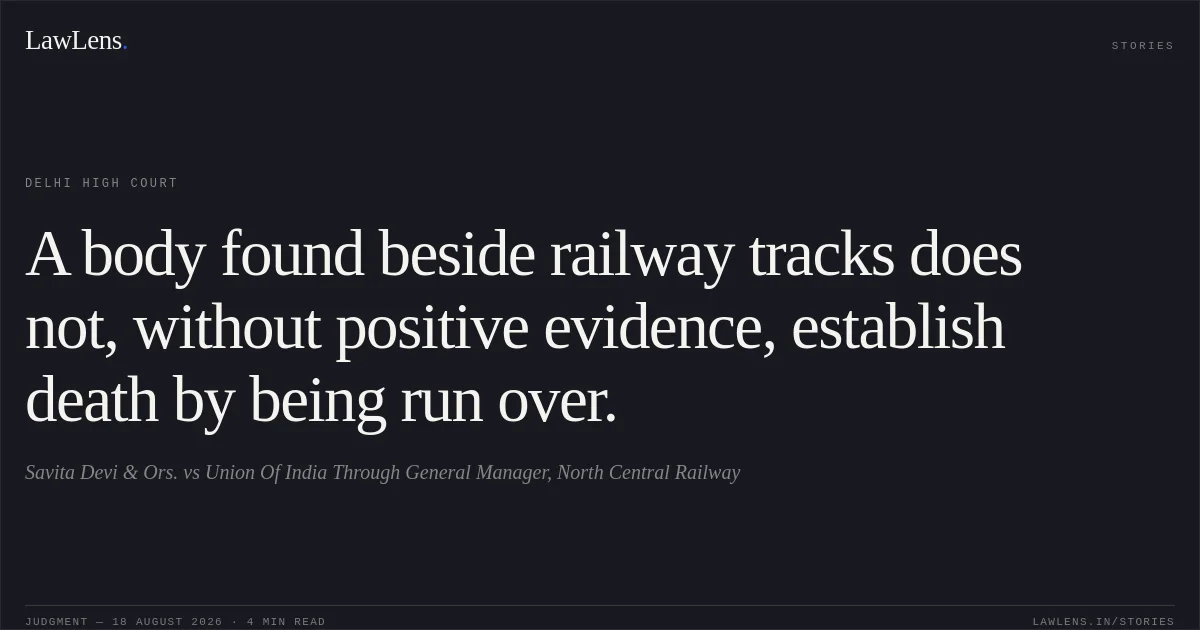
Source reference: p.6, para. 10The mere discovery of the body alongside the railway line did not prove that the deceased had been walking on the track and was run over.
Source reference: p.6, para. 11In the absence of positive evidence supporting the Railways’ theory, and in view of the evidence indicating a fall from the train, the Court held that the appellants had discharged the initial burden of proving bona fide passenger status and an accidental fall constituting an untoward incident.
Source reference: pp.6–7, paras. 12–14The Court also considered the appellants’ poverty, illiteracy, lack of funds and surrounding circumstances sufficient to condone the delay.
Source reference: pp.1–2, paras. 2–6Holding
The High Court condoned the 883-day delay in filing the appeal.
On merits, it held that the appellants had established that Mahesh Kumar was travelling as a bona fide passenger and that his death resulted from an accidental fall from the train, constituting an untoward incident under the Railways Act, 1989.
Source reference: p.7, para. 14The Tribunal’s judgment dated 16 November 2023 was set aside.
Source reference: p.7, para. 15The matter was remanded to the Tribunal to assess the compensation payable in accordance with law and direct its disbursement within two months of receiving the High Court’s order.
Source reference: p.7, para. 15The matter was directed to be listed before the Tribunal on 8 September 2026.
Source reference: p.7, para. 15The appeal was accordingly allowed and disposed of.
Source reference: p.8, para. 16Acts & Sections Cited
1 provisions across 1 statute referred to in this judgment. Each provision opens on LawLens.
Railway Claims Tribunal Act, 19871
Original Court PDF
Savita Devi & Ors.vsUnion Of India Through General Manager, North Central Railway
Click to open original judgment
Original judgment, available to read, download and summarize on LawLens.in