Facts
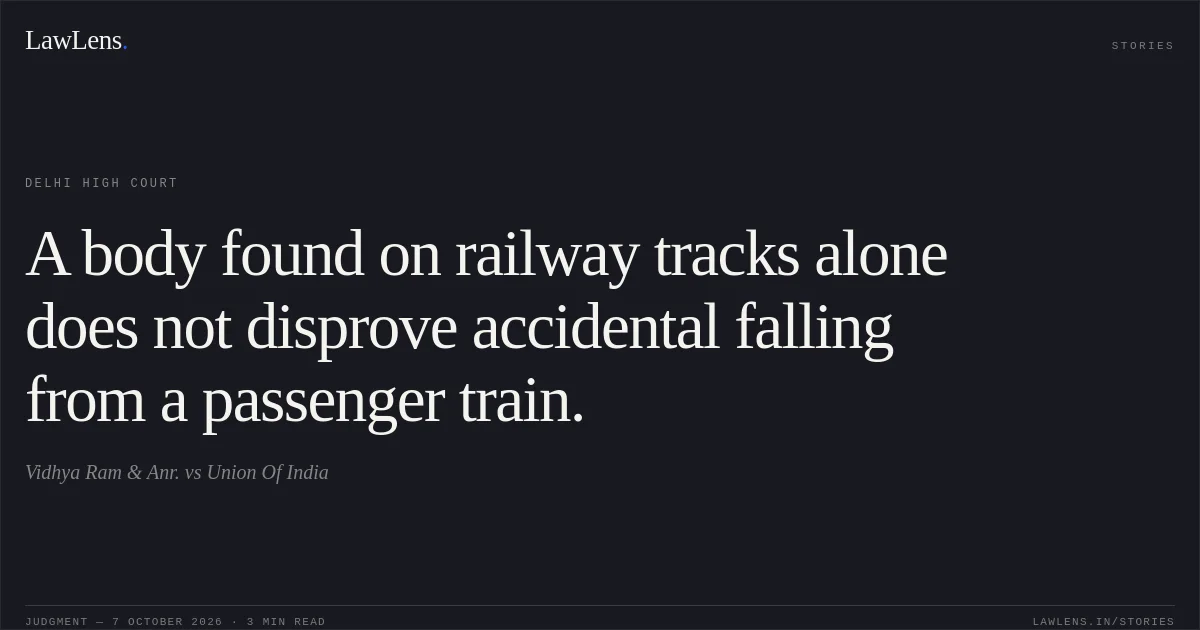
The appellants, parents of the deceased, claimed that he had purchased a valid ticket and was travelling from Rampur Junction to Bareilly Junction on 13 March 2017 when he accidentally fell from a moving train and died.
Source reference: pp. 2–3The ticket was not recovered.
Source reference: pp. 2–3The Railway Claims Tribunal dismissed the claim, finding that bona fide passenger status and an untoward incident had not been established, relying in part on inconsistencies in a witness’s testimony and the condition and location of the body.
Source reference: pp. 2–3The High Court first condoned the 210-day delay in filing the appeal, then considered the challenge to the Tribunal’s decision.
Source reference: pp. 1–2Issues
1. Whether the deceased was proved to be a bona fide passenger notwithstanding the non-recovery of his ticket.
Source reference: pp. 4–52. Whether the deceased’s death resulted from an “untoward incident” under Section 123(c) of the Railways Act, 1989, rather than trespass or suicide.
Source reference: pp. 5–6Law Applied
Section 23 of the Railway Claims Tribunal Act, 1987 provides for an appeal from a Tribunal decision; Section 123(c)(2) of the Railways Act, 1989 covers accidental falling of a passenger from a train.
Source reference: p. 4Under Union of India v. Rina Devi, the claimant bears an initial burden to establish bona fide passenger status, but non-recovery of a ticket does not by itself defeat the claim; the circumstances must be considered, and the burden may then shift to the Railways.
Source reference: p. 4The Court also relied on Lata v. Union of India for a non-technical approach and the preponderance-of-probabilities standard, and on Sukhabhai Nanjibhai Makwana & Anr. v. Union of India for the requirement that the Railways rebut the claimant’s account with cogent evidence.
Source reference: pp. 4–5The cited decisions in Guruvachan Singh v. Union of India and Sukhmandar Singh v. Union of India support the principle that the body’s location or condition, without supporting evidence, does not conclusively establish trespass or a run-over incident.
Source reference: p. 6Reasoning
The appellants had consistently pleaded that the deceased travelled with a valid ticket and lost it in the incident.
Source reference: p. 5Although the witness’s inconsistent evidence could not establish the identity of the train, it did not prove that the deceased travelled without a ticket; the Railways led no evidence after the appellants closed their case.
Source reference: p. 5As to the manner of death, the body’s location and condition showed that it had been run over, but did not establish how the deceased came onto the track or that he had committed suicide.
Source reference: pp. 5–6The Railways did not examine the persons whose statements were relied on in the DRM report, and neither the panchnama nor the medical evidence established voluntary entry onto the track.
Source reference: pp. 5–6On the evidence as a whole, accidental falling from a moving train was the more probable explanation.
Source reference: p. 7Holding
The Court held that the non-recovery of the ticket did not disprove bona fide passenger status and that the death was, on a preponderance of probabilities, caused by accidental falling within Section 123(c)(2) of the Railways Act.
It set aside the Tribunal’s judgment, allowed the appeal, and remanded the matter to the Tribunal to assess compensation and direct its disbursement within two months of receiving the order; the matter was listed before the Tribunal on 30 November 2026.
Source reference: p. 7Acts & Sections Cited
2 provisions across 2 statutes referred to in this judgment. Each provision opens on LawLens.
Railway Claims Tribunal Act, 19871
Railways Act, 19891
Original Court PDF
Vidhya Ram & Anr.vsUnion Of India
Click to open original judgment
Original judgment, available to read, download and summarize on LawLens.in