Facts
The Appellant, a US-based delivery and distribution company, entered into an Exclusive Distribution Agreement (“EDA”) with the Respondent on 26 June 2023, under which it was appointed the exclusive distributor of the Respondent’s colostrum products in North America until June 2026.
Source reference: pp. 2–4, para. 2(b)–(c)The EDA contained an exclusivity exception for Pantheryx, but provided that, upon a change of control, Pantheryx’s successor or acquirer would have to purchase the products through the Appellant.
Source reference: pp. 2–4, para. 2(b)–(c)The Appellant alleged that the Respondent breached the EDA by failing to supply ordered products and by directly supplying products to Glanbia Nutritionals, which had allegedly acquired Pantheryx.
Source reference: pp. 4–5, para. 2(d)–(f)The Respondent thereafter issued a notice terminating the EDA, alleging that the Appellant’s communication to Glanbia had damaged its reputation and caused business loss.
Source reference: p. 5, para. 2(g)–(h)The Appellant instituted a commercial suit seeking, inter alia, specific performance, a declaration that the termination was void, damages, disclosure of sales, and interim injunctive relief restraining further breaches of the exclusivity covenant.
Source reference: pp. 5–6, para. 2(i)–(l)The suit was instituted without exhausting pre-institution mediation under Section 12-A of the Commercial Courts Act, 2015, on the basis that it contemplated urgent interim relief.
Source reference: pp. 5–6, para. 2(i)–(l)The Respondent applied under Order VII Rule 11(d) of the Code of Civil Procedure, 1908, for rejection of the plaint.
Source reference: pp. 6–7, para. 2(m)–(n)The Trial Court allowed the application, holding that the suit did not genuinely involve urgent interim relief and that the urgency pleaded was merely a device to avoid mediation.
Source reference: pp. 6–7, para. 2(m)–(n)The Appellant challenged that order in the present appeal.
Source reference: no citationIssues
1. Whether the plaint was liable to be rejected under Order VII Rule 11(d) CPC for non-compliance with the mandatory requirement of pre-institution mediation under Section 12-A(1) of the Commercial Courts Act, 2015?
Source reference: pp. 15–16, paras. 22–242. Whether, on a meaningful and holistic reading of the plaint, documents, and surrounding circumstances, the suit genuinely contemplated urgent interim relief so as to fall within the statutory exception under Section 12-A(1)?
Source reference: p. 16, para. 23; pp. 20–21, para. 263. Whether the Trial Court was justified in treating the monetary claims, the delay in filing, and the alleged insufficiency of the pleaded urgency as grounds for rejecting the plaint at the threshold?
Source reference: pp. 21–27, paras. 27–36Law Applied
The Court applied Section 12-A(1) of the Commercial Courts Act, 2015, which prohibits institution of a commercial suit unless pre-institution mediation is exhausted, except where the suit contemplates urgent interim relief.
Source reference: p. 15, para. 22Relying principally on Patil Automation (P) Ltd. v. Rakheja Engineers (P) Ltd., the Court held that Section 12-A is mandatory and that non-compliance ordinarily attracts rejection under Order VII Rule 11(d) CPC, subject to the urgent-relief exception.
Source reference: p. 16, para. 24The Court further relied on Yamini Manohar v. T.K.D. Keerthi, Dhanbad Fuels (P) Ltd. v. Union of India, Novenco Building and Industry A/S v. Xero Energy Engineering Solutions Pvt. Ltd., and relevant Bombay High Court decisions, holding that the exception must be assessed objectively but from the plaintiff’s standpoint, by reading the plaint and annexed documents as a whole.
Source reference: pp. 16–21, para. 25The enquiry is a limited jurisdictional examination of whether urgent interim relief was genuinely contemplated at the time of institution, not an adjudication of the merits of the interim application.
Source reference: pp. 16–21, para. 25Mere assertions or a formal prayer for injunction are insufficient; however, monetary claims do not by themselves negate urgency, and a continuing breach may be relevant where immediate intervention is alleged to be necessary to protect contractual rights.
Source reference: pp. 18–20, para. 25(vii)–(xi)Reasoning
The Court held that the Trial Court adopted an impermissibly narrow approach by focusing primarily on the concluding paragraphs of the plaint and the interim application instead of examining the pleadings and documents holistically.
Source reference: pp. 21–22, paras. 26–28The allegations that the Respondent continued to supply products in breach of an exclusivity covenant, wrongfully terminated the EDA, and persisted in denying the Appellant’s contractual rights provided a factual foundation for seeking immediate protective relief.
Source reference: pp. 22–23, paras. 29–30The claims for damages did not eliminate the urgency because the suit also sought specific performance, declaratory relief, injunctions, and disclosure of sales.
Source reference: pp. 22–23, paras. 29–30Although the delay between the termination notice and institution of the suit was relevant, the Appellant’s explanation concerning the Colorado-law expert opinion, preparation and notarisation of pleadings in the USA, and their transmission to India was sufficient to prevent the urgency plea from being treated as necessarily illusory at the Order VII Rule 11 stage.
Source reference: pp. 23–24, para. 31The Trial Court further erred by assessing whether damages were adequate and whether an injunction should ultimately be granted—questions pertaining to the merits of the interim application rather than the threshold issue under Section 12-A.
Source reference: pp. 25–26, paras. 34–35Holding
The Court answered the issues in favour of the Appellant.
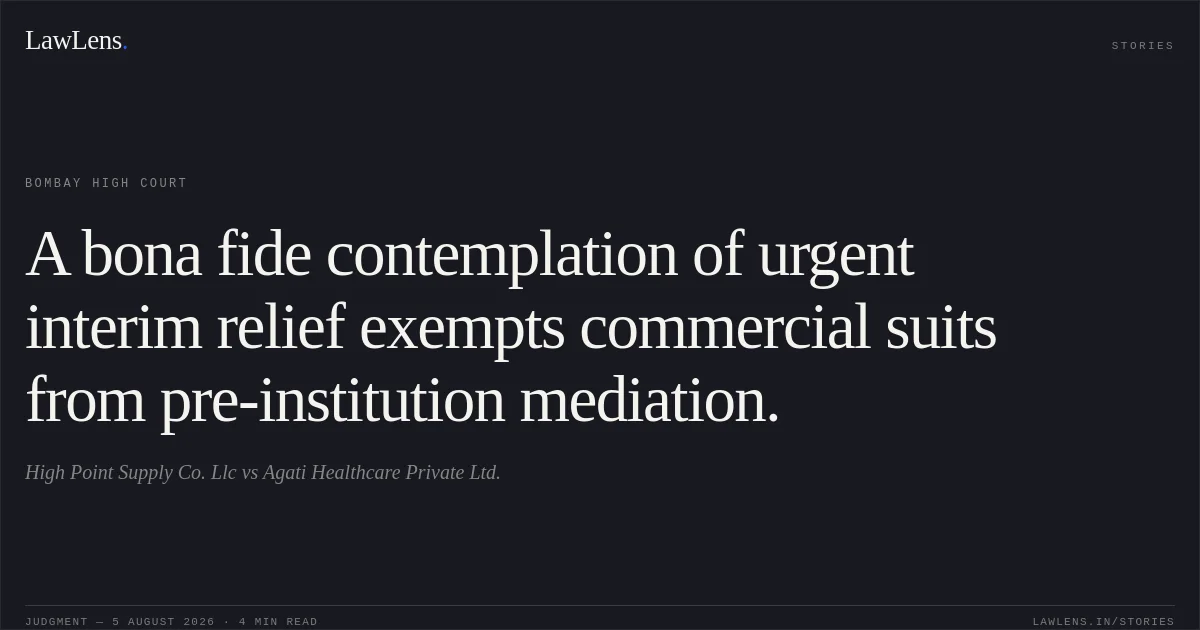
It held that the plaint disclosed a bona fide factual foundation showing that the suit genuinely contemplated urgent interim relief and therefore fell within the exception to pre-institution mediation under Section 12-A(1).
Source reference: pp. 26–27, paras. 35–37The Commercial First Appeal was allowed; the Trial Court’s order dated 9 December 2025 rejecting the plaint under Order VII Rule 11(d) CPC was set aside; and Commercial Suit No. 2 of 2025 was restored to the Trial Court from the stage preceding the impugned order.
Source reference: p. 28, para. 37(i)–(iii)The Trial Court was directed to decide the Appellant’s Interim Application independently on its merits, uninfluenced by the observations in either order, with all contentions on the merits expressly kept open.
Source reference: p. 28, para. 37(iv)–(vi)There was no order as to costs.
Source reference: p. 28, para. 37(iv)–(vi)Original Court PDF
High Point Supply Co. LlcvsAgati Healthcare Private Ltd.
Click to open original judgment
Original judgment, available to read, download and summarize on LawLens.in