Facts
On 19 October 1996, Upendra Rai allegedly went to the house of Rita Devi after being called away while playing cards. His mother, Pana Devi (PW-3), claimed that she later found him dead inside Rita Devi’s house and alleged that Kapildeo Rai, Jaibalak Rai, Butus Rai and Sanjay Rai had caused his death and subsequently burnt his body near a bamboo clump.
Source reference: paras. 3–6The FIR was lodged on 21 October 1996 under Sections 302, 201 and 34 IPC; charges were subsequently framed under Sections 328, 302 and 201/34 IPC.
Source reference: paras. 3–6The prosecution examined only three witnesses, namely Birendra Rai (PW-1), Awadh Kishore Rai (PW-2) and Pana Devi (PW-3), and produced no documentary evidence.
Source reference: paras. 7–9The trial court acquitted the accused, finding material contradictions in the prosecution evidence, uncertainty regarding the place and manner of occurrence, delay in lodging the FIR, absence of medical evidence, and failure to examine the Investigating Officer and other charge-sheeted witnesses.
Source reference: paras. 10–12Pana Devi challenged the acquittal before the High Court.
Source reference: no citationIssues
Whether the prosecution proved beyond reasonable doubt that the respondents caused the death of Upendra Rai by administering poison or otherwise committing an offence under Sections 328 and 302 read with Section 34 IPC?
Source reference: paras. 5, 20–24Whether the respondents caused the disappearance or destruction of evidence by burning the deceased’s body, thereby committing an offence under Section 201 IPC?
Source reference: paras. 3–5, 25Whether the trial court’s acquittal was perverse or based on irrelevant considerations so as to warrant interference in an appeal against acquittal?
Source reference: paras. 13–19, 26–28Law Applied
The Court applied Sections 328, 302, 201 and 34 of the Indian Penal Code, concerning administration of poison or stupefying substances, murder, causing disappearance of evidence, and acts done in furtherance of common intention, respectively.
Source reference: paras. 4–6The prosecution was required to establish the alleged offences beyond reasonable doubt, and, since its case rested substantially on circumstantial evidence, each link in the chain of circumstances had to be proved consistently and conclusively.
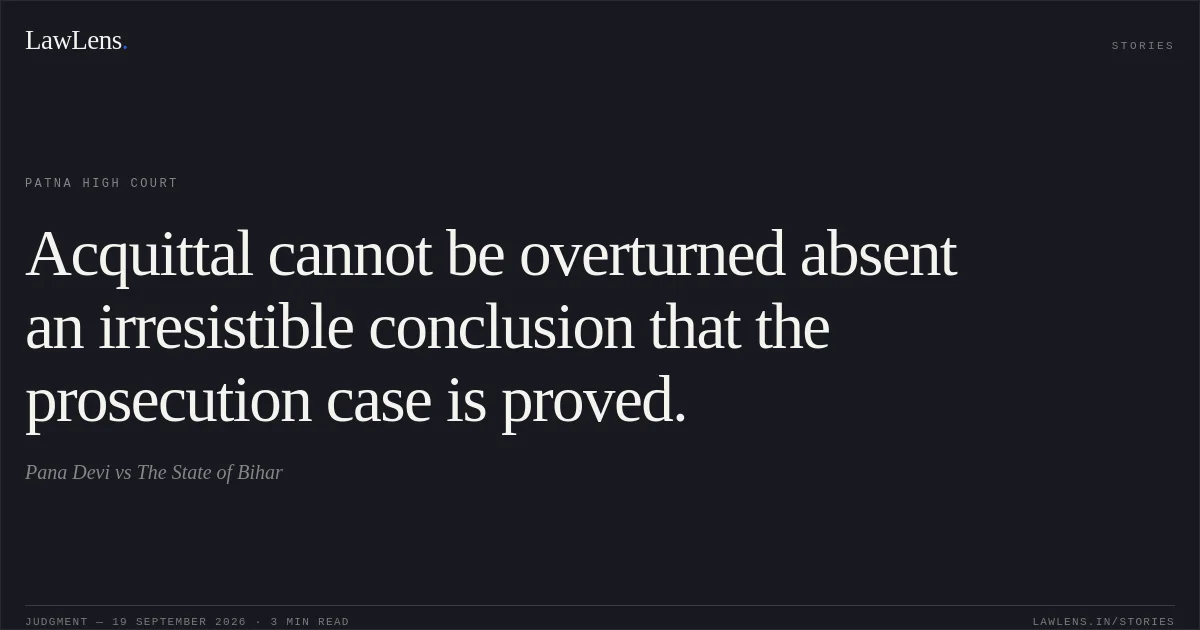
Source reference: para. 12The Court also considered the principles governing appeals against acquittal, holding that an appellate court should be slow to interfere unless the acquittal is perverse or the evidence leads to an irresistible conclusion of guilt; reliance was placed on H.D. Sundara v. State of Karnataka, (2023) 9 SCC 581.
Source reference: paras. 19, 26The judgment also referred to Section 134 of the Indian Evidence Act, now Section 139 of the Bharatiya Sakshya Adhiniyam, in assessing the reliability and sufficiency of witness testimony.
Source reference: para. 21Reasoning
The High Court found that PW-1 and PW-2 were not eyewitnesses and their testimony was hearsay.
Source reference: paras. 20, 22–23PW-3’s version materially changed on essential aspects: the alleged place of occurrence varied between Rita Devi’s house and Jagdish Rai’s house; the written information stated that the accused burnt the body, whereas her deposition attributed the funeral rites to her husband and the deceased’s grandfather; and she made inconsistent statements concerning how she learned of the occurrence.
Source reference: paras. 17–18, 21–23The prosecution produced no independent witness to corroborate the alleged occurrence in Rita Devi’s house or the alleged burning near the bamboo clump.
Source reference: paras. 21, 25Further, the body had been cremated before the FIR was registered, resulting in no post-mortem examination, no viscera preservation, and no proof of the cause of death or alleged poisoning.
Source reference: para. 24The non-examination of the Investigating Officer and other material witnesses further weakened the prosecution case, although the Court declined to remand the matter after approximately thirty years.
Source reference: para. 25In these circumstances, the chain of circumstantial evidence was incomplete, and the trial court’s view was found to be a reasonable one rather than perverse.
Source reference: paras. 12, 24–27Holding
The High Court answered the issues against the appellant. It held that the prosecution failed to prove the respondents’ guilt under Sections 328, 302, 201 and 34 IPC beyond reasonable doubt, and that the evidence did not justify disturbing the acquittal.
The appeal was consequently dismissed, and the judgment of acquittal dated 23 December 2024 passed by the 22nd Additional District and Sessions Judge, East Champaran, Motihari, was affirmed.
Source reference: para. 28Acts & Sections Cited
6 provisions across 3 statutes referred to in this judgment. Each provision opens on LawLens.
Indian Penal Code, 18604
Code of Criminal Procedure, 19731
Bharatiya Sakshya Adhiniyam, 20231
Original Court PDF
Pana DevivsThe State of Bihar
Click to open original judgment
Original judgment, available to read, download and summarize on LawLens.in