Facts
The juvenile-appellant, aged 17 years, 7 months and 19 days at the time of the alleged occurrence, was accused, along with a co-accused, of entering the informant’s house at night and allegedly committing rape upon the informant’s 13-year-old daughter, an occurrence that was allegedly videographed.
Source reference: paras. 2, 28The appellant contended that he had been falsely implicated due to a land dispute, that the FIR was lodged after 14 days, and that the prosecution case contained material improbabilities.
Source reference: paras. 3–5The Exclusive Additional Sessions Judge-cum-Special Judge, Children Court, rejected his bail application under Section 12 of the Juvenile Justice (Care and Protection of Children) Act, 2015, principally on the seriousness of the allegation and the possibility that release would expose him to moral, physical and psychological danger.
Source reference: para. 1The Social Investigation Report disclosed that the appellant had no criminal antecedents, belonged to a middle-class family, and had been studying in Class X before his detention.
Source reference: para. 30Issues
Whether the seriousness or heinous nature of the alleged offence could, by itself, justify denial of bail to a child in conflict with law under Section 12 of the Juvenile Justice Act, 2015.
Source reference: paras. 9–18, 27(2)Whether the statutory exceptions under the proviso to Section 12(1)—association with known criminals, exposure to moral, physical or psychological danger, or defeat of the ends of justice—were established on the material available in the present case.
Source reference: paras. 9–10, 27(5)–(6), 30–31Whether the appellant was entitled to release on bail subject to appropriate safeguards and supervision.
Source reference: paras. 31–32Law Applied
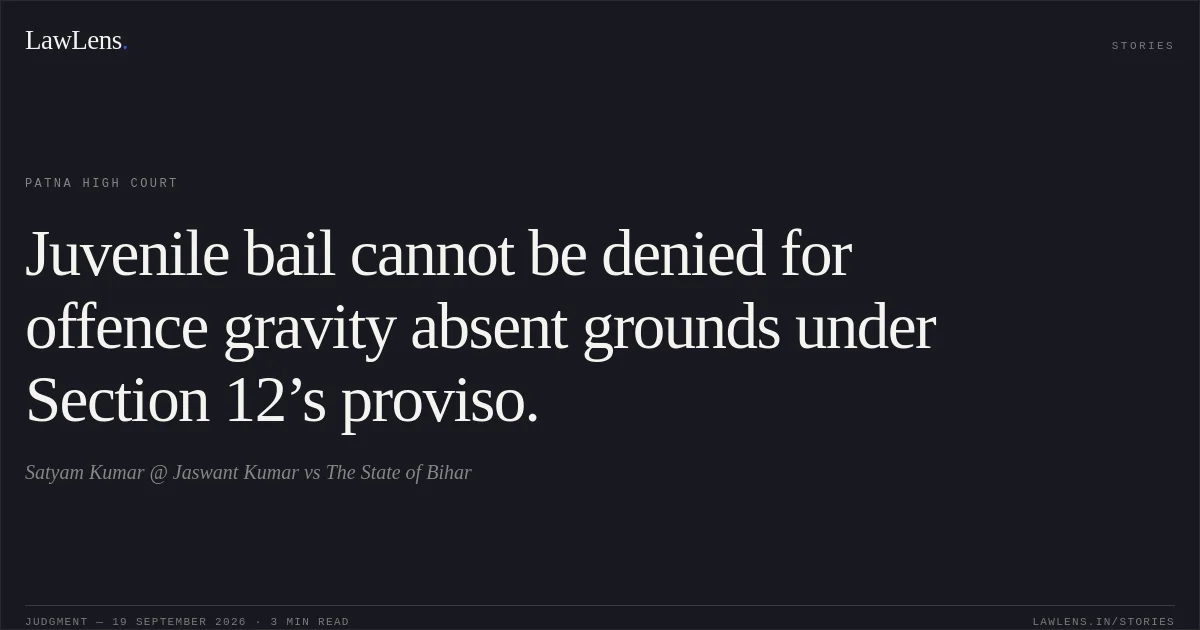
Section 12(1) of the Juvenile Justice (Care and Protection of Children) Act, 2015 makes release on bail the rule for a child alleged to be in conflict with law, irrespective of whether the alleged offence is bailable or non-bailable; bail may be denied only where there are reasonable grounds to believe that release would bring the child into association with a known criminal, expose the child to moral, physical or psychological danger, or defeat the ends of justice, and reasons must be recorded.
Source reference: p. 5; para. 9The Court relied on Juvenile in Conflict with Law v. State of Rajasthan, 2024 SCC OnLine SC 5297, and In Re-Exploitation of Children in Orphanages in the State of T.N. v. Union of India, (2020) 14 SCC 327, which require a clear and material-based finding before bail is refused.
Source reference: pp. 6–8; paras. 11–12It further relied on decisions holding that the gravity or nature of the offence is not, by itself, a relevant ground for denying bail under Section 12.
Source reference: pp. 8–12; paras. 13–18The Court applied Sections 3(iv), 3(v), 3(vii), 3(xii) and 3(xiii) of the Act, embodying the principles of the child’s best interest, family responsibility, positive measures, institutionalisation as a last resort, and restoration to the family.
Source reference: pp. 13–17; paras. 19–24The “ends of justice” exception must therefore be understood in the context of the child’s protection, development, rehabilitation and welfare, rather than as a punitive consideration.
Source reference: paras. 23–27Reasoning
The High Court held that although the allegation was heinous, its seriousness could not substitute for proof of one of the specific grounds in the proviso to Section 12(1).
Source reference: paras. 28–29The Children Court’s finding that release would expose the appellant to moral, physical or psychological danger was unsupported by the Social Investigation Report, which disclosed no criminal antecedents of the appellant or his family and described a stable family environment.
Source reference: para. 30Nor was there material establishing likely association with known criminals or showing that release would defeat the ends of justice.
Source reference: paras. 30–31On the contrary, the appellant’s family environment was considered conducive to his care, education and rehabilitation, while continued institutionalisation had disrupted his studies.
Source reference: paras. 30–31Applying the statutory preference for family-based rehabilitation and the principle that institutionalisation is a last resort, the Court found the rejection of bail legally unsustainable.
Source reference: paras. 23–24, 31Holding
The appeal was allowed and the impugned order dated 27 August 2024 was set aside.
The appellant was directed to be released on bail upon furnishing a bail bond of ₹10,000 and an undertaking by his father by affidavit.
Source reference: para. 32The father was required to supervise the appellant’s conduct, prevent his association with criminal persons, attend to his developmental needs, ensure his appearance before the Court when required, and ensure continuation of his studies and, if possible, vocational training.
Source reference: para. 32The Lower Court Records were directed to be returned to the concerned Court.
Source reference: para. 33Acts & Sections Cited
5 provisions across 1 statute referred to in this judgment. Each provision opens on LawLens.
Juvenile Justice (Care and Protection of Children) Act, 2015.5
Original Court PDF
Satyam Kumar @ Jaswant KumarvsThe State of Bihar
Click to open original judgment
Original judgment, available to read, download and summarize on LawLens.in