Facts
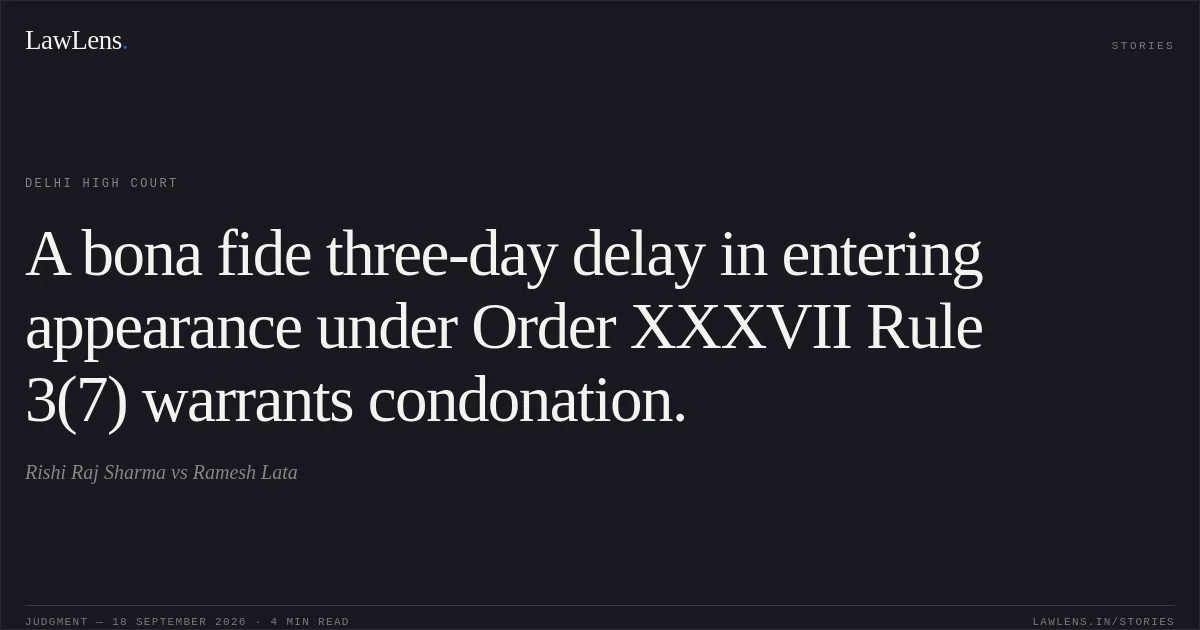
The respondent instituted a summary suit under Order XXXVII CPC seeking recovery of ₹5,24,667 towards arrears of rent, with interest at 18% per annum.
Source reference: p.2, para. 2Summons were served on the petitioner on 13 August 2025. The petitioner’s memo of appearance was e-filed on 26 August 2025 and physically filed on 28 August 2025, resulting in a three-day delay beyond the prescribed ten-day period; the memo was also not supplied to the respondent.
Source reference: pp.2–4, paras. 3–5, 7On 4 December 2025, the Trial Court held the respondent entitled to judgment under Order XXXVII Rule 2(3) CPC because of the default in entering appearance.
Source reference: pp.2–3, para. 5The petitioner thereafter sought condonation of the three-day delay under Order XXXVII Rule 3(7) CPC and recall of the order dated 4 December 2025 under Section 151 CPC.
Source reference: pp.2–3, para. 5The Trial Court dismissed both applications on 30 July 2026, observing that the medical documents were from May 2024, that there was no contemporaneous medical evidence, and that the petitioner had not acted diligently in the subsequent proceedings.
Source reference: pp.4–5, para. 9The petitioner invoked the High Court’s supervisory jurisdiction under Article 227 of the Constitution.
Source reference: p.5, para. 10Issues
1. Whether the petitioner had shown “sufficient cause” for condonation of the three-day delay in entering appearance under Order XXXVII Rule 3(7) CPC.
Source reference: pp.8–9, paras. 19–202. Whether the Trial Court was justified in refusing to recall the order dated 4 December 2025 and thereby preventing the petitioner from contesting the summary suit on merits.
Source reference: pp.8–9, paras. 19–203. Whether the petitioner’s subsequent procedural lapses, including non-supply of the memo of appearance and non-appearance on two dates, disentitled him from condonation of the initial three-day delay.
Source reference: pp.10–11, paras. 23–27Law Applied
The Court applied Order XXXVII Rule 3(1) CPC, which requires a defendant to enter appearance and furnish an address for service within ten days of service of summons; Order XXXVII Rule 3(7) CPC, which permits the Court to excuse delayed appearance upon sufficient cause; and Order XXXVII Rule 2(3) CPC, under which the plaintiff becomes entitled to judgment upon the defendant’s failure to enter appearance.
Source reference: pp.9–10, paras. 21–22The Court also considered the liberal principles governing “sufficient cause” under Section 5 of the Limitation Act, 1963, namely that the length of delay is not decisive, the acceptability of the explanation is material, and delay should not ordinarily be presumed to be deliberate.
Source reference: pp.5–7, paras. 12–15; pp.9–10, paras. 21–22These principles were drawn from N. Balakrishnan v. M. Krishnamurthy, (1998) 7 SCC 123; State of West Bengal v. Administrator, Howrah Municipality, (1972) 1 SCC 366; Hector M. Mehta v. CRB Capital Markets Ltd., 98 (2002) DLT 127; and Babu Lal Yadav v. M/s R.S. Yadav & Co., 2010 SCC OnLine Del 789.
Source reference: pp.5–7, paras. 12–15; pp.9–10, paras. 21–22The Court exercised supervisory jurisdiction under Article 227 and considered recall under Section 151 CPC.
Source reference: p.5, para. 10; p.1, para. 1Reasoning
The High Court held that the petitioner’s explanation—that he and his erstwhile counsel had proceeded on an incorrect understanding that summons had been served on 18 August rather than 13 August 2025—was not inherently implausible and did not indicate a dilatory strategy.
Source reference: p.11, para. 24Although the petitioner’s subsequent non-appearance and failure to supply the memo of appearance reflected procedural laxity, those matters were distinct from the bona fides of the specific three-day delay for which condonation was sought and could not retrospectively convert that initial delay into mala fide conduct.
Source reference: pp.10–11, para. 23The absence of contemporaneous medical records was also not decisive because the medical condition was only a supporting circumstance; the principal explanation was the misunderstanding regarding the date of service.
Source reference: p.12, para. 27Applying the liberal approach to “sufficient cause,” and bearing in mind that refusal would permanently foreclose the petitioner from defending the suit on merits, the Court found the delay sufficiently explained.
Source reference: pp.12–13, paras. 28–29Holding
The High Court answered the issues in favour of the petitioner.
It condoned the three-day delay under Order XXXVII Rule 3(7) CPC, set aside the Trial Court’s order dated 30 July 2026, and consequently set aside the order dated 4 December 2025 holding the respondent entitled to judgment under Order XXXVII Rule 2(3) CPC.
Source reference: p.13, para. 29The petitioner was directed to file his leave to defend application in the underlying suit, subject to payment of ₹10,000 as costs to the respondent within one week.
Source reference: p.13, para. 30The Trial Court was directed to fix a date for filing the leave to defend application and proceed with the suit in accordance with law.
Source reference: p.14, para. 31The petition and pending applications were disposed of, with the Court clarifying that it had expressed no opinion on the merits of the underlying dispute.
Source reference: p.14, paras. 32–33Acts & Sections Cited
2 provisions across 2 statutes referred to in this judgment. Each provision opens on LawLens.
Code of Civil Procedure, 19081
Limitation Act, 19631
Original Court PDF
Rishi Raj SharmavsRamesh Lata
Click to open original judgment
Original judgment, available to read, download and summarize on LawLens.in