Facts
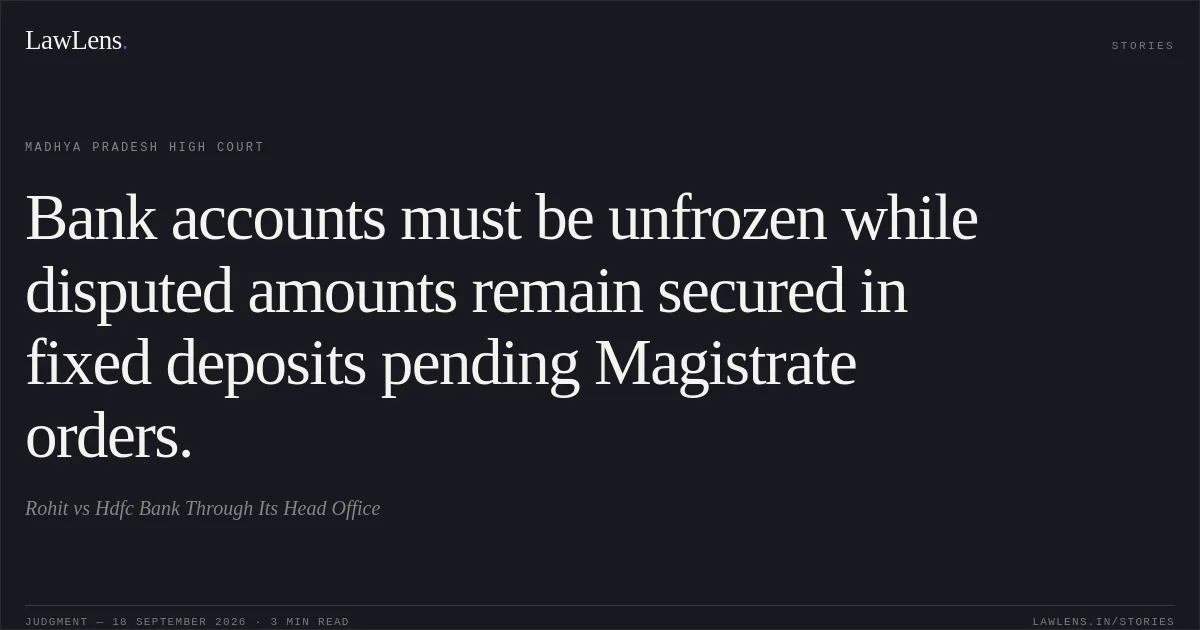
The petitioner approached the High Court under Article 226 of the Constitution challenging the imposition and continuation of a lien/debit freeze over his HDFC Bank account, contending that the freeze restricted operation of the entire account.
Source reference: para. 1The petitioner’s counsel relied upon the High Court’s earlier decision in Malcolm Murayis & Others v. State Bank of India and Others, W.P. No. 1100 of 2024, decided on 26 April 2024.
Source reference: para. 2In that case, the Court had directed that the disputed amount linked to alleged cyber-crime transactions be kept in fixed deposits, subject to orders of the competent Magistrate, while permitting operation of the remaining account.
Source reference: para. 3Applying that decision, the Court noted that the disputed amount in the present case was ₹5,065, as informed by the concerned crime agencies.
Source reference: para. 5Issues
Whether the continued debit freeze over the petitioner’s entire HDFC Bank account was liable to be set aside when only ₹5,065 was identified as the disputed amount by the crime agencies?
Source reference: paras. 1, 4–5Whether the Bank should retain the disputed amount in a fixed deposit, while unfreezing the remainder of the petitioner’s account, subject to proceedings before the competent Judicial Magistrate under the applicable law?
Source reference: paras. 3–5Law Applied
The Court exercised its jurisdiction under Article 226 of the Constitution of India to examine the legality of the restriction placed on the petitioner’s bank account.
Source reference: para. 1It relied on the principles laid down in Malcolm Murayis & Others v. State Bank of India and Others, where, in the context of accounts frozen on the instructions of cyber-crime authorities, the Court directed that the disputed amount be placed in fixed deposits and permitted liquidation only upon orders of the competent Judicial Magistrate within the prescribed period.
Source reference: para. 3The earlier decision referred to compliance with Section 102 of the Code of Criminal Procedure, 1973, or the corresponding applicable law, concerning seizure/freezing of property during investigation.
Source reference: para. 3In the present matter, the Court applied the corresponding provisions of the Bharatiya Nagarik Suraksha Sanhita, 2023 (BNSS) or any other law relied upon by the police agency.
Source reference: para. 5Reasoning
The Court found that the factual and legal circumstances of the petitioner’s case were materially covered by Malcolm Murayis and held that the earlier decision would apply mutatis mutandis.
Source reference: para. 4Since the crime agencies had identified only ₹5,065 as the disputed amount, freezing the entire bank account was not considered necessary.
Source reference: para. 5The Court therefore balanced the investigative interest in preserving the allegedly tainted funds with the petitioner’s right to operate the undisputed portion of his account.
Source reference: para. 5It directed that ₹5,065 be placed in a fixed deposit, to be liquidated only pursuant to an order of the competent Judicial Magistrate within three months, while the bank account itself was to be unfrozen.
Source reference: para. 5Holding
The petition was disposed of.
HDFC Bank was directed to unfreeze the petitioner’s account, while retaining ₹5,065 in a fixed deposit.
Source reference: para. 5The amount could be liquidated only after an order of the competent Judicial Magistrate within three months, pursuant to proceedings under the applicable provisions of the BNSS or other relevant law.
Source reference: para. 5If the police agency failed to proceed in accordance with law within that period, the fixed-deposit amount could also be withdrawn by the petitioner after intimation to the concerned police agency.
Source reference: paras. 5–6Acts & Sections Cited
1 provisions across 1 statute referred to in this judgment. Each provision opens on LawLens.
Code of Criminal Procedure, 19731
Original Court PDF
RohitvsHdfc Bank Through Its Head Office
Click to open original judgment
Original judgment, available to read, download and summarize on LawLens.in