Facts
The appellant-plaintiff instituted a partition suit concerning the suit property and obtained an ex parte ad interim injunction.
Source reference: no citationThe defendants/respondents subsequently applied under Order XXXIX Rule 4 of the Code of Civil Procedure, 1908, seeking variation or discharge of the injunction.
Source reference: no citationThe Trial Court allowed the application and permitted the respondents to complete construction already commenced on the property.
Source reference: para. 1In appeal, the appellant alleged that the respondents had misrepresented that they were residing with their family in rented accommodation and had relied upon a sanction plan obtained after the Commissioner’s report and the initial injunction order.
Source reference: paras. 2–7The respondents contended that a provisional sanction had initially existed and that final sanction was granted in June 2025; they also submitted that the construction had already been completed pursuant to the impugned order.
Source reference: paras. 9–12On the basis of the latter submission, the Division Bench dismissed the appeal as infructuous.
Source reference: paras. 13–14Issues
Whether the Trial Court’s order modifying the ex parte ad interim injunction and permitting completion of the construction required interference in view of the alleged misrepresentation regarding the respondents’ tenancy and the alleged absence of a valid sanction plan.
Source reference: paras. 2–8Whether the appeal had become infructuous because the construction had already been completed pursuant to the impugned order.
Source reference: paras. 12–14Whether the appellant’s allegations regarding construction without valid statutory sanction could be pursued before the appropriate statutory authority notwithstanding dismissal of the appeal.
Source reference: para. 16Law Applied
The Court considered the power under Order XXXIX Rule 4 of the Code of Civil Procedure, 1908, which permits the court to discharge, vary, or set aside an injunction order.
Source reference: no citationThe Court applied the procedural principle that an appellate challenge may become infructuous where the relief sought concerns an act that has already been completed and no effective relief remains to be granted.
Source reference: paras. 12–14It further recognised that alleged violations of governing municipal or statutory laws, including construction without valid sanction, may be independently raised before the competent statutory authority, which must decide the matter in accordance with law after hearing the concerned parties.
Source reference: para. 16No judicial precedent was cited or relied upon.
Source reference: no citationReasoning
The appellant raised substantial factual objections concerning the respondents’ claimed residential occupation of rented premises and the timing and validity of the sanction plan.
Source reference: paras. 2–7The respondents disputed those allegations and maintained that the construction had been supported by provisional and subsequently final sanction.
Source reference: para. 9However, the decisive consideration for the Court was that the construction had already been completed pursuant to the impugned order.
Source reference: para. 12Since the challenged interim order had already produced its practical effect, the Court held that no effective relief remained to be granted in the appeal and treated it as infructuous.
Source reference: para. 13The Court therefore did not finally adjudicate the competing factual claims concerning the tenancy, sanction, or legality of the construction.
Source reference: no citationInstead, it preserved the appellant’s right to approach the appropriate statutory authority regarding any alleged violation of law.
Source reference: para. 16Holding
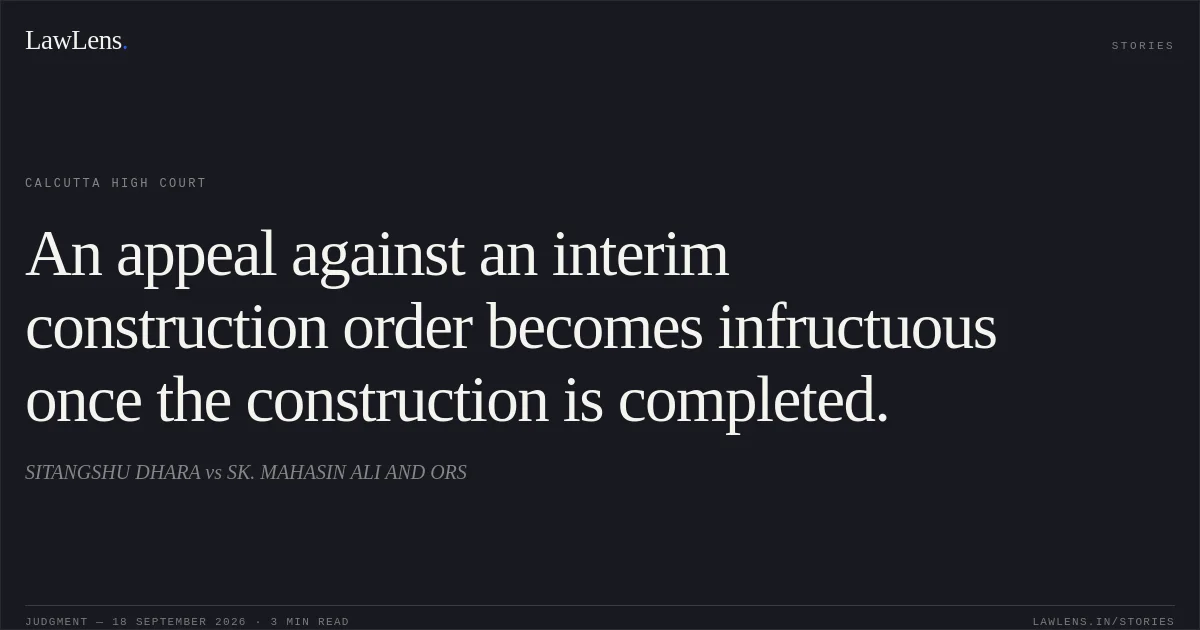
The Court held that the appeal had become infructuous because the construction had already been completed pursuant to the impugned order and accordingly dismissed F.M.A. No. 1103 of 2026.
CAN No. 1 of 2026 was consequentially disposed of.
Source reference: para. 15The appellant was granted liberty to raise before the appropriate statutory authority any grievance concerning construction without valid sanction or violation of governing laws; such authority was directed to decide the grievance in accordance with law after hearing all concerned, uninfluenced by the dismissal of the appeal.
Source reference: para. 16There was no order as to costs.
Source reference: para. 17Original Court PDF
SITANGSHU DHARAvsSK. MAHASIN ALI AND ORS
Click to open original judgment
Original judgment, available to read, download and summarize on LawLens.in