Facts
The respondent/claimant filed a claim under the Employee’s Compensation Act, 1923, arising from the death of his son, Prince Rathore, who allegedly died on 23 November 2021 after falling ill while residing and working at the appellant’s factory premises.
Source reference: pp. 2–3, para. 2The deceased was claimed to have been employed as a Factory Manager for approximately 25 years, with a monthly salary of ₹50,000. The appellant disputed the claimed salary but accepted that the deceased was being paid ₹18,000 per month.
Source reference: p. 3, para. 3The Commissioner allowed the claim and awarded compensation with penalty, calculating wages at ₹15,000 per month on the basis of the applicable Central Government notification.
Source reference: p. 3, para. 3The appellant challenged the Commissioner’s order under Section 30(1)(aa) of the Employee’s Compensation Act, but confined the appeal to the imposition of penalty.
Source reference: p. 3, para. 4The appellant had deposited ₹16.25 lakhs, although the deposit was made only after recovery proceedings were initiated.
Source reference: p. 3, para. 4The appeal was filed with a delay of 224 days, which the Court condoned.
Source reference: p. 1, paras. 1–3Issues
Whether the compensation payable to the claimant was required to be calculated on the admitted monthly wage of ₹18,000 rather than ₹15,000 adopted by the Commissioner?
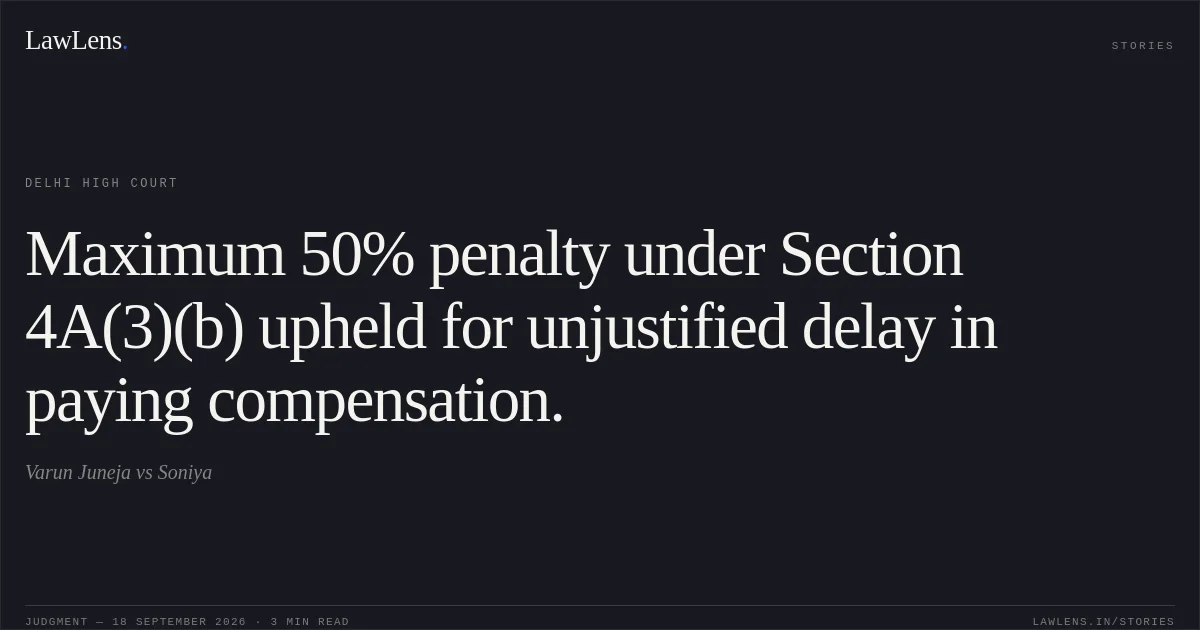
Source reference: p. 3, para. 3; p. 4, paras. 5–6Whether the Commissioner was justified in imposing the maximum penalty of 50% under Section 4A(3)(b) of the Employee’s Compensation Act?
Source reference: pp. 4–5, paras. 7–10Whether the appellant could be permitted to pay the revised compensation and penalty in instalments?
Source reference: p. 6, paras. 11–13Law Applied
The Court applied Section 30(1)(aa) of the Employee’s Compensation Act, 1923, governing appeals on substantial questions of law, and Section 4A(3)(b), which authorises the Commissioner to impose a penalty of up to 50% of the compensation where the employer defaults in payment within one month and there is no justification for the delay, after giving the employer a reasonable opportunity to show cause.
Source reference: p. 4, para. 8The compensation was calculated under the statutory formula using 50% of the monthly wage multiplied by the relevant factor prescribed in Schedule IV, with funeral expenses added under Section 4A.
Source reference: p. 4, paras. 5–6The Court treated the employer’s admitted wage of ₹18,000 per month as the appropriate basis for computation rather than the lower minimum wage figure adopted by the Commissioner.
Source reference: p. 4, para. 5Reasoning
The Court found that the appellant had admitted that the deceased was paid ₹18,000 per month. Consequently, the Commissioner erred in restricting the wage to ₹15,000 merely because that amount corresponded to the notified minimum wage.
Source reference: p. 4, para. 5Applying the statutory factor of 172.52 for a deceased aged 44 years to 50% of the admitted monthly wage, the Court recalculated the compensation at ₹15,52,680, and added ₹5,000 towards funeral expenses, resulting in total compensation of ₹15,57,680.
Source reference: p. 4, paras. 5–6On penalty, the Court held that the Commissioner had jurisdiction to impose a penalty up to 50% under Section 4A(3)(b).
Source reference: p. 4, para. 8The deceased died on 23 November 2021, the demand notice remained unanswered, and more than three and a half years had elapsed before the Commissioner’s order. The appellant’s payment was not voluntary but followed recovery proceedings. These circumstances justified the maximum penalty of 50%.
Source reference: pp. 4–5, paras. 8–10The Court therefore upheld the rate of penalty but recalculated its amount on the revised compensation. It permitted payment of the revised compensation, penalty and arrears within four months.
Source reference: p. 6, paras. 11–13Holding
The Court allowed the appeal in part by revising the compensation to ₹15,57,680, including funeral expenses, and fixing the penalty at ₹7,76,340, being 50% of the revised compensation.
The imposition of penalty at the rate of 50% was upheld.
Source reference: p. 5, para. 10The amount of ₹16.25 lakhs already deposited was directed to be released to the claimant towards the revised compensation, if not already released.
Source reference: p. 6, para. 11The appellant was permitted to deposit the revised compensation, penalty and arrears within four months, and the matter was listed before the Commissioner on 24 September 2026 for ensuring expeditious payment.
Source reference: p. 6, paras. 12–13The appeal and pending application were disposed of accordingly.
Source reference: p. 6, para. 15Acts & Sections Cited
3 provisions across 1 statute referred to in this judgment. Linked provisions open on LawLens.
Employee3
Original Court PDF
Varun JunejavsSoniya
Click to open original judgment
Original judgment, available to read, download and summarize on LawLens.in