Facts
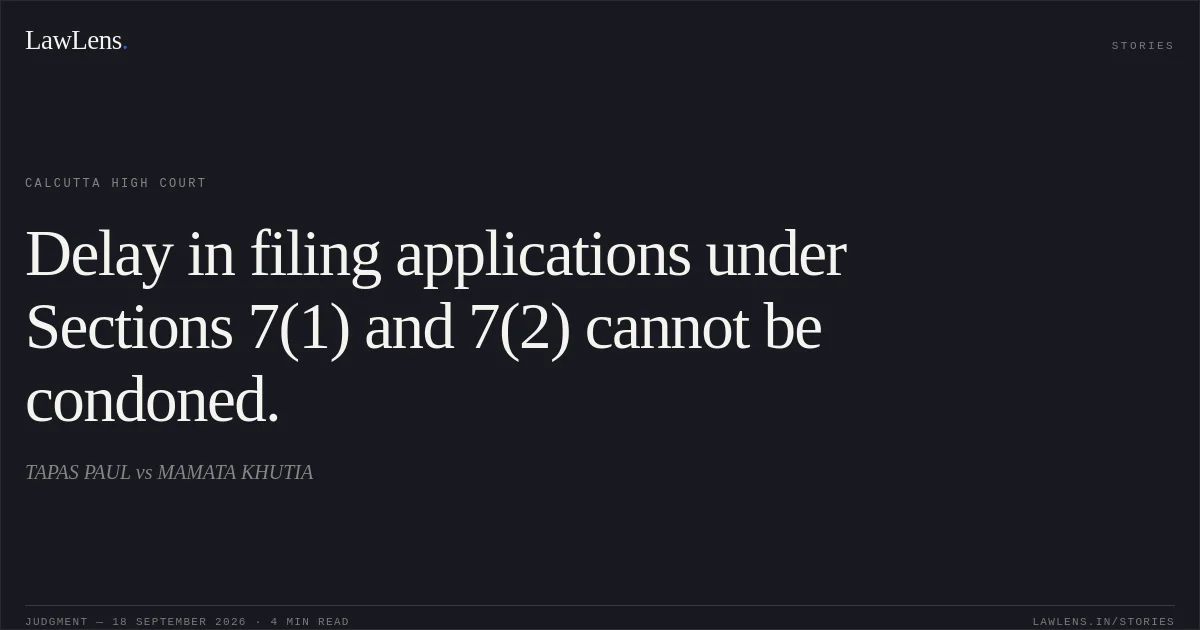
The opposite party instituted Ejectment Suit No. 66 of 2008 before the Civil Judge (Junior Division), 1st Court, Sealdah, seeking eviction of the petitioner on grounds including default in payment of rent and reasonable requirement.
Source reference: para. 2(a)The petitioner entered appearance on or about 17 July 2008 but claimed to have deposited rent with the Rent Controller on the advice of his former advocate. Subsequently, he filed applications under Sections 7(1) and 7(2) of the West Bengal Premises Tenancy Act, 1997 (“1997 Act”), along with an application under Section 5 of the Limitation Act, 1963.
Source reference: para. 2(b)By order dated 28 August 2017, the Trial Court condoned the delay subject to payment of costs of Rs. 500; thereafter, the petitioner began depositing rent in Court.
Source reference: para. 2(c)The petitioner’s application under Section 7(2) was later dismissed on 4 September 2024 for failure to advance arguments, but that order was set aside by the High Court on 24 June 2025 with a direction for expeditious hearing.
Source reference: para. 2(d)–(f)On 4 December 2025, after hearing the parties, the Trial Court rejected the applications under Sections 7(1) and 7(2) and struck out the petitioner’s defence under Section 7(3). The petitioner challenged that order under Article 227 of the Constitution.
Source reference: para. 2(g)–(h)Issues
Whether the petitioner’s belated applications under Sections 7(1) and 7(2) of the 1997 Act could validly be entertained or their delay condoned under Section 5 of the Limitation Act, 1963.
Source reference: paras. 11–17; pp. 7–10Whether deposits made by the petitioner with the Rent Controller after institution of the ejectment suit could be treated as valid payment or deposit for the purposes of Section 7(1) of the 1997 Act.
Source reference: paras. 6–10; pp. 5–7Whether the petitioner’s failure to deposit admitted arrears and comply with the statutory requirements justified rejection of his applications and striking out of his defence under Section 7(3).
Source reference: paras. 10, 16–20; pp. 7–10Whether the Trial Court was precluded from subsequently rejecting the applications because it had earlier condoned the delay by an unchallenged order.
Source reference: paras. 11, 17; pp. 7–10Law Applied
Sections 7(1) and 7(2) of the West Bengal Premises Tenancy Act, 1997 require the tenant to deposit or pay admitted rent and, where necessary, apply for determination of disputed rent within the prescribed period; non-compliance attracts striking out of the defence under Section 7(3).
Source reference: paras. 12–14In Seventh Day Adventist Senior Secondary School v. Ismat Ahmed and Bijay Kumar Singh v. Amit Kumar Chamariya, the Supreme Court held that the statutory timelines and the requirement of depositing admitted arrears are mandatory, and that Section 5 of the Limitation Act cannot be used to extend the time for compliance with Sections 7(1) and 7(2).
Source reference: para. 12; pp. 7–9Under Siddheswar Paul v. Prakash Chandra Dutta, approved in Kaluram Onkarmal v. Baidyanath Gorain, rent deposited with the Rent Controller after institution of the suit is neither payment to the landlord nor deposit in the Court where the ejectment suit is pending.
Source reference: paras. 6–9; pp. 5–7A decision made without jurisdiction does not create a binding bar, and jurisdictional questions are not concluded by an erroneous earlier order: Noharlal Verma v. District Cooperative Central Bank Ltd. and Mathura Prasad Bajoo Jaiswal v. Dossibai N.B. Jeejeebhoy.
Source reference: paras. 15 and 17; pp. 9–10The equitable principle in Monoj Lal Seal v. Octavious Tea and Industries Ltd., concerning a timely but wrongly-forum deposit, does not excuse prolonged non-compliance with mandatory statutory timelines.
Source reference: para. 21; p. 11Reasoning
The High Court held that the petitioner’s applications were filed approximately seven years after his appearance and were therefore beyond the mandatory statutory period.
Source reference: paras. 2(b), 3(a), 12–14Since the 1997 Act does not provide for extension of time for the relevant compliance under Sections 7(1) and 7(2), the Trial Court lacked jurisdiction to condone the delay under Section 5 of the Limitation Act; its earlier condonation order was consequently without jurisdiction and did not prevent later dismissal of the applications.
Source reference: paras. 14–17The petitioner also relied on deposits made with the Rent Controller, but such deposits were legally ineffective after institution of the ejectment suit and could not satisfy Section 7(1).
Source reference: paras. 6–10Further, the application under Section 7(2) was not accompanied by a valid deposit of admitted arrears, making it independently non-maintainable.
Source reference: para. 16Even assuming that the delay had been properly condoned, the petitioner failed to pay the Rs. 500 costs until 2021; therefore, the benefit of the conditional condonation order had not accrued during the intervening period, and the subsequent current-rent deposits could not be treated as valid compliance.
Source reference: paras. 18–20The Court distinguished Monoj Lal Seal, observing that the present case involved prolonged and continuing non-compliance rather than a mere mistake as to the forum of a timely deposit.
Source reference: para. 21Holding
The High Court answered the issues against the petitioner. It held that the applications under Sections 7(1) and 7(2) of the 1997 Act were filed beyond the mandatory period, were not maintainable without valid deposits of admitted arrears, and could not be saved by condonation under Section 5 of the Limitation Act.
Deposits made with the Rent Controller after institution of the suit did not constitute valid statutory deposits, and the petitioner’s continued non-compliance attracted Section 7(3).
Source reference: paras. 8–10, 19–20The order dated 4 December 2025 rejecting the applications and striking out the petitioner’s defence was therefore upheld.
Source reference: para. 25The revisional application, C.O. No. 185 of 2026, was dismissed/disposed of without costs.
Source reference: para. 25Acts & Sections Cited
8 provisions across 4 statutes referred to in this judgment. Each provision opens on LawLens.
West Bengal Premises Tenancy Act, 19972
Limitation Act, 19631
Code of Civil Procedure, 19081
west bengal premises tenancy act, 19564
Original Court PDF
TAPAS PAULvsMAMATA KHUTIA
Click to open original judgment
Original judgment, available to read, download and summarize on LawLens.in