Facts
Respondent No.2 alleged that Accused No.1, with whom she was in a relationship, had promised to marry her and had established a physical relationship with her.
Source reference: pp.4–5; para.7When Accused No.1 subsequently distanced himself, respondent No.2 contacted the petitioner, described as Accused No.1’s former girlfriend.
Source reference: pp.4–5; para.7It was alleged that, during a telephonic conversation on 22 September 2024, the petitioner abused respondent No.2 and her father in vulgar and caste-related terms, including remarks that persons belonging to the Scheduled Caste community were “labours” and that such persons would merely seek suitable marriages.
Source reference: pp.4–5; para.7A complaint lodged on 28 September 2024 resulted in registration of Crime No.966 of 2024.
Source reference: pp.4–5; para.2.1After investigation, including recording statements of witnesses and collection of call-data and FSL material, the police filed a charge-sheet on 29 March 2025.
Source reference: pp.4–5; para.2.1The Special Sessions Court took cognizance of offences under Sections 69, 351(2) and 79 of the Bharatiya Nyaya Sanhita, 2023 (“BNS”), and Sections 3(2)(v) and 3(2)(va) of the Scheduled Castes and Scheduled Tribes (Prevention of Atrocities) Act, 1989 (“SC/ST Act”).
Source reference: pp.4–5; para.13The petitioner sought quashing of the proceedings in S.C. No.300 of 2025.
Source reference: p.3Issues
Whether the allegations in the complaint and charge-sheet, taken at face value, disclosed the ingredients of offences under Sections 351(2) and 79 of the BNS and Sections 3(2)(v) and 3(2)(va) of the SC/ST Act against the petitioner.
Source reference: pp.9–11; paras.8–9, 17Whether the alleged telephonic caste-based abuse, including the absence of an allegation that it occurred in public view, justified quashing the criminal proceedings at the threshold.
Source reference: pp.6–8, 11–13; paras.4.1, 5.1, 10–13Whether the High Court should exercise its inherent jurisdiction under Section 528 of the Bharatiya Nagarik Suraksha Sanhita, 2023 (“BNSS”) to quash the pending prosecution.
Source reference: pp.13–15; paras.14–18Law Applied
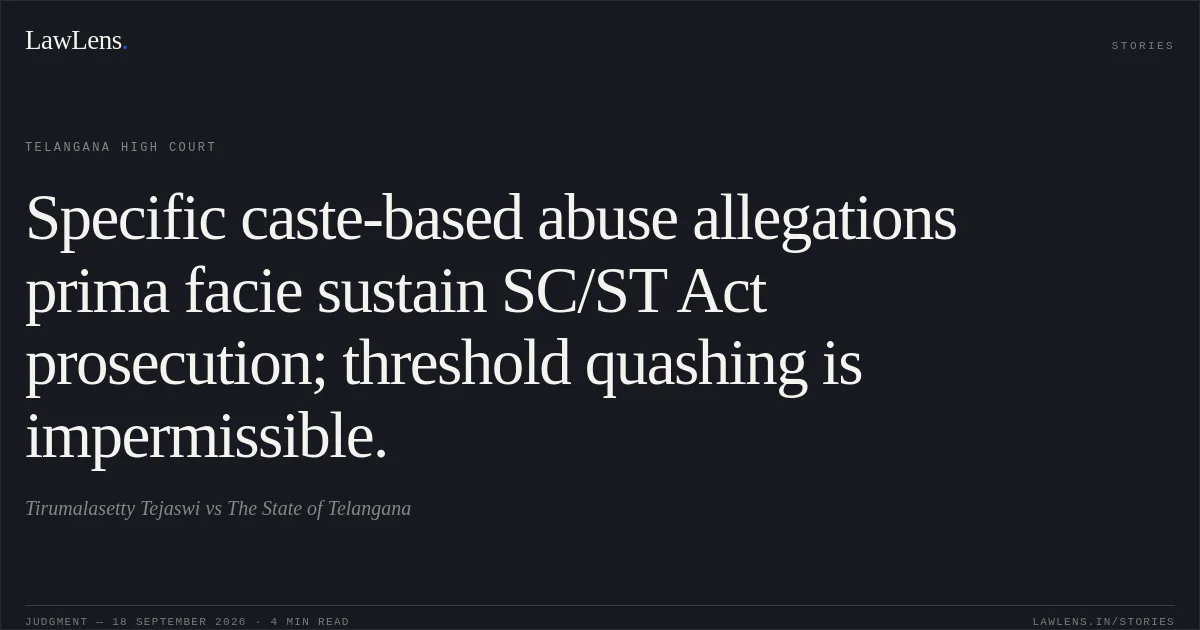
The Court applied Sections 351(2) and 79 of the BNS and Sections 3(2)(v) and 3(2)(va) of the SC/ST Act, holding that specific allegations of intentional caste-based abuse, coupled with knowledge of the victim’s Scheduled Caste status, may prima facie attract the statutory offences.
Source reference: pp.9–11; paras.8–9It relied on Naresh Aneja @ Naresh Kumar Aneja v. State of Uttar Pradesh, which states that criminal intimidation requires an intention to cause alarm; mere words without such intention are insufficient.
Source reference: p.11; para.10It distinguished G.P. Hemakoti Reddy v. Public Prosecutor, concerning the requirement of intentional caste-based humiliation and the relevance of public view in the context of the offence considered there.
Source reference: p.12; para.12It also referred to Pasupuleti Chinachennaiah v. State of A.P., which requires material indicating an intention to insult a woman’s modesty for the corresponding offence.
Source reference: p.11; para.11Under State of Andhra Pradesh v. B. Reddeppa Reddy, State of Haryana v. Bhajan Lal and Sau. Kamala Shivaji Pokarnekar v. State of Maharashtra, the High Court should not conduct a mini-trial, assess evidentiary reliability, or quash proceedings where the allegations disclose cognizable and triable offences; inherent powers are to be exercised sparingly and only to prevent abuse of process or secure the ends of justice.
Source reference: pp.13–14; paras.14–16Reasoning
The Court found that the complaint and the statement of respondent No.2 contained specific allegations identifying the petitioner, the telephonic conversation, the caste-related words allegedly used, and the petitioner’s knowledge of respondent No.2’s caste identity.
Source reference: pp.9–11; paras.7–9These allegations, if accepted at face value, prima facie disclosed intentional caste-based insult and the offences invoked under the BNS and the SC/ST Act.
Source reference: pp.9–11; paras.7–9The Court declined to accept the petitioner’s arguments that the absence of public view, the alleged lack of injury or reputational harm, and the petitioner’s denial of the conversation warranted quashing.
Source reference: pp.7–8, 12–13; paras.5.1–6.1, 13Those contentions involved disputed questions of fact and assessment of evidence, particularly in light of the witness statements, call-data records and FSL report collected during investigation.
Source reference: pp.7–8, 12–13; paras.5.1–6.1, 13Applying the limited scope of inherent jurisdiction, the Court held that the case did not fall within the exceptional categories identified in Bhajan Lal, and that the truthfulness of the allegations had to be determined at trial rather than in a quashing petition.
Source reference: pp.13–14; paras.14–17Holding
The High Court held that the allegations in the complaint and charge-sheet prima facie disclosed offences under Sections 351(2) and 79 of the BNS and Sections 3(2)(v) and 3(2)(va) of the SC/ST Act.
It therefore declined to quash the proceedings in S.C. No.300 of 2025 and dismissed Criminal Petition No.13386 of 2026.
Source reference: pp.14–15; paras.18–19However, considering that the petitioner was a woman and a software employee, her personal appearance before the trial Court was dispensed with unless specifically required, subject to her being represented by counsel on every hearing date.
Source reference: p.15; para.19The trial Court was permitted to proceed in accordance with law if she failed to appear on a date when her presence was specifically directed.
Source reference: p.15; para.19Acts & Sections Cited
10 provisions across 5 statutes referred to in this judgment. Each provision opens on LawLens.
Bharatiya Nyaya Sanhita, 20233
Indian Penal Code, 18601
Code of Criminal Procedure, 19732
Bharatiya Nagarik Suraksha Sanhita, 20232
Original Court PDF
Tirumalasetty TejaswivsThe State of Telangana
Click to open original judgment
Original judgment, available to read, download and summarize on LawLens.in