Facts
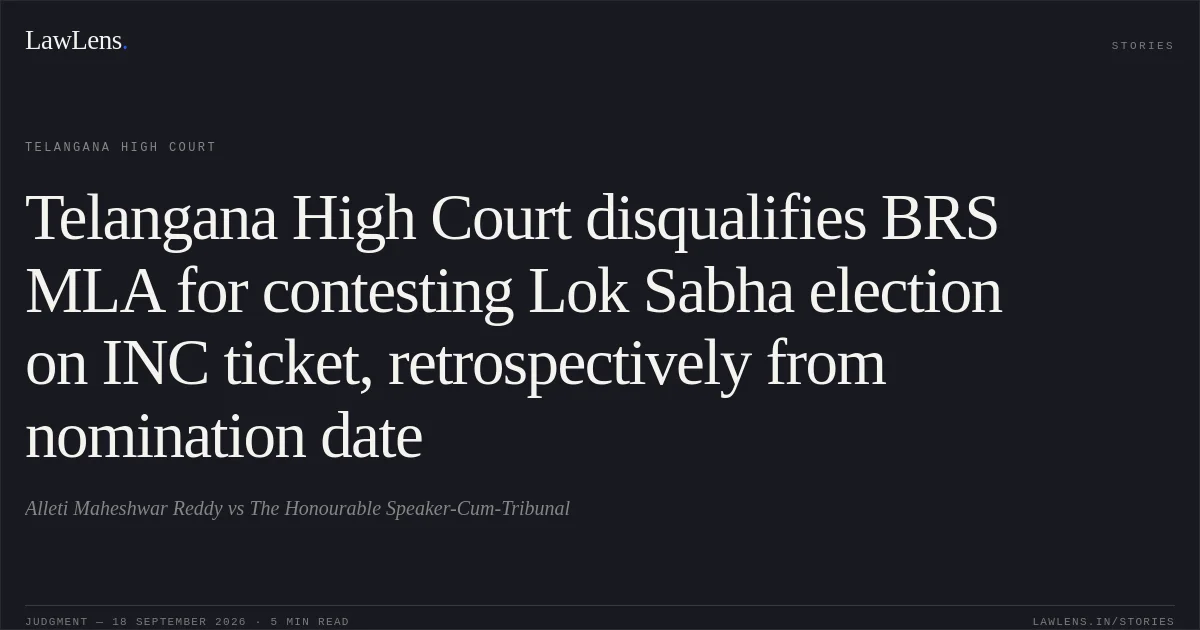
Respondent No. 2 was elected in December 2023 as a Bharat Rashtra Samithi (BRS) MLA from the Khairatabad Assembly Constituency. In April 2024, while continuing as a BRS MLA, he filed his nomination as a candidate set up by the Indian National Congress (INC) for the Secunderabad Lok Sabha Constituency and campaigned against the BRS candidate; he ultimately lost the election
Source reference: paras. 3–4, 16The Supreme Court had directed the Speaker to decide the pending disqualification petitions within three months. The Speaker thereafter dismissed both petitions on 11 March 2026, holding, inter alia, that the alleged conduct was external to the House, that the evidence was insufficient, that BRS had continued to recognise respondent No. 2 as its member, and that the petitioners had failed to comply with the verification requirements under the Telangana Legislative Assembly Members (Disqualification on Ground of Defection) Rules, 1986 (“1986 Rules”). The petitioners challenged those orders under Article 226 of the Constitution.
Source reference: paras. 4, 17–19, 66–69Issues
Whether the Speaker’s decision was amenable to judicial review under Article 226 on the grounds of violation of constitutional mandates, mala fides, breach of natural justice or perversity, as recognised in Kihoto Hollohan v. Zachillhu?
Source reference: paras. 13–15Whether conduct occurring outside the Legislative Assembly, including contesting a parliamentary election on the ticket of another political party, could attract disqualification under paragraph 2(1)(a) of the Tenth Schedule?
Source reference: paras. 18–25, 70–72Whether respondent No. 2, by filing his nomination and contesting the 2024 Lok Sabha election as an INC candidate while being a BRS MLA, had voluntarily given up his BRS membership?
Source reference: paras. 20–28, 56–58, 72–75Whether the petitioners’ documentary and other evidence established the alleged defection, and whether the Speaker erred in treating the evidence as inadmissible or insufficient?
Source reference: paras. 29–41, 73Whether non-compliance with the verification requirements under Rules 6(6) and 6(7) of the 1986 Rules rendered the disqualification petitions invalid?
Source reference: paras. 42–47, 75From what date did the disqualification take effect?
Source reference: paras. 57–61, 72–75Law Applied
Article 191(2) of the Constitution disqualifies a member who incurs disqualification under the Tenth Schedule. Paragraph 2(1)(a) of the Tenth Schedule applies where a member voluntarily gives up membership of the political party to which he belongs; a formal resignation is not essential, and voluntary abandonment may be inferred from the member’s conduct. Paragraph 2(1)(b), concerning voting or abstaining contrary to a party direction, is distinct and includes the concept of party condonation
Source reference: para. 20Under Kihoto Hollohan v. Zachillhu, the Speaker acts as a tribunal and the decision is reviewable under Articles 226 and 227 for violation of constitutional mandates, mala fides, non-compliance with natural justice or perversity, although mere procedural irregularities are ordinarily protected
Source reference: paras. 14–15Ravi S. Naik v. Union of India and G. Viswanathan v. Speaker establish that voluntary giving up may be inferred without formal resignation
Source reference: paras. 21, 36–37Dr. Mahachandra Prasad Singh v. Chairman, Bihar Legislative Council holds that contesting a parliamentary election as an independent or another party’s candidate, despite having been elected on a political party’s ticket, may amount to voluntarily giving up membership; it also holds that the 1986-type procedural rules are directory and should not defeat the substantive constitutional prohibition against defection
Source reference: paras. 21, 44, 47R. Bhoopathi Reddy v. Chairman, Telangana Legislative Council similarly recognises that contesting an election on behalf of another political party constitutes voluntary abandonment of the original party
Source reference: paras. 23, 35The disqualification relates back to the date of the act constituting defection, and subsequent conduct or party inaction cannot cure the disqualification, as affirmed in Shrimanth Balasaheb Patil v. Speaker, Karnataka Legislative Assembly and Subhash Desai v. State of Maharashtra
Source reference: paras. 39, 59–60Reasoning
The High Court held that the Speaker had committed a constitutional and jurisdictional error by treating the Tenth Schedule as confined to conduct occurring within the House or conduct directly affecting the numerical strength or functioning of the legislature. The Court relied on Dr. Mahachandra Prasad Singh and related authorities to hold that conduct outside the House may establish voluntary abandonment of party membership under paragraph 2(1)(a)
Source reference: paras. 20–25, 70The decisive and undisputed facts were that respondent No. 2 had been elected as a BRS MLA, had filed his nomination as an INC candidate for the Lok Sabha election on 23 April 2024, and had contested against the BRS candidate. These facts were supported by statutory election documents, including Form 26 and Form 7A, and were not denied by respondent No. 2. On the authority of Mahachandra Prasad Singh and Jagjit Singh, the Court held that the admitted conduct itself established voluntary abandonment; no formal resignation, INC membership certificate, or disciplinary action by BRS was necessary
Source reference: paras. 27, 30–35, 72–73The Court further held that BRS’s continued recognition of respondent No. 2 and its failure to initiate disciplinary proceedings were irrelevant to paragraph 2(1)(a), since condonation is material principally to paragraph 2(1)(b), involving disobedience of a legislative direction or whip
Source reference: paras. 26, 74, 77The Speaker’s insistence on original or certified copies and examination of media witnesses was also held erroneous because the decisive election documents were official or statutory materials, and the proceedings under the Tenth Schedule are not governed by the strict adversarial standards applicable to election petitions
Source reference: paras. 29–35, 73Finally, the Court held that Rules 6(6) and 6(7) of the 1986 Rules were directory, not mandatory, and that procedural defects could not defeat an otherwise established constitutional disqualification
Source reference: paras. 42–47, 75Holding
The High Court allowed both writ petitions and set aside the Speaker’s orders dated 11 March 2026 dismissing Disqualification Petition Nos. 4 of 2024 and 1 of 2024
It declared that respondent No. 2 had voluntarily given up his BRS membership under paragraph 2(1)(a) of the Tenth Schedule read with Article 191(2) by contesting the 2024 Lok Sabha election as an INC candidate while being a BRS MLA. The disqualification was held to take effect from 23 April 2024, the date on which respondent No. 2 filed his nomination as an INC candidate
Source reference: paras. 56–60, 72–75, 79Consequently, the Assembly seat was declared vacant, and copies of the order were directed to be communicated to the Secretary to the Speaker of the Telangana Legislative Assembly and the Election Commission of India
Source reference: paras. 61, 79–80No order was made as to costs.
Source reference: para. 81Acts & Sections Cited
7 provisions across 2 statutes referred to in this judgment. Each provision opens on LawLens.
Bharatiya Sakshya Adhiniyam, 20235
Haryana Panchayati Raj Act, 1994 ( 11 of 1994)2
Original Court PDF
Alleti Maheshwar ReddyvsThe Honourable Speaker-Cum-Tribunal
Click to open original judgment
Original judgment, available to read, download and summarize on LawLens.in