Facts
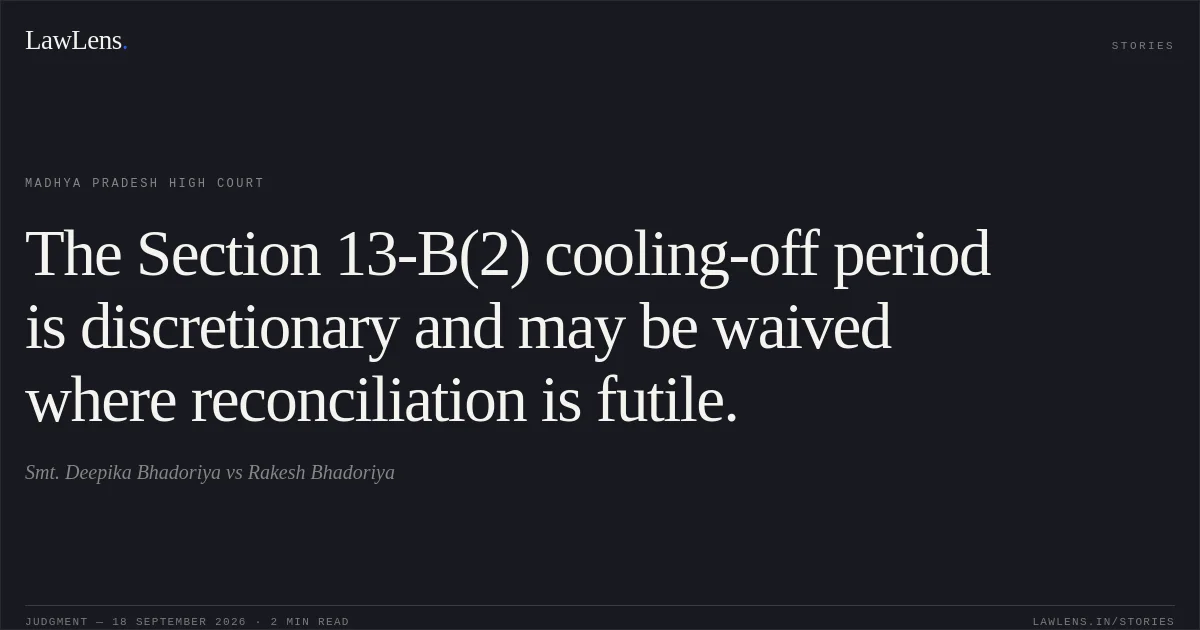
The petitioner and respondent were married on 21.04.2015 at Gwalior according to Hindu rites and ceremonies. They had been residing separately since 02.07.2020 due to serious matrimonial differences and incompatibility.
Source reference: paras. 2–5; pp. 1–2Their efforts at reconciliation failed, and they jointly decided to dissolve the marriage by mutual consent under Section 13-B of the Hindu Marriage Act, 1955. They accordingly filed a joint application seeking waiver of the six-month cooling-off period under Section 13-B(2). The Principal Judge, Family Court, Gwalior, rejected the application by order dated 20.08.2026 in H.M.A. Case No. 678/2026. The wife challenged that order under Article 227 of the Constitution of India.
Source reference: paras. 2–5; pp. 1–2Issues
Whether the statutory six-month waiting period under Section 13-B(2) of the Hindu Marriage Act, 1955, is mandatory or directory and may be waived by the court in appropriate circumstances?
Source reference: paras. 5–7; pp. 2–4Whether, in the facts of the case, the Family Court erred in rejecting the parties’ joint application for waiver despite their prolonged separation, failed reconciliation efforts, and mutual decision to dissolve the marriage?
Source reference: paras. 4–5, 8; pp. 2, 5Law Applied
The Court applied Section 13-B(2) of the Hindu Marriage Act, 1955, holding that the six-month cooling-off period is directory and not mandatory. Relying on Amardeep Singh v. Harveen Kaur, (2017) 8 SCC 746, the Court noted that waiver may be considered where the parties have already completed the requisite period of separation, reconciliation efforts have failed, the parties have genuinely settled their disputes, and further waiting would merely prolong their agony.
Source reference: para. 6; pp. 3–4The Court further relied on Amit Kumar v. Suman Beniwal, 2021 SCC OnLine SC 1270, which clarified that the factors identified in Amardeep Singh are not rigid or mandatory conditions and that the court must exercise discretion by considering factors including the duration of the marriage, the period of cohabitation, the length of separation, pending litigation, the possibility of reconciliation, children, and the voluntariness and completeness of the settlement. The High Court exercised supervisory jurisdiction under Article 227 of the Constitution of India.
Source reference: para. 7; pp. 4–5; para. 2; p. 1Reasoning
The Court found that the parties had been living separately since 02.07.2020, had made unsuccessful efforts at reconciliation, and had consciously and jointly decided to seek dissolution of their marriage by mutual consent. In these circumstances, insisting on completion of the statutory waiting period would serve no useful purpose and would only prolong their matrimonial agony.
Source reference: paras. 5, 8; pp. 2, 5The Family Court failed to apply the discretionary principles laid down in Amardeep Singh and clarified in Amit Kumar, and therefore acted erroneously in rejecting the waiver application.
Source reference: paras. 5, 8; pp. 2, 5Holding
The High Court allowed the miscellaneous petition and set aside the Family Court’s order dated 20.08.2026 rejecting the waiver application. It held that the period under Section 13-B(2) is directory and discretionary, not mandatory.
The concerned Family Court was directed to decide the application under Section 13-B of the Hindu Marriage Act expeditiously, keeping in view the principles laid down in Amit Kumar. The petition was accordingly disposed of, with a direction for issuance of a certified copy as per rules.
Source reference: paras. 9–11; p. 5Acts & Sections Cited
2 provisions across 2 statutes referred to in this judgment. Each provision opens on LawLens.
Hindu Marriage Act, 19551
Family Courts Act, 19841
Original Court PDF
Smt. Deepika BhadoriyavsRakesh Bhadoriya
Click to open original judgment
Original judgment, available to read, download and summarize on LawLens.in