Facts
The respondent obtained a temporary metered electricity connection on 22 December 2009 with a connected load and contract demand of 48 kW/kVA, later enhanced to 492 kW and 495 kVA respectively in March 2011.
Source reference: para. 2An audit party allegedly detected overdrawal of contract demand between March 2011 and November 2015, based on MRI data and an audit report dated 30 November 2016.
Source reference: para. 2The Assessing Officer issued a provisional assessment under Section 126 of the Electricity Act, 2003 for ₹1,65,34,470 on 3 March 2017 and, after considering the respondent’s objections, passed a final assessment order on 19 April 2017.
Source reference: paras. 3–4On appeal under Section 127, the Divisional Commissioner set aside the order as non-speaking and remanded the matter for fresh consideration.
Source reference: para. 5The Assessing Officer subsequently passed a fresh final assessment order dated 17 September 2020 for the same amount. The Divisional Commissioner again allowed the respondent’s appeal on 11 January 2023, holding that the statutory and regulatory requirements of inspection and timely issuance of assessment orders had not been followed.
Source reference: para. 6The Board challenged that appellate order under Article 226 of the Constitution.
Source reference: para. 7Issues
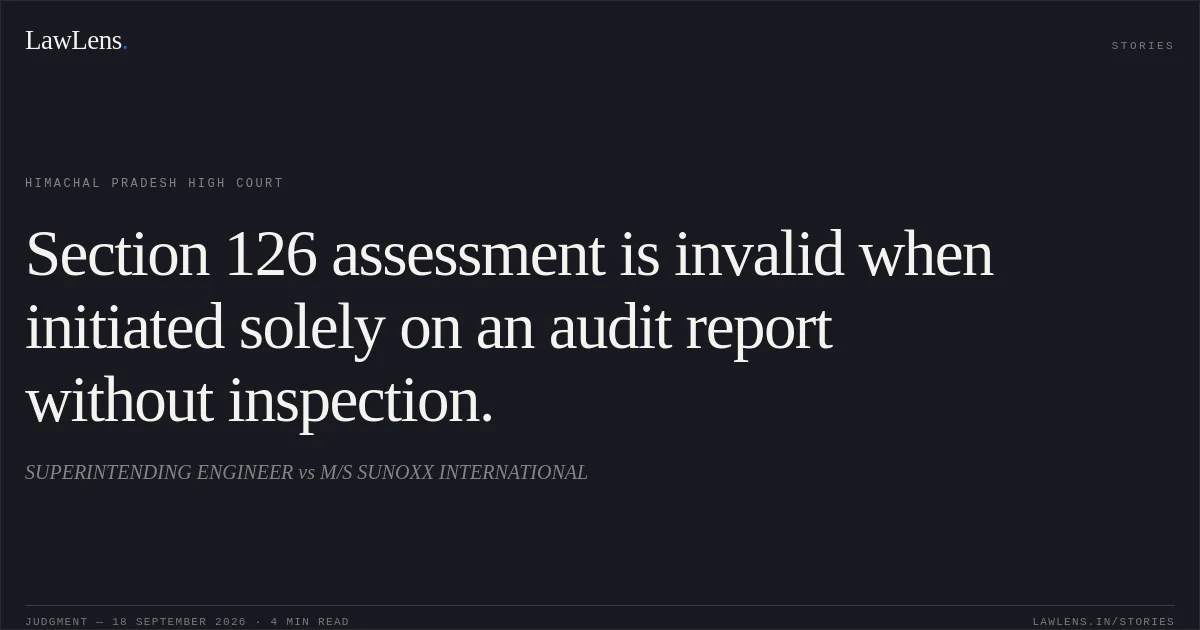
1. Whether an assessment under Section 126 of the Electricity Act, 2003 could validly be initiated and finalized solely on the basis of an audit report and records, without an inspection of the premises by the Assessing Officer.
Source reference: paras. 17–232. Whether the assessment was invalid for non-compliance with the inspection, inspection-report, and time-related requirements under the Himachal Pradesh Electricity Supply Code, 2009, including Clauses 6.1.1–6.1.7.
Source reference: paras. 26–293. Whether overdrawal of electricity beyond the sanctioned or contracted load constituted “unauthorised use of electricity” under Section 126 of the Electricity Act, 2003.
Source reference: paras. 32–354. Whether issuance of a final bill and settlement of dues upon permanent disconnection prevented the licensee from subsequently raising a Section 126 assessment for the earlier period.
Source reference: para. 29Law Applied
The Court applied Sections 50, 126, 127 and 181 of the Electricity Act, 2003.
Source reference: no citationSection 126 requires the assessment process to follow an inspection of the premises, equipment, or relevant records by the Assessing Officer, followed by provisional assessment, opportunity to object, hearing, and a reasoned final assessment.
Source reference: paras. 16–17Section 127 provides the statutory appellate remedy against the final assessment order.
Source reference: para. 16The Court relied on Executive Engineer, Southern Electricity Supply Company of Orissa Ltd. v. Sri Seetaram Rice Mill, (2012) 2 SCC 108, for the principle that overconsumption beyond sanctioned or connected load may constitute unauthorised use under Section 126, but noted that such proceedings commence with inspection by the Assessing Officer.
Source reference: paras. 22–23It also considered Kerala State Electricity Board v. Thomas Joseph, (2023) 11 SCC 700, which recognizes overdrawal beyond sanctioned or contracted load as unauthorised use and requires assessment at twice the applicable tariff, while not dispensing with the statutory inspection process.
Source reference: paras. 30–35Clauses 6.1.1–6.1.7 of the Supply Code require prompt inspection, preparation and service of an inspection report, and issuance of the provisional assessment order within 48 hours of inspection.
Source reference: paras. 26–27Clause 7.1.6 requires preparation of the final bill, including arrears, within five days of a request for permanent disconnection.
Source reference: para. 29Reasoning
The Court held that the statutory scheme under Section 126 contemplates commencement of proceedings through inspection by the Assessing Officer and a finding of unauthorised use, followed by provisional assessment and adjudication of objections.
Source reference: paras. 17–23In the present case, the Assessing Officer had not inspected the respondent’s premises; the assessment was based merely on an audit report prepared by another officer, with no identified inspection date, inspection report, or evidence of compliance with the Supply Code.
Source reference: paras. 19–21, 27–29The Assessing Officer also failed to issue a reasoned order despite the earlier remand specifically requiring a speaking decision.
Source reference: para. 21Although the Court accepted the broader proposition that overdrawal beyond sanctioned or contracted load can amount to unauthorised use, that substantive principle could not cure the failure to comply with the mandatory procedural requirements of Section 126 and the Supply Code.
Source reference: paras. 32–35Further, after permanent disconnection and settlement of the final bill, the Board could not retrospectively raise the assessment in the absence of a valid inspection-based proceeding.
Source reference: para. 29Holding
The High Court dismissed the Board’s writ petition and upheld the Divisional Commissioner’s order dated 11 January 2023 setting aside the assessment of ₹1,65,34,470.
It held that, although excess consumption beyond sanctioned or contracted load may fall within unauthorised use under Section 126, the assessment was invalid because it was founded solely on an audit report, without inspection by the Assessing Officer, a proper inspection report, compliance with the 48-hour requirement, or a reasoned adjudication.
Source reference: para. 36No order as to costs was made, and pending applications were disposed of.
Source reference: para. 36Acts & Sections Cited
30 provisions across 1 statute referred to in this judgment. Each provision opens on LawLens.
Electricity Act, 2003
Original Court PDF
SUPERINTENDING ENGINEERvsM/S SUNOXX INTERNATIONAL
Click to open original judgment
Original judgment, available to read, download and summarize on LawLens.in