Facts
Under a Co-Production Agreement dated 3 April 2026, VVAA Films agreed to fund up to ₹15 crore for the film “SNAP” in three tranches, in return for a 40% interest in the film’s intellectual property rights and net profits.
Source reference: para. 2VVAA paid the first ₹5 crore, but disputed that the conditions for payment of the second tranche had been met; it also alleged that DUNE had failed to provide accounts and operationalise the agreed escrow arrangements.
Source reference: paras. 4–5On 29 June 2026, DUNE demanded ₹6.5 crore within 36 hours and stated that the Agreement would otherwise terminate immediately.
Source reference: para. 2VVAA applied under Section 9 of the Arbitration and Conciliation Act, 1996, seeking interim protection before arbitration, including restraint against termination and creation of third-party rights.
Source reference: para. 3The Bombay High Court partly allowed the petition.
Source reference: para. 72Issues
1. Whether VVAA established a prima facie basis for interim protection against DUNE creating third-party rights in the film or in VVAA’s claimed interest pending arbitration.
Source reference: paras. 55, 63–712. Whether the Agreement was determinable in its nature, and whether DUNE’s purported termination complied with the agreed default-and-cure procedure.
Source reference: paras. 39–50, 57–603. Whether the Court should grant the requested directions for performance of the Agreement and disclosure of accounts under Section 9.
Source reference: paras. 66–70Law Applied
Section 9 of the Arbitration and Conciliation Act, 1996 empowers the Court to grant interim measures to preserve the subject matter pending arbitration, but does not permit it to bypass restrictions imposed by the Specific Relief Act.
Source reference: paras. 43–49Under Sections 14(d) and 41(e) of the Specific Relief Act, 1963, an injunction cannot be used to enforce a contract that is in its nature determinable.
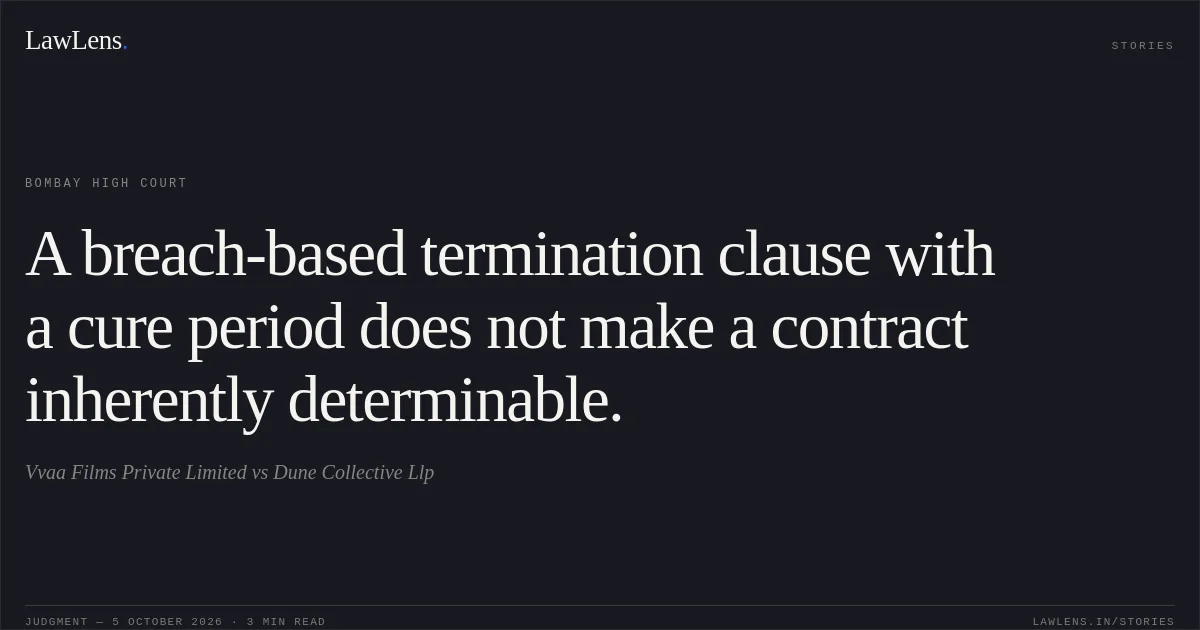
Source reference: paras. 43–49A contractual termination provision does not, by itself, make a contract determinable in its nature where termination is permitted only for specified cause and after an agreed opportunity to cure; the termination must also comply with the contractual procedure.
Source reference: paras. 43–49, 57–60The Court applied *Indian Oil Corporation Ltd. v. Amritsar Gas Service*, (1991) 1 SCC 533, and *Inter Ads Exhibition Pvt. Ltd. v. Busworld International Cooperative*, 2020 SCC OnLine Del 351, while distinguishing their application to the Agreement before it, and relied on *K.S. Manjunath v. Moorasavirappa*, 2025 SCC OnLine SC 2378, on the distinction between termination at will and termination for cause after notice and an opportunity to cure.
Source reference: paras. 43–49, 57–60It also applied the principle that a contractually stipulated cure period must be observed; the Court referred to *Maharashtra State Road Development Corporation Ltd. v. Plus BKSP Toll Ltd.*, 2021 SCC OnLine Bom 607, concerning strict compliance with a contractual notice period.
Source reference: paras. 41–42Reasoning
The Agreement established reciprocal obligations: VVAA’s funding was tied to the cash-flow schedule and specified tranche conditions, while DUNE undertook obligations concerning production, accounts, financial transparency, escrow and the protection of VVAA’s economic interest.
Source reference: paras. 27–28, 35–38DUNE’s own communications referred to pending invoices and outstanding payments, leaving a bona fide dispute over whether the second tranche had become payable.
Source reference: paras. 32–33, 52Although the first tranche was paid later than scheduled, DUNE accepted it and continued to act under the Agreement.
Source reference: paras. 29–31The Court considered the 36-hour demand and immediate termination inconsistent, prima facie, with the Agreement’s 30-day cure period; the earlier emails did not establish that the required opportunity to remedy the particular breach had been given.
Source reference: paras. 39–42, 49–51The Court therefore found a prima facie basis to preserve the claimed interest in the film and its revenues against unilateral third-party dealings, but declined to order complete performance of the Agreement or grant the requested restraint on acting upon the termination.
Source reference: paras. 63–70Holding
The petition was partly allowed.
DUNE was restrained, pending commencement of arbitration and subject to the Tribunal’s orders, from creating third-party rights in VVAA’s claimed interest under the Agreement, and from selling, assigning, transferring, licensing or encumbering that claimed 40% interest except in accordance with the Agreement and with VVAA’s concurrence.
Source reference: para. 72(ii)–(iii)DUNE was directed to provide, within four weeks, supporting documents concerning use of VVAA’s funds and the production accounts and financial records required by the Agreement.
Source reference: para. 72(iv)–(v)The Court did not grant the requested order directing performance of the Agreement or restraining DUNE from acting upon the termination; the merits were left open for arbitration, and VVAA was directed to commence arbitral proceedings within 30 days.
Source reference: para. 72(vi)–(xii)Acts & Sections Cited
4 provisions across 3 statutes referred to in this judgment. Each provision opens on LawLens.
Arbitration and Conciliation Act, 19961
Indian Contract Act, 18721
Specific Relief Act, 19632
Original Court PDF
Vvaa Films Private LimitedvsDune Collective Llp
Click to open original judgment
Original judgment, available to read, download and summarize on LawLens.in