Facts
On 17 October 2017 at approximately 4:00 p.m., the appellant was allegedly found by a police patrolling party near Hussain Chowk, Supaul, in an intoxicated condition and creating a commotion.
Source reference: para. 3He was apprehended and subjected to a breath-analyser test, which allegedly recorded an alcohol level of 251 mg/100 ml. Supaul P.S. Case No. 623 of 2017 was thereafter instituted under Section 37(c) of the Bihar Prohibition and Excise Act, 2016.
Source reference: para. 3The prosecution examined four witnesses, all police personnel, and produced the informant’s written application and the breath-analyser report slip.
Source reference: paras. 4–5The trial court convicted the appellant and sentenced him to five years’ imprisonment, a fine of Rs. 1,00,000, and, in default, one year’s further imprisonment.
Source reference: para. 2Issues
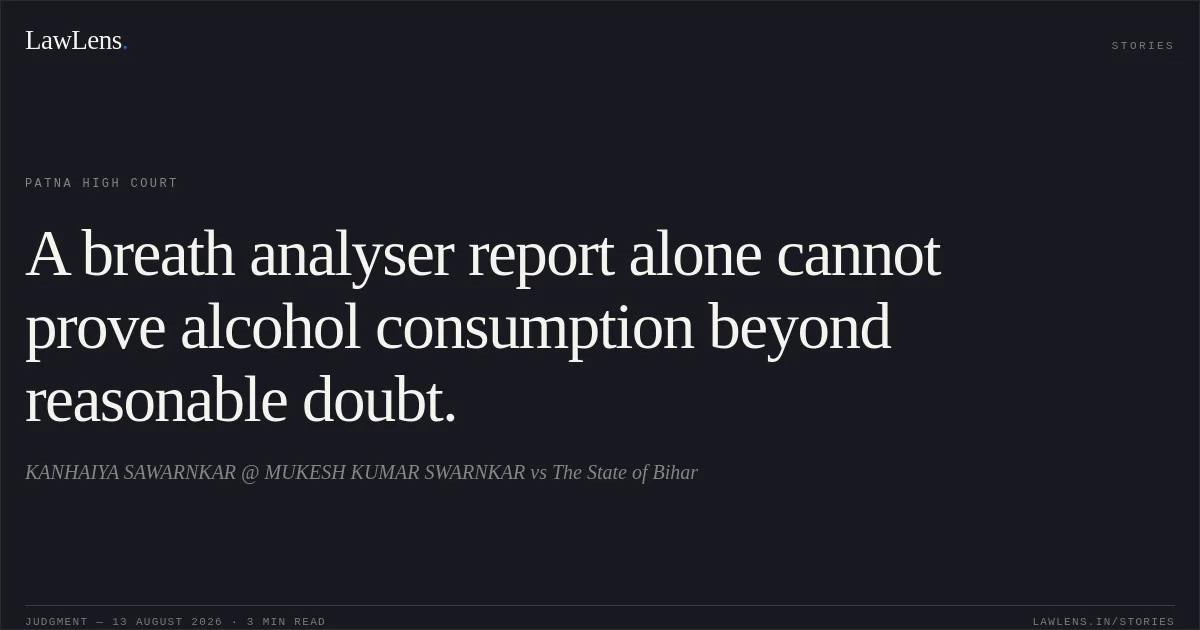
Whether the prosecution proved beyond reasonable doubt that the appellant had consumed alcohol in violation of Section 37(c) of the Bihar Prohibition and Excise Act, 2016, primarily on the basis of the breath-analyser report.
Source reference: paras. 7, 9–11Whether the absence of independent witnesses, non-recovery of liquor, inconsistencies in the witnesses’ evidence regarding the breath-analyser reading, and failure to obtain blood or urine samples created a reasonable doubt in the prosecution case.
Source reference: paras. 7, 9–11Whether the appellant was entitled to acquittal by extending to him the benefit of doubt.
Source reference: para. 11Law Applied
The court applied Section 37(c) of the Bihar Prohibition and Excise Act, 2016, under which consumption of liquor is punishable.
Source reference: para. 11It applied the settled criminal-law principle that the prosecution must establish guilt beyond reasonable doubt and that reasonable doubt must operate in favour of the accused.
Source reference: para. 11The court relied on Manju Devi v. State of Bihar & Ors., CWJC No. 2590 of 2022, for the proposition that a breath-analyser report, by itself, cannot be treated as conclusive proof of liquor consumption.
Source reference: para. 10It also referred to Bachubhai Hassanalli Karyani v. State of Maharashtra, (1971) 3 SCC 930, which recognised the importance of scientific examination, including blood and urine tests, in determining the presence of alcohol.
Source reference: para. 10The court further considered the evidentiary significance of corroboration and the effect of material inconsistencies in prosecution evidence.
Source reference: paras. 9–11Reasoning
The court found that the prosecution case rested substantially on the alleged breath-analyser reading, but the supporting evidence was materially deficient.
Source reference: paras. 10–11Although the alleged incident occurred in a public market, no independent witness was examined to corroborate the allegation that the appellant was intoxicated or creating a nuisance.
Source reference: para. 9The prosecution witnesses were inconsistent regarding the breath-analyser: P.W. 3 stated that he had not seen the device, while P.W. 4 stated that he had seen it but could not disclose the reading recorded on it.
Source reference: para. 9Apart from the informant, there was no consistent and reliable evidence proving the numerical reading.
Source reference: para. 9No liquor was recovered from the appellant, and no blood or urine sample was collected to independently verify the breath-analyser result.
Source reference: para. 10Applying the principles in Manju Devi and Bachubhai Hassanalli Karyani, the court held that the breath-analyser slip, unsupported by reliable corroborative evidence, was insufficient to establish consumption beyond reasonable doubt.
Source reference: paras. 10–11Holding
The High Court held that the prosecution failed to prove the charge under Section 37(c) of the Bihar Prohibition and Excise Act, 2016, beyond reasonable doubt.
The judgment of conviction dated 25 July 2019 and the order of sentence dated 27 July 2019 were set aside.
Source reference: para. 12The appellant was acquitted of all charges and discharged from the liability of his bail bond; the appeal was accordingly allowed.
Source reference: paras. 13–14Acts & Sections Cited
1 provisions across 1 statute referred to in this judgment. Each provision opens on LawLens.
BIHAR PROHIBITION AND EXCISE ACT, 20161
Original Court PDF
KANHAIYA SAWARNKAR @ MUKESH KUMAR SWARNKARvsThe State of Bihar
Click to open original judgment
Original judgment, available to read, download and summarize on LawLens.in