Facts
On 26 July 1999, Rangarao, who was travelling on a scooter, died after being hit by a bus insured with United India Insurance Co. Ltd.
Source reference: para. 3Rangarao was employed as a Superintendent at Gadge Maharaj Mahavidyalaya, Murtizapur, and his salary was proved at Rs. 13,027 per month, comprising basic pay, dearness allowance, house-rent allowance and scooter allowance.
Source reference: para. 3The Motor Accident Claims Tribunal treated his income as Rs. 12,000 per month, deducted 50% towards personal expenses, and awarded compensation to his brother, Ashok Mahadeo Kalaskar, treating him as a dependent.
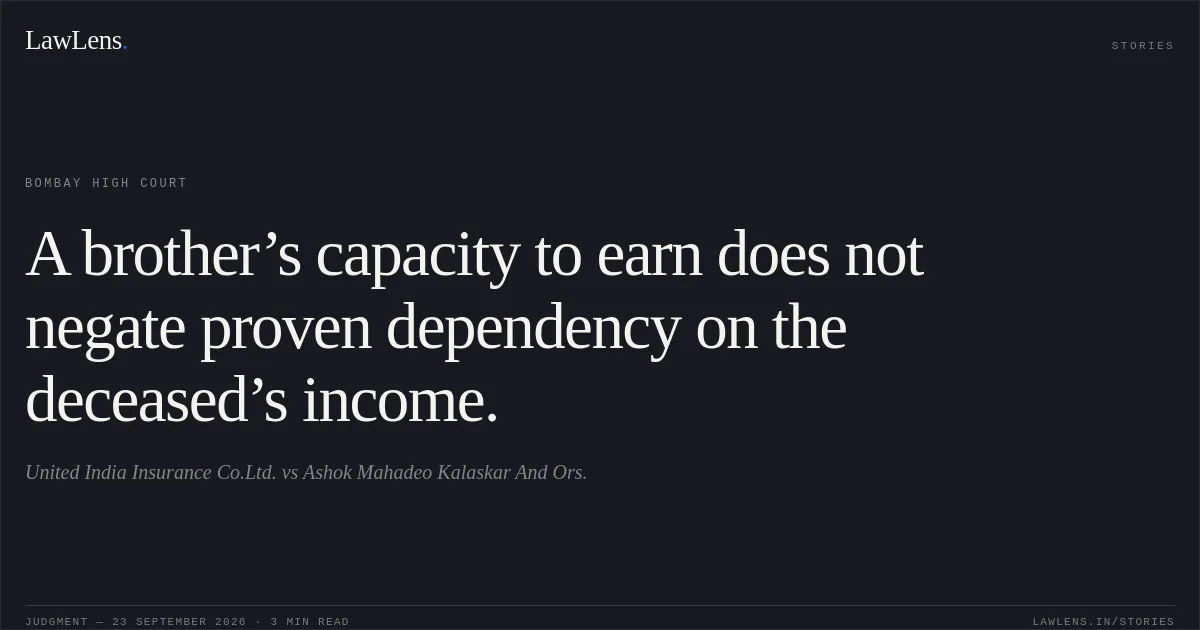
Source reference: paras. 1, 4The Insurance Company challenged the award principally on the ground that the claimant, being the deceased’s brother and capable of earning his own livelihood, was not dependent upon the deceased.
Source reference: paras. 1, 5Issues
Whether the deceased’s brother, as a legal representative, could maintain a claim under Section 166 of the Motor Vehicles Act, 1988, despite not being a spouse, child or parent of the deceased?
Source reference: paras. 7–11Whether the claimant established dependency upon the deceased notwithstanding his admission that he could earn through his labour?
Source reference: paras. 5–6, 12Whether the compensation required recalculation by applying the correct income, multiplier, future prospects and conventional heads of damages?
Source reference: para. 14Law Applied
Section 166 of the Motor Vehicles Act permits a legal representative of the deceased to apply for compensation; a legal representative need not necessarily be a legal heir or fall within the conventional categories of spouse, parent or child.
Source reference: paras. 7, 11Section 2(11) of the Code of Civil Procedure gives “legal representative” an inclusive and broad meaning, covering a person who represents the estate of the deceased.
Source reference: para. 7Section 168 requires the Tribunal to determine just compensation and specify the persons entitled to it and the person liable to pay it.
Source reference: paras. 9–10The Court relied on Gujarat State Road Transport Corporation v. Ramanbhai Prabhatbhai, holding that a person who suffers on account of the death may qualify as a legal representative; Manjuri Bera v. Oriental Insurance Co. Ltd., distinguishing the right to apply from entitlement to compensation; and National Insurance Co. Ltd. v. Birender, recognising that major or married claimants may apply, although the quantum depends upon proof of dependency.
Source reference: paras. 7–8The principles in Sarla Verma v. Delhi Transport Corporation and National Insurance Co. Ltd. v. Pranay Sethi governed the multiplier, deduction for personal expenses and future prospects.
Source reference: para. 10The Court also relied on Sunita v. Vinod Singh regarding assessment of age from reliable evidence, including the post-mortem report.
Source reference: para. 14(a)Reasoning
The Court distinguished between the locus to file a claim and entitlement to compensation.
Source reference: paras. 8–10As the deceased’s brother, the claimant could represent the deceased’s estate and therefore satisfied the requirement of being a legal representative under Section 166.
Source reference: para. 11On dependency, the claimant stated in examination-in-chief that he depended on Rangarao’s income, while his statement that he could earn through his own labour merely established physical earning capacity.
Source reference: paras. 5–6, 12The Court held that earning capacity and actual dependency are distinct considerations; the former does not by itself disprove the latter, particularly when the claimant’s evidence of dependency remained substantially unshaken in cross-examination.
Source reference: paras. 5–6, 12For quantum, the Court accepted a monthly income of Rs. 12,827 after deducting Rs. 200 as professional tax from the proved salary of Rs. 13,027, rather than the Tribunal’s figure of Rs. 12,000.
Source reference: para. 14(b)It applied a multiplier of 13, treating the deceased’s age as 50 years, deducted 50% towards personal expenses, and added 30% towards future prospects.
Source reference: paras. 14(a)–(c), 15It further awarded filial consortium, loss of estate and funeral expenses in accordance with the applicable principles.
Source reference: para. 15Holding
The Court held that the claimant, although the deceased’s brother and capable of earning, was a legal representative and had proved dependency upon the deceased.
The Insurance Company’s challenge to his entitlement was therefore rejected.
Source reference: paras. 11–13The compensation was recalculated at Rs. 13,84,556, comprising loss of dependency, future prospects, filial consortium, loss of estate and funeral expenses.
Source reference: para. 15Since Rs. 5,00,000 had already been awarded/claimed, the Appellant was directed to pay an additional Rs. 8,84,556 with interest at 9% per annum within eight weeks.
Source reference: para. 17(a)The appeal was dismissed, the civil application was disposed of, and withdrawal was made subject to adjustment of amounts already withdrawn, payment of additional court fee and production of appropriate material regarding the deceased’s income-tax liability.
Source reference: para. 17(b)–(e)Acts & Sections Cited
4 provisions across 2 statutes referred to in this judgment. Each provision opens on LawLens.
Motor Vehicles Act, 19883
Code of Civil Procedure, 19081
Original Court PDF
United India Insurance Co.Ltd.vsAshok Mahadeo Kalaskar And Ors.
Click to open original judgment
Original judgment, available to read, download and summarize on LawLens.in