Facts
Late Anand Kumar Singh and the petitioner, Shashi Kiran Devi, had availed a housing loan of ₹17,77,000 from the State Bank of India, ADB Begusarai Branch. The loan arrangement included proposed insurance coverage, and an insurance premium of ₹35,400 was debited from the borrower’s account on 4 February 2014.
Source reference: para. 2After Anand Kumar Singh died on 14 January 2016, the petitioner was informed that the insurance had not been effected or had been cancelled because the requisite medical formalities had not been completed, and that the premium had subsequently been refunded.
Source reference: paras. 2, 9The petitioner and the legal heirs submitted representations seeking settlement of the insurance claim and liquidation of the loan liability.
Source reference: para. 14Proceedings before the Banking Ombudsman indicated that the Bank had not effectively informed the borrower about the medical requirement, cancellation or non-coverage of the insurance; the insurer’s communication also allegedly contained an incorrect address.
Source reference: para. 15Meanwhile, the Bank issued a demand notice dated 10 July 2016 for ₹15,16,577 and a possession notice dated 21 September 2016 concerning the secured residential property under the SARFAESI Act.
Source reference: para. 4Issues
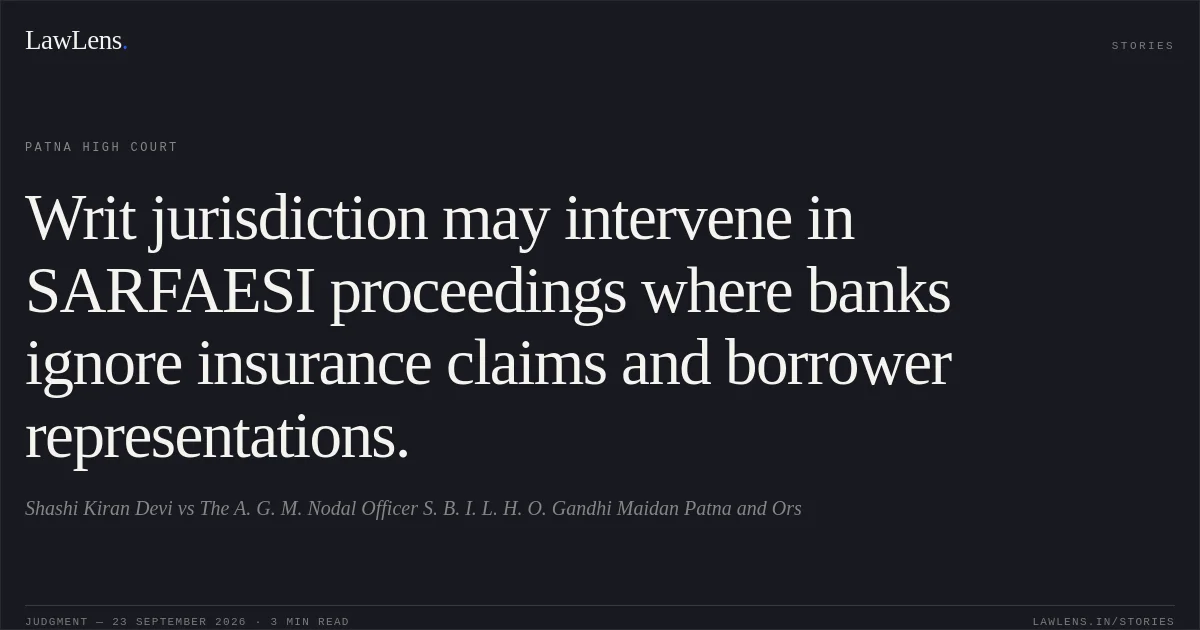
Whether the writ petition was maintainable despite the alternative statutory remedy available under Section 17 of the SARFAESI Act against the Bank’s measures under Section 13(4).
Source reference: paras. 7, 18Whether the Bank could proceed against the secured residential property without properly considering the petitioner’s insurance claim and representations, particularly when the insurance premium had been debited and effective communication regarding non-coverage had not been established.
Source reference: paras. 15–18Whether the demand notice dated 10 July 2016 and possession notice dated 21 September 2016 were liable to be quashed.
Source reference: paras. 4, 19Law Applied
The Court applied Section 13(4) of the Securitisation and Reconstruction of Financial Assets and Enforcement of Security Interest Act, 2002, which governs measures that a secured creditor may take for enforcement of security interests, read with Rule 8 of the Security Interest (Enforcement) Rules, 2002 concerning possession notices.
Source reference: para. 12It also considered Section 17 of the SARFAESI Act, which provides an efficacious statutory remedy before the Debt Recovery Tribunal against measures taken under Section 13(4).
Source reference: paras. 7, 18The Court applied the principles of natural justice and procedural fairness, holding that where a bank facilitates insurance for a loan, debits the premium, and is aware that the insurance is intended to cover the loan liability, it must ensure effective communication regarding completion of formalities, cancellation, or non-coverage of the insurance.
Source reference: paras. 15–16The Court also recognised that the death of a borrower does not, by itself, extinguish the outstanding loan liability.
Source reference: para. 17The petitioner relied upon Cheemala Nagendra Babu v. SBI Life Insurance Company Limited, reported in 2024 SCC OnLine TS 773.
Source reference: para. 6Reasoning
Although the Bank contended that the writ petition was barred by the availability of the remedy under Section 17 of the SARFAESI Act, the Court held that the present case involved more than a challenge to ordinary recovery measures.
Source reference: para. 18The central grievance concerned the Bank’s failure to properly consider the insurance claim and the petitioner’s representations before taking coercive action.
Source reference: para. 18The record showed that the Bank had facilitated the insurance proposal and debited the premium, but had not satisfactorily established that the deceased borrower was effectively informed about the medical requirements or the cancellation and consequences of non-coverage.
Source reference: paras. 15–16The Ombudsman proceedings further supported the petitioner’s contention regarding inadequate communication and the incorrect address in the insurer’s communication.
Source reference: para. 15In these circumstances, proceeding against the residential property without first addressing the insurance-related grievance was held to be procedurally unfair and warranted interference under Article 226, notwithstanding the alternative SARFAESI remedy.
Source reference: paras. 17–18Holding
The Court held that the writ petition was maintainable in the peculiar facts of the case because the Bank had not properly considered the insurance claim and the petitioner’s representations before initiating coercive SARFAESI measures.
The demand notice dated 10 July 2016 and possession notice dated 21 September 2016 were quashed.
Source reference: para. 19The Bank was directed to reconsider the petitioner’s claim concerning insurance coverage, taking into account the premium debited, the representations of the petitioner and legal heirs, and the observations of the Banking Ombudsman, and to communicate a reasoned decision.
Source reference: para. 19Until such reconsideration and communication, the respondents were restrained from taking coercive action against the residential property.
Source reference: para. 19The writ petition was accordingly allowed, and any interlocutory application was disposed of.
Source reference: paras. 20–21Acts & Sections Cited
2 provisions across 1 statute referred to in this judgment. Each provision opens on LawLens.
Securitisation and Reconstruction of Financial Assets and Enforcement of Security Interest Act, 20022
Original Court PDF
Shashi Kiran DevivsThe A. G. M. Nodal Officer S. B. I. L. H. O. Gandhi Maidan Patna and Ors
Click to open original judgment
Original judgment, available to read, download and summarize on LawLens.in