Facts
Baban Kumar Paswan, employed as a security guard at the Gangwara Power Grid Sub-Station, was found dead inside the sub-station after suffering electrocution.
Source reference: p. 2, para. 3The informant alleged that the petitioner, an Assistant Executive Engineer, had called the deceased inside for maintenance work and directed him to handle an earthing clamp despite his lack of technical training, resulting in his death.
Source reference: p. 2, para. 3Darbhanga Sadar P.S. Case No. 30 of 2021 was registered, and the police submitted a charge-sheet under Section 304-A of the Indian Penal Code.
Source reference: p. 2, para. 2; p. 3, para. 5The Chief Judicial Magistrate, Darbhanga, took cognizance on 15 February 2022.
Source reference: p. 2, para. 2; p. 3, para. 5During the proceedings, the petitioner and the informant also entered into an amicable settlement, which was supported by the informant before the High Court.
Source reference: p. 4–5, paras. 6–7Issues
Whether the materials on record disclosed the commission of an offence under Section 304-A IPC against the petitioner so as to justify the order taking cognizance
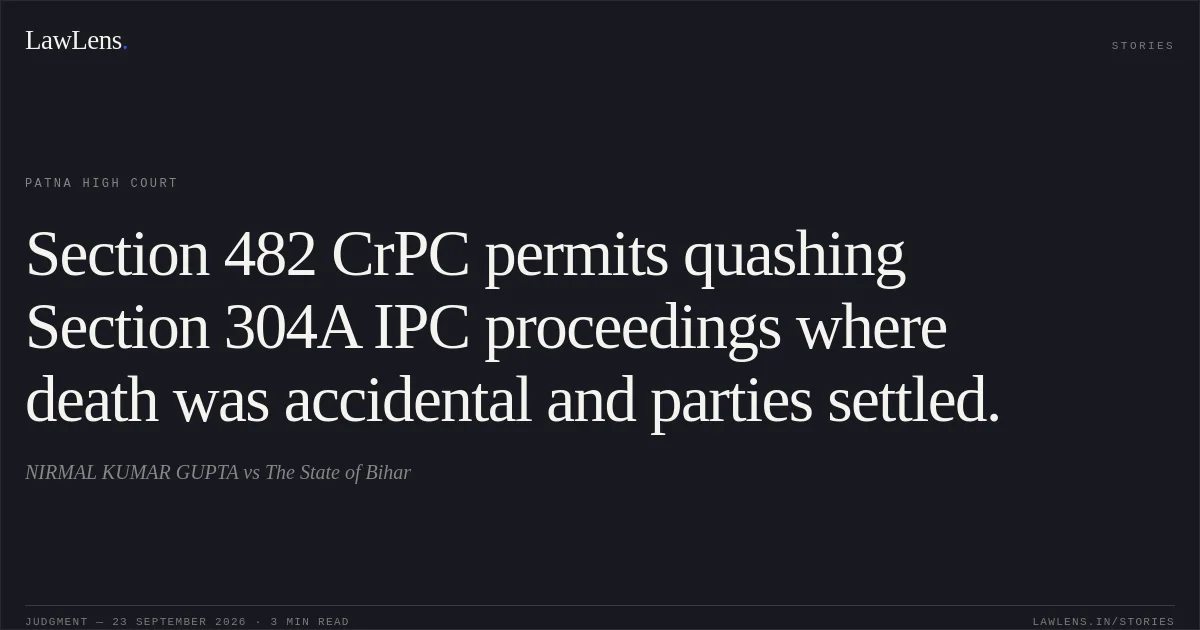
Source reference: p. 3–5, paras. 5 and 8Whether the High Court could quash the criminal proceedings under Section 482 CrPC in view of the finding that the death was accidental and the subsequent compromise between the parties
Source reference: p. 4–6, paras. 6 and 8–10Law Applied
The Court applied Section 304-A IPC, which criminalises causing death by a rash or negligent act not amounting to culpable homicide; an accidental death, without proof of a rash or negligent act causally connected to the death, does not satisfy its ingredients.
Source reference: p. 3–5, paras. 5 and 8The Court also exercised its inherent jurisdiction under Section 482 CrPC to prevent abuse of the process of the court and secure the ends of justice.
Source reference: p. 5–6, para. 9Relying on Gian Singh v. State of Punjab, (2012) 10 SCC 303, and Narinder Singh v. State of Punjab, (2014) 6 SCC 466, the Court held that proceedings in a non-compoundable case may be quashed where the dispute has been genuinely settled and continuation of the prosecution would serve no useful purpose, particularly where the offence is not heinous or attended by serious societal ramifications.
Source reference: p. 5–6, para. 9The Court also referred to The State of Punjab v. Avtar Singh & Ors., 2026 INSC 934, as authority supporting quashing on the basis of settlement.
Source reference: p. 4, para. 6; p. 6, para. 9Reasoning
The Court found that the internal inquiry attributed the death to accidental contact with a cable or discharge rod, possibly following stumbling or loss of balance in circumstances involving inductive power.
Source reference: p. 5, para. 8On that material, the Court concluded that the prosecution had not established any rash or negligent act by the petitioner that caused the death, and therefore the essential ingredients of Section 304-A IPC were absent.
Source reference: p. 3–5, paras. 5 and 8Independently, the parties had resolved their dispute through a compromise, and the informant did not oppose quashing of the proceedings.
Source reference: p. 4–5, paras. 6–7Applying the principles governing the exercise of inherent powers under Section 482 CrPC, the Court held that continuation of the prosecution would constitute an abuse of process and that quashing would secure the ends of justice.
Source reference: p. 5–6, para. 9Holding
The High Court answered the issues in favour of the petitioner.
It held that the deceased’s death was purely accidental and that no case of rash or negligent conduct under Section 304-A IPC was made out against the petitioner.
Source reference: p. 5, para. 8In view of the absence of the offence’s essential ingredients and the amicable settlement between the parties, the Court quashed the order dated 15 February 2022 taking cognizance in Darbhanga Sadar P.S. Case No. 30 of 2021, along with all consequential criminal proceedings arising from that case against the petitioner.
Source reference: p. 6, paras. 10–11The application under Section 482 CrPC was accordingly allowed.
Source reference: p. 6, paras. 10–11Acts & Sections Cited
1 provisions across 1 statute referred to in this judgment. Each provision opens on LawLens.
Code of Criminal Procedure, 19731
Original Court PDF
NIRMAL KUMAR GUPTAvsThe State of Bihar
Click to open original judgment
Original judgment, available to read, download and summarize on LawLens.in