Facts
A registered power of attorney was executed in favour of Augustine Paul on 02.06.1987 authorising him to execute a sale deed concerning the disputed property. Although the power of attorney was allegedly cancelled on 18.09.1987, its cancellation was registered only on 29.09.1987. In the intervening period, Augustine Paul executed a sale deed dated 22.09.1987 in favour of the mother-in-law of Appellant No. 1, who thereafter constructed a house on the property.
Source reference: paras. 3–5The respondents subsequently instituted Original Suit No. 100 of 1991 seeking cancellation of the sale deed. The suit was decreed ex parte on 21.04.2001, but the decree cancelled the sale deed and restrained further construction; it did not direct delivery of possession or eviction.
Source reference: paras. 6–9The decree was prepared on 07.04.2023, following which the respondents allegedly attempted to dispossess the appellants, who claimed continuous and peaceful possession since 1987.
Source reference: para. 10The appellants filed Regular Suit No. 238 of 2023 for permanent injunction and sought interim protection under Order XXXIX Rules 1 and 2 CPC.
Source reference: paras. 11–12The Trial Court dismissed the injunction application on 03.07.2025, leading to the present appeal under Order XLIII Rule 1(r) read with Section 104 CPC.
Source reference: paras. 14, 38Issues
Whether the appellants established a prima facie case, balance of convenience, and likelihood of irreparable injury so as to warrant temporary injunction under Order XXXIX Rules 1 and 2 CPC.
Source reference: para. 38Whether the respondents could dispossess the appellants, who claimed long-standing settled possession, without an express decree or order for eviction or otherwise than by due process of law.
Source reference: paras. 54–57Whether the Trial Court’s refusal to grant interim protection was arbitrary, perverse, or contrary to the settled principles governing temporary injunctions.
Source reference: paras. 51–52Law Applied
The Court applied Section 94(c) CPC and Order XXXIX Rules 1 and 2 CPC, under which temporary injunction may be granted to prevent dispossession, injury, alienation, or frustration of the subject matter of the suit.
Source reference: paras. 39–43The governing requirements are the existence of a prima facie case, balance of convenience, and irreparable injury, as explained in Dalpat Kumar v. Prahlad Singh, Seema Arshad Zaheer v. Municipal Corporation of Greater Mumbai, and Zenit Mataplast Pvt. Ltd. v. State of Maharashtra.
Source reference: paras. 48–49, 53An interlocutory injunction is intended to preserve the status quo and protect the subject matter pending trial, not to finally determine title; the Court should not conduct a mini-trial at the interim stage.
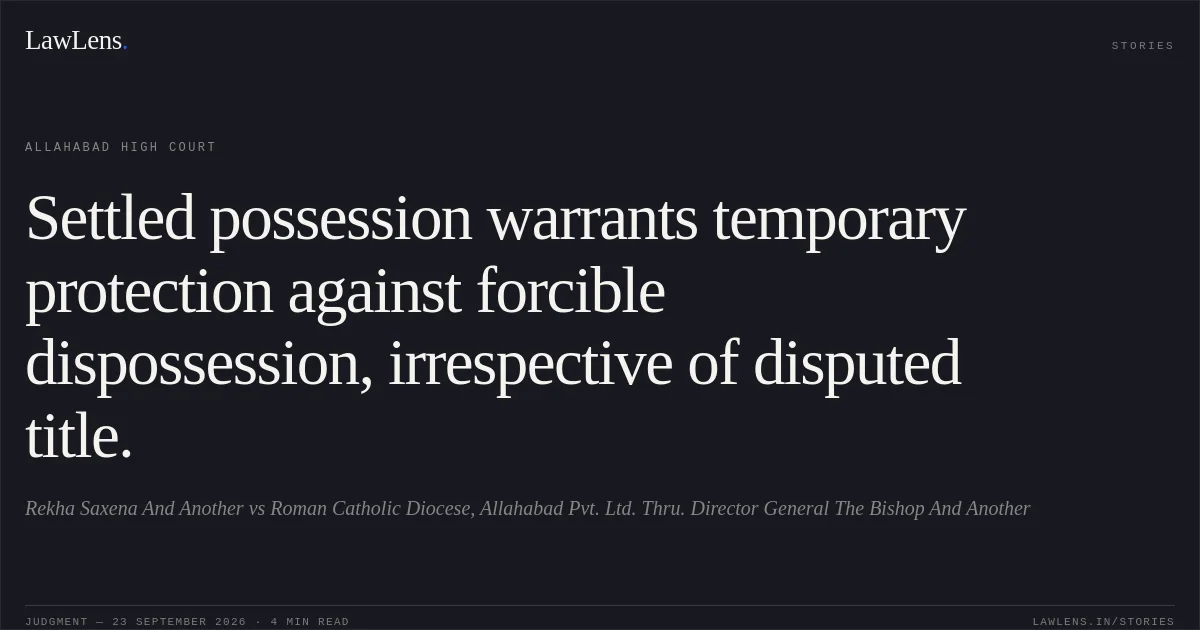
Source reference: paras. 44, 47, 49, 53Under Rame Gowda v. M. Varadappa Naidu, even a person alleged to be a trespasser in settled, peaceful, and effective possession cannot be forcibly dispossessed by the true owner and may be removed only through due process of law.
Source reference: para. 54Samir Sobhan Sanyal v. Tracks Trade (P) Ltd. similarly holds that possession cannot be disturbed without a decree or order of eviction.
Source reference: para. 57Under Wander Ltd. v. Antox India (P) Ltd. and Ramakant Ambalal Choksi v. Harish Ambalal Choksi, an appellate court should not substitute its discretion for that of the Trial Court unless the impugned exercise of discretion is arbitrary, capricious, perverse, or contrary to settled legal principles.
Source reference: paras. 51–52Reasoning
The Court found that the appellants had shown long, continuous, and peaceful possession of the disputed residential property since 1987, and that such possession was also substantially acknowledged in the respondents’ pleadings.
Source reference: para. 58The earlier decree cancelled the sale deed but did not grant possession or authorise eviction; therefore, it could not by itself justify forcible dispossession.
Source reference: paras. 56–57Without finally deciding the validity of the power of attorney or the appellants’ title, the Court held that their settled possession constituted a prima facie case warranting protection under Rame Gowda and Dalpat Kumar.
Source reference: paras. 59–60The balance of convenience favoured the appellants because they had remained in possession for more than three decades and the property was their residence; dispossession during the suit would cause irreparable injury not adequately compensable in money.
Source reference: para. 61The Trial Court had therefore failed to properly apply the principles governing interim injunctions, and its refusal of protection could not be sustained.
Source reference: paras. 62–64Holding
The appeal was allowed.
The order dated 03.07.2025 dismissing the appellants’ application under Order XXXIX Rules 1 and 2 CPC was set aside, and a temporary injunction was granted in favour of the appellants during the pendency of Regular Suit No. 238 of 2023.
Source reference: para. 64The respondents were restrained from forcibly dispossessing or otherwise interfering with the appellants’ possession except in accordance with due process of law.
Source reference: paras. 62–64The Court clarified that its observations were confined to the interim injunction application and would not prejudice the Trial Court’s independent determination of the parties’ rights, title, or the validity of the power of attorney at trial.
Source reference: paras. 65–66Parties were directed to bear their own costs.
Source reference: para. 67Acts & Sections Cited
3 provisions across 2 statutes referred to in this judgment. Each provision opens on LawLens.
Code of Civil Procedure, 19082
Registration Act, 19081
Original Court PDF
Rekha Saxena And AnothervsRoman Catholic Diocese, Allahabad Pvt. Ltd. Thru. Director General The Bishop And Another
Click to open original judgment
Original judgment, available to read, download and summarize on LawLens.in