Facts
The first respondent/plaintiff instituted O.S. No. 672 of 2009 seeking declarations that certain sale deeds executed in favour of the petitioner and another defendant were null and void, along with a permanent injunction.
Source reference: pp.3–5; paras.2–4The plaintiff claimed a share in the suit property as a legal heir and co-sharer, while the petitioner, the eighth defendant, claimed to be a bona fide purchaser of portions of the property under registered sale deeds.
Source reference: pp.3–5; paras.2–4The defendants engaged a common counsel, but failed to file their written statements and were set ex parte.
Source reference: p.5; para.4An ex parte decree was passed on 4 August 2011.
Source reference: p.5; para.4The petitioner alleged that he had entrusted the litigation to the other defendants and their counsel, and became aware of the decree only upon receiving a notice dated 4 March 2013.
Source reference: pp.5–6; paras.6–7He thereafter filed an application under Order IX Rule 13 CPC, along with an application under Section 5 of the Limitation Act to condone a delay of 576 days.
Source reference: pp.5–6; paras.6–7The Additional District Munsif dismissed the condone-delay application, holding that the delay was insufficiently explained and that the petitioner had been negligent.
Source reference: p.6; para.8Issues
Whether the petitioner had shown sufficient cause under Section 5 of the Limitation Act for condoning the 576-day delay in filing the application to set aside the ex parte decree?
Source reference: pp.5–6, 12–14; paras.7–8, 12–15Whether the absence of reasons, findings and proper adjudication in the ex parte decree justified granting the petitioner an opportunity to contest the suit on merits?
Source reference: pp.6–12; paras.10–12Whether the Trial Court had properly exercised its discretion in dismissing the condone-delay application?
Source reference: pp.6, 12–15; paras.8, 17–18Law Applied
The Court applied Section 5 of the Limitation Act, under which delay may be condoned upon proof of “sufficient cause,” and Order IX Rule 13 CPC, which permits an ex parte decree to be set aside in appropriate circumstances.
Source reference: no citationThe revisional jurisdiction under Section 115 CPC was invoked to examine the correctness of the Trial Court’s order.
Source reference: no citationUnder Order XX Rules 4(2) and 5 CPC, a judgment must contain a concise statement of the case, points for determination, findings and reasons; these requirements apply even to an ex parte judgment.
Source reference: pp.9–11; para.11Relying on Meenakshi v. Andal, Management Neptune Travels India Pvt. Ltd. v. Special Deputy Commissioner, Labour, Brahmand Farm Lands Ltd. v. K. Venkatesan and Meenakshisundaram Textiles v. Valli Textiles Ltd., the Court held that an ex parte decree cannot be granted merely because the defendant is absent and must reflect consideration of the pleadings, evidence and relief claimed.
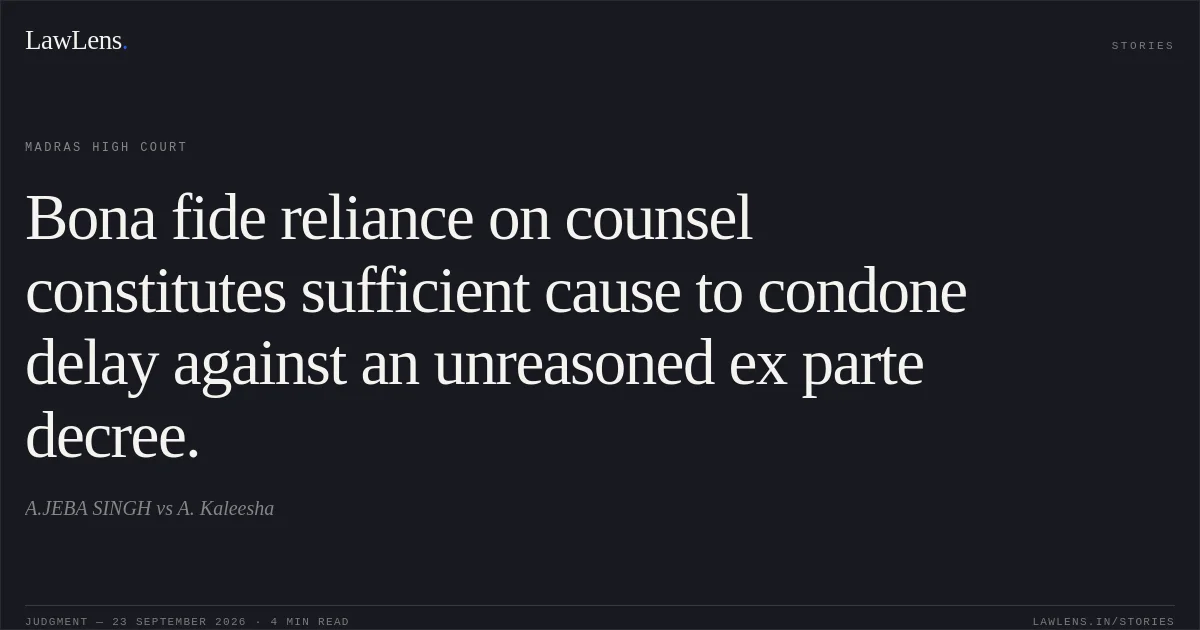
Source reference: pp.7–12; para.11The Court also relied on Kumari Sahu v. Bhubananda Sahu for the principle that litigants may reasonably depend upon counsel, and on Arunoday Singh v. Lee Anne Elton for adopting a liberal approach where refusal to condone delay would defeat adjudication on merits.
Source reference: pp.13–14; paras.14–16Reasoning
The High Court found that the petitioner had entrusted the matter to the common counsel engaged by the family members, who were also defendants in the connected litigation.
Source reference: pp.12–13; para.13The fact that the same counsel appeared in both proceedings and that the defendants remained ex parte raised a serious doubt whether the petitioner had been deliberately or effectively prevented from contesting the suit.
Source reference: pp.12–13; para.13The Court further noted that the ex parte decree dated 4 August 2011 contained no properly framed issues, findings or reasons, despite the plaintiff’s own claim being limited to a share in the joint property.
Source reference: pp.6, 12; paras.10, 12The legal effect of alienations by co-sharers and the plaintiff’s asserted limited share had not been examined.
Source reference: pp.6, 12; paras.10, 12These circumstances constituted sufficient cause under Section 5 of the Limitation Act and warranted an opportunity to contest the matter on merits.
Source reference: pp.13–14; paras.15–17The Court considered that the interests of justice were better served by condoning the delay subject to costs rather than allowing an apparently unreasoned ex parte decree to stand.
Source reference: pp.13–14; paras.15–17Holding
The High Court allowed the Civil Revision Petition and set aside the order dated 3 February 2023 dismissing I.A. No. 427 of 2016.
The delay of 576 days in filing the application to set aside the ex parte decree was condoned, subject to the petitioner paying Rs.20,000 to the first respondent within three weeks from receipt of the order.
Source reference: p.15; para.18If the amount was not paid within the stipulated time, the revision petition would stand dismissed.
Source reference: p.15; para.18Upon compliance, the Trial Court was directed to proceed with the case and dispose of it within six months, uninfluenced by the observations made in the revision order.
Source reference: p.15; para.18Acts & Sections Cited
3 provisions across 2 statutes referred to in this judgment. Each provision opens on LawLens.
Code of Civil Procedure, 19082
Limitation Act, 19631
Original Court PDF
A.JEBA SINGHvsA. Kaleesha
Click to open original judgment
Original judgment, available to read, download and summarize on LawLens.in