Facts
M/s. Piccadily Agro Industries Ltd. (“PAIL”) owned a 17 MW bagasse/biomass-based co-generation power plant comprising four generating units at its sugar mill and distillery premises in Haryana.
Source reference: p.6; para. 6PAIL entered into banking and wheeling arrangements under which up to 3 MW/5 MW of power could be transmitted to Piccadily Hotels Private Limited (“PHPL”), a related company, for its use.
Source reference: pp.6–7; para. 7For the relevant financial year, PHPL consumed only 37.24% of the electricity generated from the concerned 5 MW unit. DHBVNL consequently issued notices dated 21 June 2024 requiring restoration/payment of the captive-use benefit amounting to ₹68,03,220, on the ground that the 51% consumption requirement under Rule 3(1)(a)(ii) of the Electricity Rules, 2005 had not been met.
Source reference: p.2; para. 1The Haryana Electricity Regulatory Commission, by order dated 10 November 2025 in Petition No. 44 of 2024, upheld the notices.
Source reference: p.2; para. 1Before the Appellate Tribunal, the Appellants argued that the entire 17 MW plant was a captive generating plant and that consumption by PAIL and PHPL ought to be aggregated. The Respondents contended that PHPL alone was identified as the captive user under the relevant agreements and had failed to meet the mandatory 51% threshold.
Source reference: pp.3–5; paras. 3–5The Tribunal ultimately upheld the Commission’s result, but on the distinct ground that PHPL did not satisfy the minimum ownership requirement.
Source reference: no citationIssues
1. Whether PAIL and PHPL could collectively qualify as captive users of electricity generated from PAIL’s 17 MW co-generation power plant, such that their combined consumption could be considered for the 51% captive-use requirement under Rule 3(1)(a)(ii) of the Electricity Rules, 2005?
Source reference: p.5; para. 52. Whether PHPL satisfied the minimum 26% ownership requirement prescribed for captive users under Rule 3(1)(a)(i) of the Electricity Rules, 2005?
Source reference: pp.24–26; paras. 30–323. Whether the notices requiring restoration/payment of the captive-use benefit were legally sustainable?
Source reference: pp.27–29; paras. 34–38Law Applied
Section 2(8) of the Electricity Act, 2003 defines a “captive generating plant” as a power plant established primarily for the owner’s own use, including use by members of a cooperative society or association.
Source reference: p.8; paras. 11–12Section 9 recognises the right of a person establishing and operating a captive generating plant to obtain open access for carrying electricity to the destination of its own use.
Source reference: p.12; para. 16Rule 3(1)(a) of the Electricity Rules, 2005 requires, in the case of a power plant, that at least 26% of ownership be held by the captive user(s) and that at least 51% of the aggregate electricity generated annually be consumed for captive use; failure to maintain the minimum captive-use percentage results in the electricity being treated as supply by a generating company under Rule 3(2).
Source reference: pp.9–12; para. 13The Explanation defines a “captive user” as the end user of electricity generated in a captive generating plant.
Source reference: p.11; para. 15The Tribunal relied on Chhattisgarh State Power Distribution Company Ltd. v. Chhattisgarh State Electricity Regulatory Commission & Anr., 2022 SCC OnLine SC 604, which held that separate corporate entities may collectively qualify as captive users where the requisite ownership and consumption conditions are satisfied, including the relevant company’s holding of at least 26% equity in the generating company.
Source reference: pp.19–23; paras. 25–29Reasoning
The Tribunal found that the banking agreements did not establish that PHPL alone was the captive user. The tripartite agreement expressly identified PAIL as a captive user and contemplated wheeling power from the entire 17 MW project for captive/own use at PHPL’s premises.
Source reference: pp.15–18; paras. 21–22However, the decisive requirement was ownership. PHPL held only 14.57% equity in PAIL.
Source reference: p.24; para. 30Applying the principle in CSPDCL, the Tribunal held that PHPL, as the separate consuming entity, had to satisfy the minimum 26% ownership requirement in the generating company in order for its consumption to be treated as captive use.
Source reference: pp.23–24, 26; paras. 27–32The Commission had incorrectly treated the concerned 5 MW unit as a proportionate part of the 17 MW plant and notionally enhanced PHPL’s ownership percentage to determine compliance.
Source reference: p.26; para. 31The Tribunal rejected that approach because PAIL’s plant was not owned by an SPV covered by Rule 3(1)(b); PAIL carried on other businesses in addition to owning the generating plant. PHPL’s actual equity participation therefore remained 14.57%, whether assessed against the entire plant or the particular 5 MW unit.
Source reference: p.26; para. 31Since PHPL failed the ownership test, the Tribunal held that it was unnecessary to examine whether PAIL’s and PHPL’s consumption together satisfied the 51% requirement.
Source reference: p.27; para. 33Holding
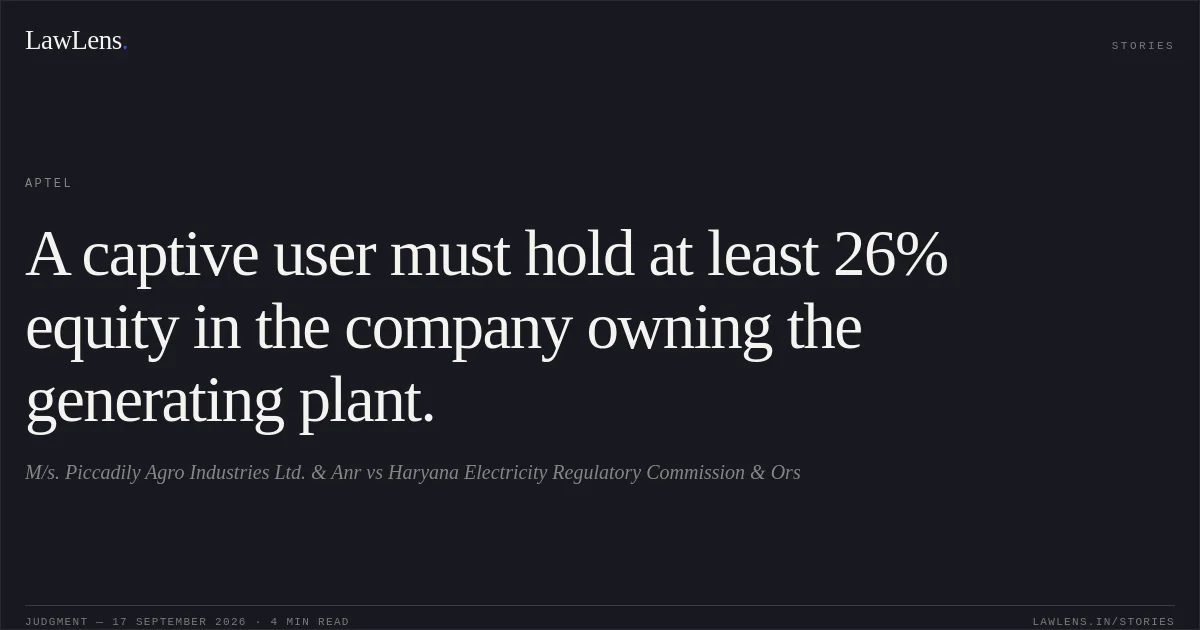
The Tribunal held that PHPL did not qualify as a captive user because it held only 14.57% equity in PAIL, below the mandatory 26% ownership threshold under Rule 3(1)(a)(i) of the Electricity Rules, 2005.
Accordingly, PHPL was not entitled to the captive-use benefit and remained liable for the charges raised by DHBVNL.
Source reference: no citationThe Commission’s order and the recovery notices were upheld, though on a different reasoning from that adopted by the Commission.
Source reference: pp.27–29; paras. 34–37The Appellants were directed to pay the outstanding amount within four weeks, together with interest at the State Bank of India Marginal Cost of Funds-based Lending Rate applicable in the relevant year plus 150 basis points.
Source reference: p.28; paras. 36–38Acts & Sections Cited
3 provisions across 1 statute referred to in this judgment. Each provision opens on LawLens.
Electricity Act, 20033
Original Court PDF
M/s. Piccadily Agro Industries Ltd. & AnrvsHaryana Electricity Regulatory Commission & Ors
Click to open original judgment
Original judgment, available to read, download and summarize on LawLens.in