Facts
Tara Singh’s estate became the subject of competing claims based on two Wills: an earlier registered Will dated 30 July 1984 in favour of Balbir Singh and others, and a subsequent Will dated 2 April 1986 relied upon by Hardial Singh and another, which purported to cancel the earlier Will.
Source reference: paras. 1, 6–7Hardial Singh and another instituted Civil Suit No. 238 of 1993 seeking declaration of ownership and permanent injunction on the basis of the 1986 Will, while Balbir Singh and others filed Civil Suit No. 371 of 1993 seeking permanent injunction.
Source reference: paras. 2–3The Trial Court dismissed the suit based on the 1986 Will and decreed the suit filed by Balbir Singh and others. The First Appellate Court reversed that decision, accepted the 1986 Will, and dismissed the claim founded on the 1984 Will.
Source reference: para. 4The plaintiffs examined the scribe and attesting witnesses to the 1986 Will. The defendants relied on the 1984 Will, examined its scribe and the registration clerk, and stated that both attesting witnesses had died.
Source reference: paras. 10–11The connected writ petitions concerned revenue mutations and entries founded on the 1984 Will and subsequent transactions involving the suit property.
Source reference: para. 5Issues
Whether the Will dated 2 April 1986 was duly executed and proved, or whether it was surrounded by suspicious circumstances requiring explanation by its propounders?
Source reference: paras. 6, 16–17Whether the Will dated 30 July 1984 was duly proved despite non-examination of its attesting witnesses, where its execution and registration had been admitted by the plaintiffs and the attesting witnesses were stated to be dead?
Source reference: paras. 26–34Whether the revenue proceedings and mutations founded on the 30 July 1984 Will were liable to be set aside?
Source reference: paras. 5, 35–36Law Applied
The Court applied Section 63 of the Indian Succession Act, 1925, requiring due execution and attestation of a Will, and Section 68 of the Indian Evidence Act, 1872, requiring examination of at least one attesting witness to prove a document required by law to be attested, subject to the statutory qualification contained therein.
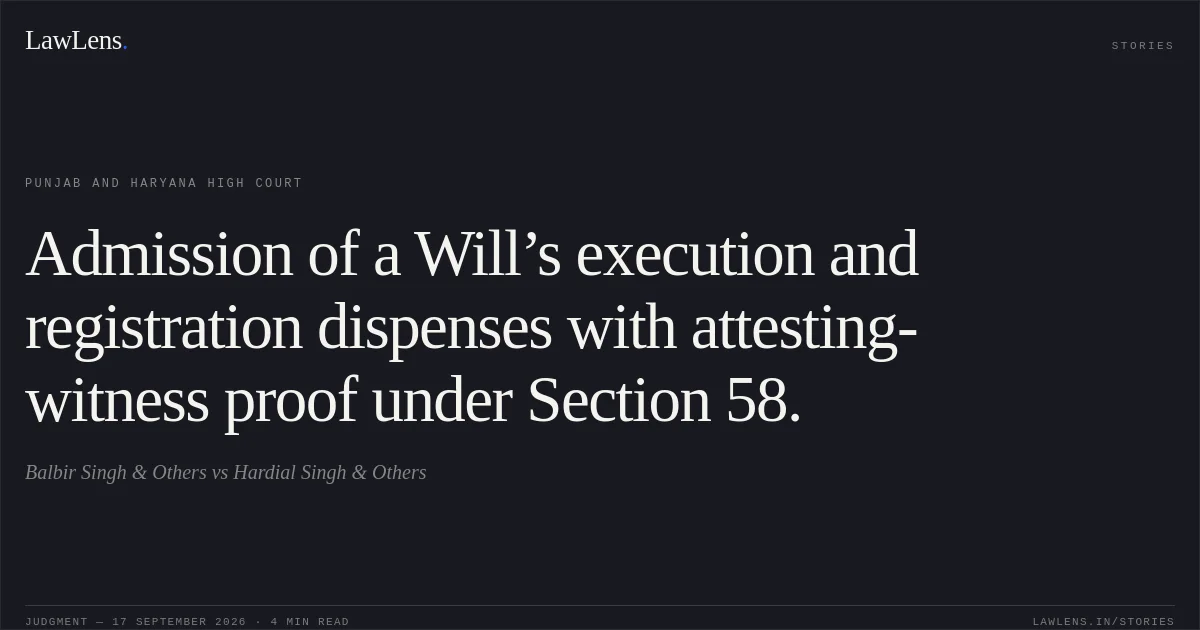
Source reference: paras. 29–31It also applied Section 58 of the Evidence Act, under which admitted facts need not be proved, and held that Sections 58 and 68 must be read harmoniously: where execution of a Will is expressly admitted, separate proof through an attesting witness may be unnecessary.
Source reference: paras. 29–34The Court relied on the principles summarised from Derek A.C. Lobo v. Ulric M.A. Lobo, 2024 (2) RCR (Civil) 873, and other authorities, that the initial burden lies on the propounder to prove due execution and the testator’s free and sound disposition; where specific suspicious circumstances are established, the propounder must remove those suspicions.
Source reference: para. 15Mere registration does not, by itself, validate a Will, and suspicion must be assessed in light of the surrounding evidence.
Source reference: para. 15Reasoning
The Court held that the 2 April 1986 Will was surrounded by substantial suspicious circumstances. The earlier 1984 Will was thumb-marked by Tara Singh, whereas the subsequent Will bore his alleged signatures, and no satisfactory explanation was given for the change in the mode of execution despite the short interval between the two documents.
Source reference: paras. 18–21The plaintiffs also failed to establish that the signatures on the 1986 Will were genuinely those of Tara Singh or that he had begun signing documents instead of affixing thumb impressions.
Source reference: paras. 20–21Further, the scribe did not produce the register in which the Will was allegedly recorded; the plaintiffs’ evidence disclosed that the scribe had been imprisoned in a forgery-related matter; and no convincing explanation was offered as to why the Will, allegedly prepared at the Tehsil office and intended to cancel an earlier registered Will, was not registered.
Source reference: paras. 22–23These circumstances were not dispelled by the propounders, making the execution of the 1986 Will doubtful.
Source reference: paras. 24–25Conversely, the execution and registration of the 30 July 1984 Will stood admitted in the pleadings and in the text of the subsequent Will itself.
Source reference: paras. 18–19, 26, 33The plaintiffs’ attesting witness also admitted having seen the earlier Will and that it bore Tara Singh’s thumb mark.
Source reference: paras. 18–19, 26, 33Since both attesting witnesses had died, and the execution of the Will had been admitted, Section 58 relieved the defendants from proving it afresh through an attesting witness. The scribe and registration clerk had also been examined, further supporting its execution and registration.
Source reference: paras. 26, 33–34Holding
The High Court allowed both regular second appeals, set aside the First Appellate Court’s judgment dated 27 January 1997, and restored the Trial Court’s judgment and decree dated 29 July 1995.
It held that the 2 April 1986 Will was not proved because its suspicious circumstances remained unexplained, while the 30 July 1984 Will was sufficiently established through admissions and supporting evidence notwithstanding the non-examination of its deceased attesting witnesses.
Source reference: paras. 25, 34Consequently, Civil Suit No. 238 of 1993 filed by Hardial Singh and another remained dismissed, and Civil Suit No. 371 of 1993 filed by Balbir Singh and others remained decreed.
Source reference: para. 35The connected writ petitions challenging revenue proceedings based on the 1984 Will were also dismissed.
Source reference: para. 36Acts & Sections Cited
2 provisions across 2 statutes referred to in this judgment. Each provision opens on LawLens.
Indian Penal Code, 18601
Indian Succession Act, 19251
Original Court PDF
Balbir Singh & OthersvsHardial Singh & Others
Click to open original judgment
Original judgment, available to read, download and summarize on LawLens.in