Facts
The petitioner served as a part-time workshop instructor at Raiganj Polytechnic from 1 December 1995 until 31 July 2025, continuously and without interruption.
Source reference: p.1–2During his service, he received benefits under various Government orders, including the order dated 2 September 2010 concerning contractual fixed remuneration for part-time lecturers and other employees of Government/Government-sponsored polytechnics, and the memorandum dated 22 July 2024, under which his last drawn remuneration was ₹13,750 per month.
Source reference: p.2After superannuation, he sought payment of the terminal benefit of ₹3 lakh under the Government order/notification dated 26 February 2021.
Source reference: p.1–2, p.5The State opposed the claim on the ground that the notification applied only to contractual workshop instructors and not to part-time employees.
Source reference: p.2Issues
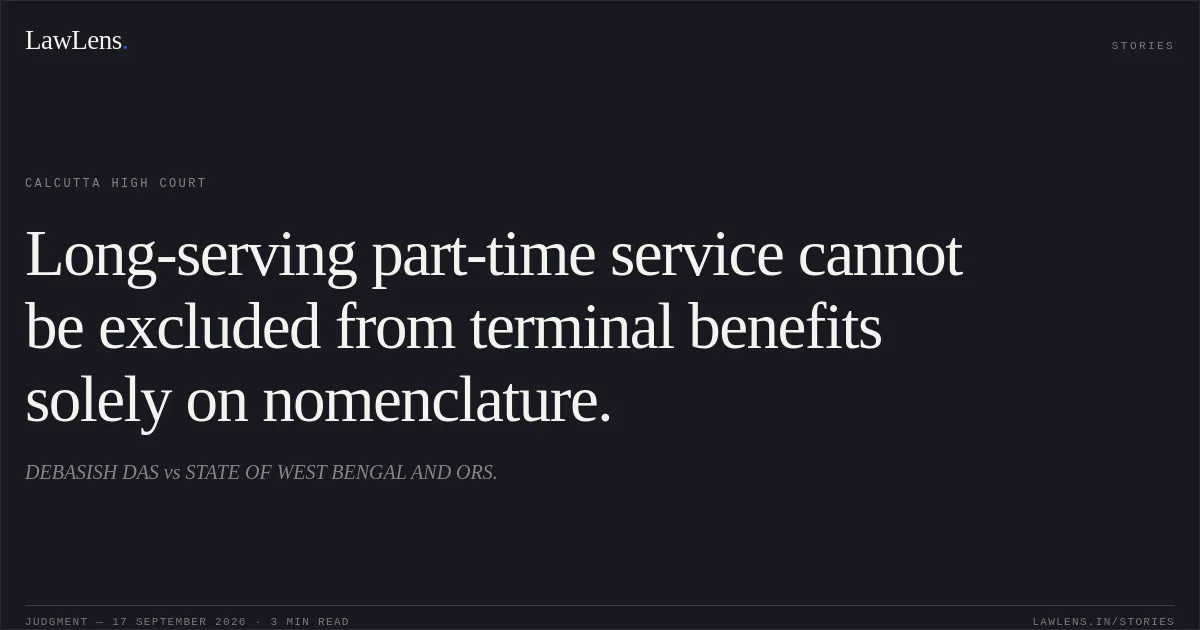
Whether a part-time workshop instructor who rendered continuous and uninterrupted service for nearly three decades could be denied the terminal benefit solely because his engagement was described as “part-time” rather than “contractual”.
Source reference: para. 7–10Whether exclusion of the petitioner from the terminal-benefit scheme was consistent with Article 14 of the Constitution, having regard to the object of recognising long and continuous service and providing post-retirement security.
Source reference: para. 7–9Whether the petitioner was entitled to payment of the terminal benefit of ₹3 lakh under the notification/order dated 26 February 2021.
Source reference: para. 10Law Applied
The Court applied Article 14 of the Constitution, which prohibits arbitrary State action and requires similarly situated persons to receive equal treatment in relation to the object sought to be achieved.
Source reference: para. 7, 9Relying on D.S. Nakara v. Union of India, (1983) 1 SCC 305, the Court treated retirement benefits as measures of socio-economic justice and post-retirement security, and held that distinctions must bear a rational nexus with the purpose of the benefit.
Source reference: para. 7–8The Court also relied on Food Corporation of India v. Kamdhenu Cattle Feed Industries, (1993) 1 SCC 71, for the principle that legitimate expectation is closely connected with Article 14 and that State action affecting such expectation must be non-arbitrary and rational.
Source reference: para. 9The Court further applied the principle of beneficial construction, under which welfare and social-security provisions should be interpreted to advance, rather than defeat, their underlying purpose.
Source reference: para. 8The relevant Government orders concerning contractual fixed remuneration and terminal benefits formed the administrative basis of the claim.
Source reference: p.2, p.5Reasoning
The Court held that the petitioner’s eligibility could not be determined solely by the nomenclature “part-time”.
Source reference: para. 7His continuous engagement from 1995 to 2025, the absence of any break in service, the perennial nature of his duties, and the State’s prior recognition of his service through remuneration-related benefits demonstrated a sustained and enduring employment relationship.
Source reference: p.1–2, para. 10Since the State had extended terminal benefits to contractual employees, the Court found that denying the same benefit to a long-serving part-time employee required a rational justification connected with the purpose of the scheme.
Source reference: para. 7–9No such justification was established.
Source reference: para. 7–9A complete denial based only on the formal label attached to the engagement would undermine the welfare-oriented purpose of the benefit and could amount to arbitrary discrimination under Article 14.
Source reference: para. 7–9Although the petitioner’s entitlement under the 26 February 2021 notification was disputed, his continuous and uninterrupted service remained unchallenged; the Court therefore considered it appropriate to grant him terminal security as a one-time measure.
Source reference: para. 10–11Holding
The writ petition was disposed of with a direction to respondent no. 4 to issue an order for payment of ₹3 lakh to the petitioner as terminal benefit pursuant to the notification/order dated 26 February 2021, within two weeks from communication of the judgment.
The Court clarified that the direction was a one-time beneficial security measure for the petitioner and would not operate as a precedent in similar cases in the institution or otherwise.
Source reference: para. 11–12Original Court PDF
DEBASISH DASvsSTATE OF WEST BENGAL AND ORS.
Click to open original judgment
Original judgment, available to read, download and summarize on LawLens.in