Facts
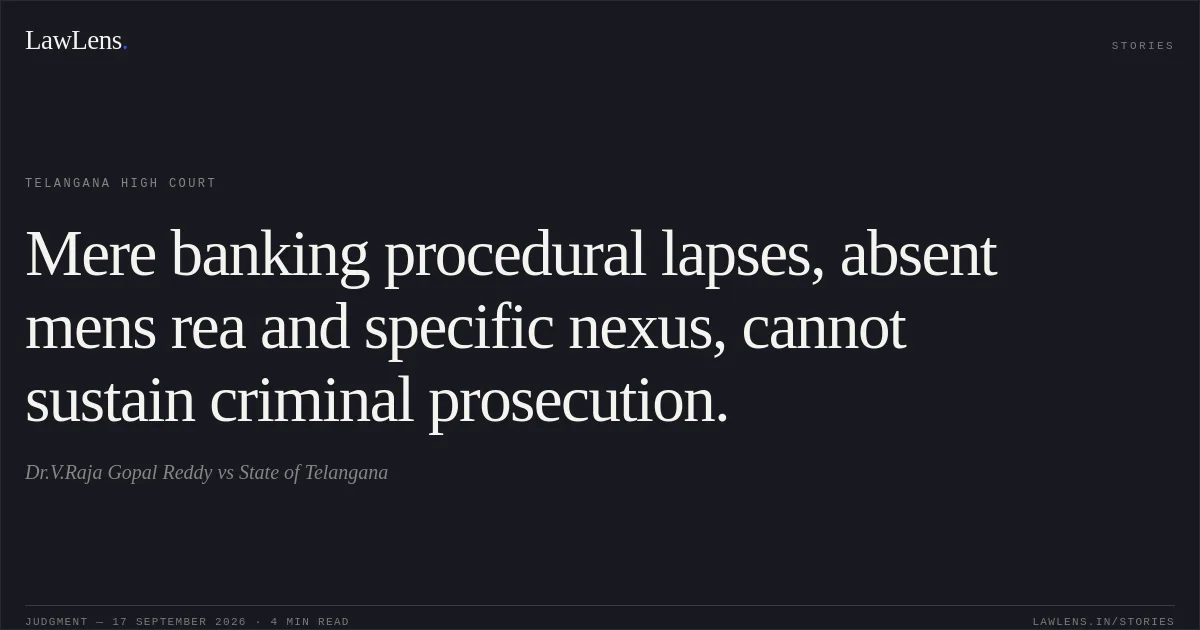
The petitioner, Accused No. 7, was the Branch Manager of Indian Bank, Osmangunj Branch, Hyderabad, from 27 July 2001 to 16 July 2006.
Source reference: paras. 4.1–4.3The prosecution alleged that Accused No. 1, proprietor of M/s. PDM Industries, in conspiracy with other accused, obtained various credit facilities from Indian Bank by submitting forged title deeds, financial statements, invoices, net-worth certificates and other documents.
Source reference: paras. 4.1–4.3, 5.1, 6.1The petitioner contended that his role was limited to sanctioning the initial facility within his delegated authority and forwarding subsequent proposals to the competent Circle Office.
Source reference: paras. 5.1–5.3The petitioner sought quashing of the proceedings in C.C. No. 16 of 2014 under Section 482 Cr.P.C. The trial had substantially progressed, with 42 of 98 prosecution witnesses examined and 387 documents marked.
Source reference: para. 6.5Issues
Whether the material on record prima facie disclosed the essential ingredients of the offences alleged against the petitioner?
Source reference: para. 8(A)Whether there was specific material connecting the petitioner with the alleged criminal conspiracy?
Source reference: para. 8(B)Whether criminal liability could be fastened upon the petitioner merely because he was a Bank officer who processed, authorised or forwarded loan proposals?
Source reference: para. 8(C)Whether continuation of the criminal proceedings against the petitioner would amount to an abuse of the process of law warranting exercise of jurisdiction under Section 482 Cr.P.C.?
Source reference: para. 8(D)Law Applied
The Court applied Section 482 Cr.P.C., under which the High Court may quash criminal proceedings to prevent abuse of process and secure the ends of justice, while ordinarily avoiding a mini-trial or detailed appreciation of evidence.
Source reference: para. 9It considered Sections 120-B, 420, 409, 467, 468 and 471 IPC, holding that conspiracy requires an agreement or concert; cheating requires deception and dishonest intention; Section 471 requires knowledge or reason to believe that the document is forged; and Section 409 requires the requisite dishonest misappropriation or criminal breach of trust.
Source reference: para. 16The Court also considered Section 13(1)(d) read with Section 13(2) of the Prevention of Corruption Act, 1988, which requires obtaining or attempting to obtain a valuable thing or pecuniary advantage by corrupt or illegal means or by abuse of official position.
Source reference: para. 16Relying on Susanta Kumar Dalei v. State of Odisha (Vigilance), 2026 INSC 510, the Court held that vague or omnibus allegations without a specific role or nexus are insufficient; relying on K. Bharathi Devi v. State of Telangana, (2024) SCC 384, it emphasised individualised criminal culpability.
Source reference: paras. 5.4, 6.6–6.7, 19–20Reasoning
The Court found that the petitioner’s involvement was principally in processing and forwarding proposals, while the enhanced OCC limits and housing loan were sanctioned by the Circle Office and the proposals were prepared by the Credit Officer with supporting legal opinions and valuation reports.
Source reference: paras. 10, 22Although several security documents were later found to be forged, there was no specific material showing that the petitioner fabricated, procured or knowingly used the forged documents, or that he agreed with the borrowers to defraud the Bank.
Source reference: paras. 11, 14, 22The alleged failure to follow the prescribed procedure, including reliance on photocopies for legal opinion, could at most indicate a procedural lapse or negligence; it did not, without proof of knowledge or dishonest intention, establish cheating, forgery, use of forged documents or conspiracy.
Source reference: paras. 12–15Similarly, the petitioner’s official position and duty of care could not, by themselves, establish criminal liability.
Source reference: para. 15The Court also considered the absence of adverse findings in audits and staff-accountability studies, the later enhancement of limits by the Circle Office, and the fact that the accounts became NPAs after the petitioner had left the branch as relevant surrounding circumstances, though not conclusive proof of innocence.
Source reference: para. 17The OTS and recoveries were not treated as independent grounds for quashing; the decisive consideration was the absence of foundational material showing the petitioner’s conscious participation, knowledge or dishonest intention.
Source reference: para. 19Holding
The Court held that the prosecution failed to establish a specific nexus between the petitioner and the forged documents, fraudulent transactions or alleged conspiracy.
Mere processing or forwarding of loan proposals, supervisory lapses, or the petitioner’s status as Branch Manager did not satisfy the essential ingredients of Sections 120-B, 409, 420, 467, 468 or 471 IPC, or Section 13(1)(d) of the Prevention of Corruption Act.
Source reference: paras. 22–23The Criminal Petition was accordingly allowed, and the proceedings in C.C. No. 16 of 2014 were quashed insofar as they related to the petitioner/Accused No. 7.
Source reference: para. 24The Court clarified that its observations were confined to the petitioner and would not affect the proceedings against the other accused.
Source reference: para. 24Acts & Sections Cited
7 provisions across 3 statutes referred to in this judgment. Each provision opens on LawLens.
Code of Criminal Procedure, 19731
Indian Penal Code, 18605
Prevention of Corruption Act, 19881
Original Court PDF
Dr.V.Raja Gopal ReddyvsState of Telangana
Click to open original judgment
Original judgment, available to read, download and summarize on LawLens.in