Facts
The appellant was convicted by the Special Court under Section 363 of the Indian Penal Code, 1860 (“IPC”) and Section 6 of the Protection of Children from Sexual Offences Act, 2012 (“POCSO Act”), and was sentenced to ten years’ rigorous imprisonment under Section 6 POCSO and one year under Section 363 IPC, with the sentences directed to run in accordance with the trial court’s order.
Source reference: pp. 1–3The prosecution alleged that, on 9 December 2015, the appellant took the complainant’s approximately two-and-a-half-year-old daughter to a nearby park without the mother’s consent.
Source reference: pp. 3–5The High Court affirmed the conviction, relying substantially on the testimony of the child’s mother, the evidence of the child’s uncle, the evidence of a private doctor, and the statutory presumption under Section 29 of the POCSO Act.
Source reference: pp. 6–7Before the Supreme Court, the appellant challenged the reliability of the prosecution evidence and contended that the medical and forensic evidence did not support the allegation of penetrative sexual assault.
Source reference: p. 8The defence also relied on prior enmity between the parties arising from disputes over a common water connection.
Source reference: pp. 20–22Issues
Whether the prosecution proved beyond reasonable doubt that the appellant committed penetrative sexual assault punishable under Section 6 of the POCSO Act, notwithstanding the statutory presumption under Section 29 of that Act?
Source reference: pp. 22–36, 40–41Whether the evidence of the complainant-mother and other prosecution witnesses was sufficiently reliable and consistent to sustain the appellant’s conviction under Sections 363 IPC and 6 POCSO?
Source reference: pp. 10–20Whether the presumptions under Sections 29 and 30 of the POCSO Act dispense with the prosecution’s initial obligation to establish the foundational facts of the alleged offence beyond reasonable doubt?
Source reference: pp. 27–36Whether the appellant successfully rebutted the statutory presumptions by demonstrating material contradictions, evidentiary gaps, and a probable defence?
Source reference: pp. 29–41Law Applied
The Court applied Section 363 IPC, read with Section 361 IPC, concerning kidnapping from lawful guardianship, and Sections 3, 5 and 6 of the POCSO Act concerning penetrative sexual assault and aggravated penetrative sexual assault.
Source reference: pp. 1–3Sections 29 and 30 of the POCSO Act create rebuttable presumptions regarding the commission of specified POCSO offences and the existence of culpable mental state, respectively; however, they operate only after the prosecution establishes the foundational facts constituting the offence.
Source reference: pp. 23–31The prosecution must still prove the accused’s guilt beyond reasonable doubt, whereas the accused may rebut the presumption on a preponderance of probabilities.
Source reference: pp. 33–36The Court relied on Navin Dhaniram Baraiye v. State of Maharashtra for the principle that Section 29 is not an absolute presumption and cannot be invoked merely because a charge-sheet has been filed.
Source reference: pp. 27–28The Court relied on Rai Sandeep alias Deepu v. State (NCT of Delhi) and Ganesan v. State for the requirement that a witness relied upon without adequate corroboration must be of “sterling quality”.
Source reference: pp. 17–20The Court relied on Kali Ram v. State of Himachal Pradesh for the principle that reasonable doubt must enure to the accused and that the prosecution must establish guilt consistently with the exclusion of innocence.
Source reference: pp. 37–39Reasoning
The Court held that the prosecution evidence did not establish the foundational facts necessary to sustain the POCSO presumption.
Source reference: pp. 22–36, 40–41The mother’s account materially conflicted with the private doctor’s evidence concerning the time of the child’s visit, who accompanied her, and the circumstances of the alleged examination.
Source reference: pp. 11–14Her testimony also contained material omissions and improvements when compared with the FIR and her earlier statement.
Source reference: pp. 12–14The medical evidence contradicted rather than corroborated the allegation: the examining doctor found no injury or abnormality, the hymen was intact, and the FSL report detected neither semen nor male DNA and did not establish blood on the pyjama.
Source reference: pp. 14–17Consequently, the Court held that the evidence did not merely fail to corroborate penetration but substantially undermined the alleged sexual assault itself.
Source reference: pp. 16–17The complainant could not be treated as a “sterling witness” because her testimony contained material inconsistencies and was incompatible with the medical and forensic evidence.
Source reference: pp. 17–20The proven dispute over water-sharing provided a plausible motive for a false implication, further weakening the prosecution case.
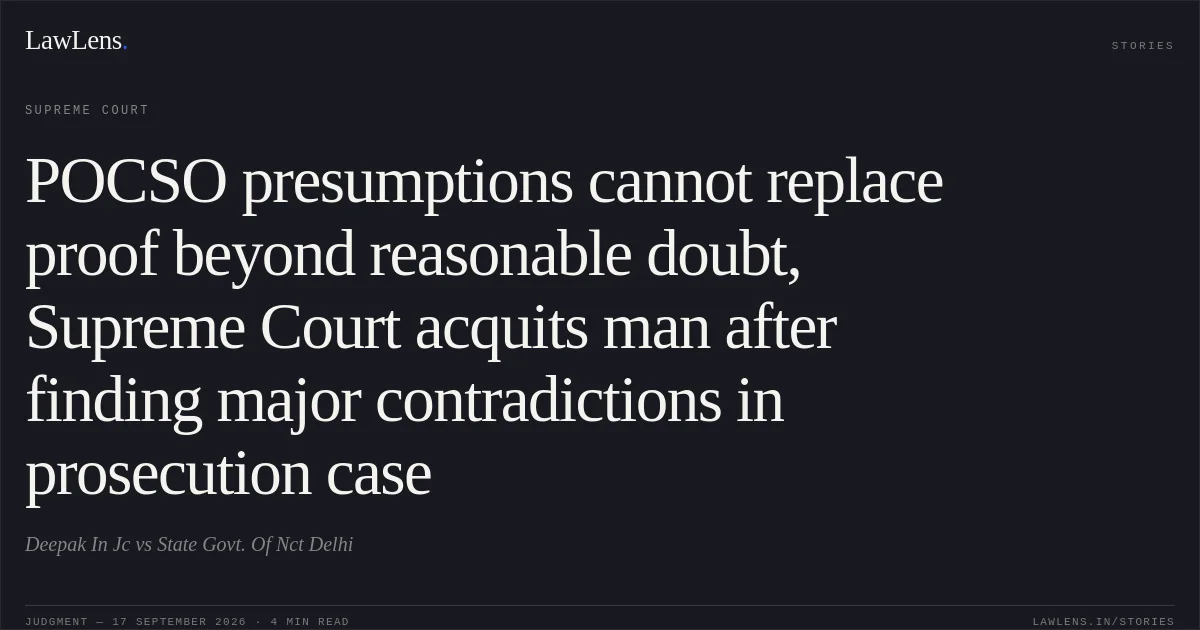
Source reference: pp. 20–22The Court emphasized that Sections 29 and 30 POCSO could not convert unreliable or internally inconsistent evidence into proof beyond reasonable doubt; the appellant was entitled to rebut the presumptions by exposing contradictions, evidentiary gaps, and the improbability of the prosecution version.
Source reference: pp. 29–36, 40–41Holding
The Supreme Court answered the issues in favour of the appellant.
It held that the prosecution failed to prove beyond reasonable doubt the commission of penetrative sexual assault or the appellant’s guilt under Section 6 of the POCSO Act.
Source reference: pp. 40–41The statutory presumptions under Sections 29 and 30 did not cure the absence of reliable foundational evidence and stood effectively rebutted by the material contradictions, non-supportive medical and forensic evidence, and the probable defence version.
Source reference: pp. 40–41The judgments of the High Court dated 3 July 2025 and the trial court dated 21 August 2023 were set aside.
Source reference: p. 42The appellant was acquitted of the offences under Section 363 IPC and Section 6 POCSO, and was directed to be released forthwith unless required in connection with any other offence.
Source reference: p. 42Acts & Sections Cited
23 provisions across 9 statutes referred to in this judgment. Each provision opens on LawLens.
Indian Penal Code, 18604
Protection of Children from Sexual Offences Act, 20128
Code of Criminal Procedure, 19732
Narcotic Drugs and Psychotropic Substances Act, 19852
Prevention of Corruption Act, 19881
Wild Life (Protection) Act, 19721
Customs Act,19622
Foreign Exchange Management Act, 19991
Negotiable Instruments Act, 18812
Original Court PDF
Deepak In JcvsState Govt. Of Nct Delhi
Click to open original judgment
Original judgment, available to read, download and summarize on LawLens.in