Facts
On 24 August 2017, the informant was allegedly cleaning a drain on her land when the petitioners and other accused persons, armed with weapons, abused and assaulted her with an iron rod and khanti in connection with a land dispute.
Source reference: p. 2; para. 3The informant’s daughter-in-law was allegedly assaulted by petitioner no. 2 on the head when she intervened. Both injured persons were taken to Sadar Hospital, Munger.
Source reference: p. 2; para. 3The petitioners were named in the FIR, and petitioner no. 1 was implicated with the aid of Section 34 IPC.
Source reference: p. 2; para. 8After investigation, the police allegedly exonerated petitioner no. 1 from the allegations and dropped the allegation under Section 307 IPC against petitioners nos. 2 and 3; nevertheless, the learned Magistrate took cognizance under Section 307 and other allied provisions of the IPC on 20 December 2017.
Source reference: p. 2–3; para. 4The petitioners did not challenge the cognizance order but filed an application for discharge under Section 227 CrPC, which was rejected by the learned Additional District and Sessions Judge, Munger, on 15 February 2019.
Source reference: p. 1; para. 2; p. 3; para. 4Issues
Whether the rejection of the petitioners’ application for discharge under Section 227 CrPC was legally sustainable when they contended that the investigation did not support the allegations under Section 307 IPC and that petitioner no. 1 had been exonerated by the police.
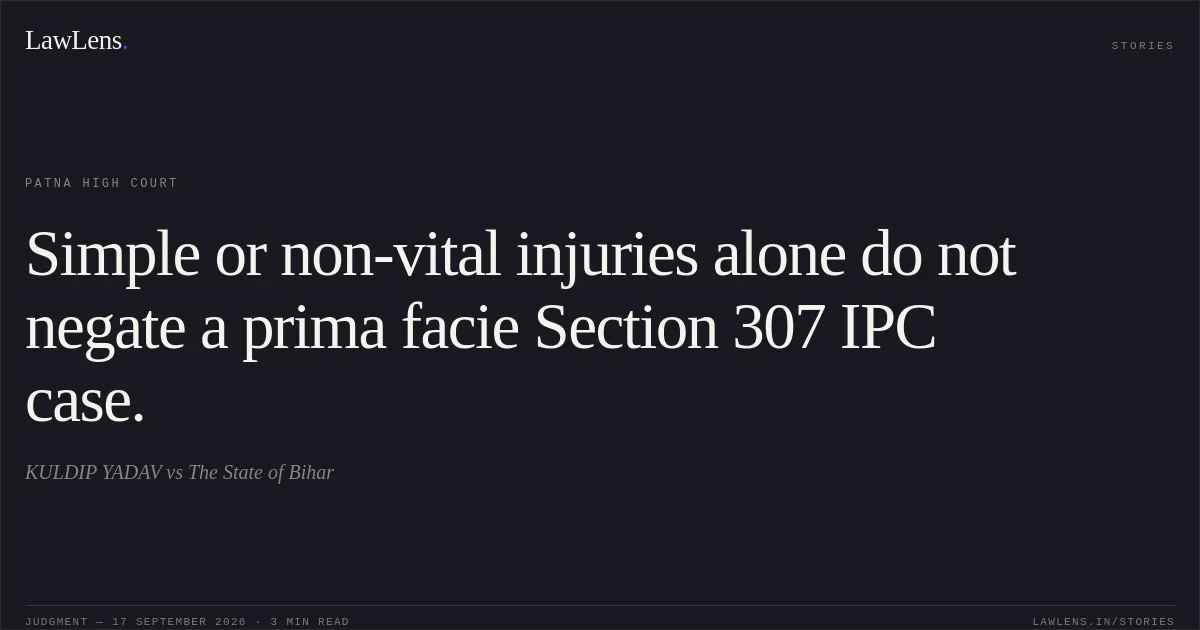
Source reference: p. 3–4; paras. 4–5Whether the nature and location of the injuries—one grievous injury on a non-vital part and one simple head injury—negated the existence of a prima facie case under Section 307 IPC against the petitioners.
Source reference: p. 3–5; paras. 5, 7, 10Whether the petitioners’ challenge involved disputed questions of fact that could be adjudicated only during trial, rather than in proceedings for quashing or discharge.
Source reference: p. 4–5; paras. 8–9Law Applied
The Court considered Section 227 CrPC, which permits discharge where the material on record does not disclose sufficient ground for proceeding against the accused, and Section 307 IPC, concerning attempt to murder, read with the other allied provisions of the IPC, including Section 34 regarding acts done in furtherance of common intention.
Source reference: p. 3–4; paras. 4, 8It relied on the principles in State of Haryana v. Bhajan Lal, 1992 Supp (1) SCC 335, concerning the limited circumstances in which criminal proceedings may be quashed.
Source reference: p. 3; para. 6The Court also considered State of Himachal Pradesh v. Shamsher Singh, 2025 INSC 503, for the principle that the nature of the injury alone is not determinative of an offence under Section 307 IPC; the weapon used, manner of assault, surrounding circumstances, and the accused’s conduct are also relevant.
Source reference: p. 4; para. 7Reasoning
The High Court held that the petitioners’ being named in the FIR, together with the injured witnesses’ allegations that they participated in the assault, disclosed sufficient prima facie material to proceed against them.
Source reference: p. 4–5; paras. 8, 10The Court rejected the argument that petitioner no. 1 could not be proceeded against merely because no specific overt act was attributed to him, observing that his alleged participation could be assessed in the context of Section 34 IPC.
Source reference: p. 4–5; para. 8It further held that the grievous injury being on a non-vital part and the other injury being simple did not, by themselves, eliminate the possibility of an offence under Section 307 IPC, since the nature of the weapon, manner of assault, and other surrounding circumstances were relevant.
Source reference: p. 4–5; paras. 5, 7, 10The petitioners’ contentions regarding false implication, the effect of the police report, and the evidentiary value of the injuries involved disputed factual matters requiring adjudication at trial.
Source reference: p. 4–5; paras. 8–9The Court also noted that the cognizance order dated 20 December 2017 had not been challenged independently.
Source reference: p. 3–5; para. 4Holding
The Court answered the issues against the petitioners and held that the allegations and materials on record could not be considered legally insufficient merely because of the location or classification of the injuries, or because petitioner no. 1 was not assigned a specific overt act.
The petition seeking quashing of the order dated 15 February 2019, by which the discharge application under Section 227 CrPC had been rejected, was dismissed as devoid of merit.
Source reference: p. 5; para. 10The trial court record, if any, was directed to be returned to the learned trial court along with a copy of the judgment.
Source reference: p. 5; para. 11Acts & Sections Cited
3 provisions across 2 statutes referred to in this judgment. Each provision opens on LawLens.
Code of Criminal Procedure, 19731
Indian Penal Code, 18602
Original Court PDF
KULDIP YADAVvsThe State of Bihar
Click to open original judgment
Original judgment, available to read, download and summarize on LawLens.in