Facts
The prosecution alleged that the respondent repeatedly teased the minor victim over mobile phone and, despite being cautioned by her father, followed her while she was returning from school on 27 September 2017 and attempted to show intimacy.
Source reference: paras. 1–5The victim lodged a written complaint on 28 September 2017, pursuant to which an FIR was registered under Section 354-D of the IPC and Sections 11(iv)/12 of the POCSO Act. The police recorded the victim’s statement under Section 164 CrPC, collected school records concerning her age, seized the respondent’s motorcycle, and filed a charge-sheet. The trial court examined seven prosecution witnesses but acquitted the respondent, finding material discrepancies and insufficient evidence to establish stalking. The State preferred the present appeal against acquittal.
Source reference: paras. 1–5Issues
Whether the prosecution proved beyond reasonable doubt that the respondent committed the offence of stalking punishable under Section 354-D of the IPC.
Source reference: paras. 9–13Whether the evidence established the offence under Sections 11(iv)/12 of the POCSO Act against the respondent.
Source reference: paras. 1, 3, 13Whether the trial court’s acquittal was so perverse or impossible as to warrant interference in an appeal against acquittal.
Source reference: paras. 14–16Law Applied
The Court applied Section 354-D of the IPC concerning stalking and Sections 11(iv)/12 of the POCSO Act concerning following or contacting a child with the requisite intent and the corresponding punishment.
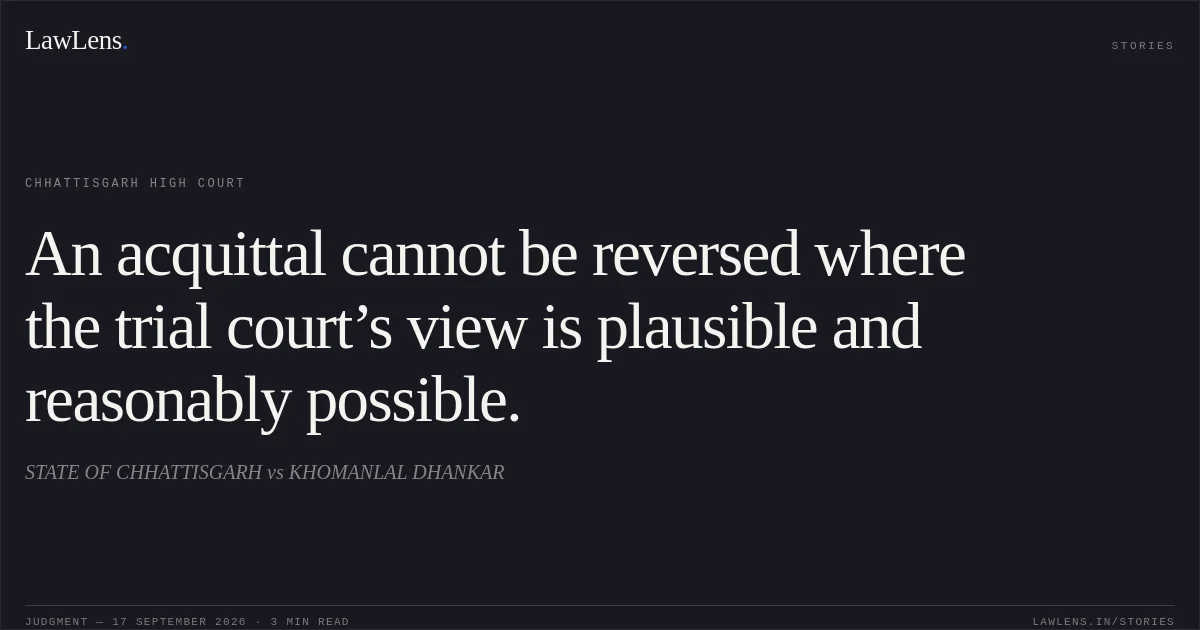
Source reference: paras. 1, 3It reaffirmed that, in an appeal against acquittal under Section 378 CrPC, the appellate court may reappraise the evidence but should interfere only where the trial court’s view is impossible, perverse, or wholly unsustainable. Where two views are reasonably possible, the view favourable to the accused must ordinarily be maintained because an acquittal reinforces the presumption of innocence. The Court relied on State of Rajasthan v. Kistoora Ram, 2022 SCC OnLine SC 984, and Jafarudheen v. State of Kerala, (2022) 8 SCC 440.
Source reference: paras. 14–16Reasoning
The High Court found that the victim was acquainted with the respondent and had admitted that she had spoken to him by telephone. She also admitted that, after her father warned the respondent, he did not meet her again, and that she had not complained immediately when she allegedly saw him near the school ground or while returning home.
Source reference: para. 10The evidence of PW-2 and PW-3 was also inconclusive: both stated that the respondent approached the victim on a motorcycle and asked why she had not called him, but they admitted that the victim did not ask them to stop and that other students were present. The trial court had additionally identified discrepancies concerning the place of occurrence, the conduct of the victim, and the circumstances in which the respondent was present at the police station. These circumstances created reasonable doubt regarding the alleged stalking and supported a plausible view of acquittal. Applying the restricted standard governing appeals against acquittal, the High Court held that merely because conviction might be another possible view was insufficient to justify interference.
Source reference: paras. 9–16Holding
The High Court answered the issues against the State. It held that the prosecution had failed to establish the offences under Section 354-D of the IPC and Sections 11(iv)/12 of the POCSO Act beyond reasonable doubt. The trial court’s view was found to be a possible and plausible view based on the evidence and was neither perverse nor legally unsustainable.
Accordingly, the State’s acquittal appeal was dismissed, and the respondent’s acquittal was affirmed.
Source reference: paras. 16–17Acts & Sections Cited
6 provisions across 2 statutes referred to in this judgment. Each provision opens on LawLens.
Protection of Children from Sexual Offences Act, 20122
Code of Criminal Procedure, 19734
Original Court PDF
STATE OF CHHATTISGARHvsKHOMANLAL DHANKAR
Click to open original judgment
Original judgment, available to read, download and summarize on LawLens.in