Facts
The petitioner, a retired Bihar Administrative Service officer, was posted as Deputy Development Commissioner, Gopalganj, in 2010.
Source reference: p. 3A Panchayat Secretary, Bhanu Pratap Chouhan, was arrested in a vigilance trap for accepting a bribe and was subsequently subjected to departmental proceedings.
Source reference: p. 3The petitioner was later charged with failing to properly scrutinise the enquiry report and with not recommending a major penalty against the Panchayat Secretary.
Source reference: pp. 3–6The Enquiry Commissioner submitted a report stating that there was no occasion to frame charges against the petitioner and that the charge memo appeared baseless.
Source reference: p. 7After the petitioner’s retirement, the proceedings were continued under Rule 43(B) of the Bihar Pension Rules.
Source reference: p. 7The State ultimately imposed withholding of 5% of his pension for five years.
Source reference: pp. 7–8In an earlier writ petition, CWJC No. 21659 of 2019, the High Court set aside the punishment order dated 08.03.2019 for non-consideration of the petitioner’s explanation and directed the disciplinary authority to pass a fresh speaking order after considering each contention raised by him.
Source reference: pp. 8–9, 14The State thereafter passed Resolution No. 4693 dated 25/28.03.2022, affirming the penalty.
Source reference: pp. 9–10The petitioner challenged that resolution in the present proceedings.
Source reference: pp. 9–10Issues
1. Whether the impugned Resolution No. 4693 dated 25/28.03.2022 was legally sustainable when it failed to consider and discuss the petitioner’s specific contentions, despite the earlier High Court direction to pass a speaking order.
Source reference: pp. 8–10, 14–152. Whether the disciplinary proceedings were without jurisdiction because the charge memo against the petitioner, a Gazetted Officer, was issued by the Collector, who was neither his appointing authority nor his disciplinary authority.
Source reference: p. 153. Whether the petitioner was entitled to quashing of the pensionary penalty and payment of consequential dues.
Source reference: pp. 15–16Law Applied
The Court applied Rule 43(B) of the Bihar Pension Rules, under which pensionary benefits may be withheld or withdrawn for proved grave misconduct or negligence after retirement.
Source reference: pp. 2, 7–8It also considered Rule 18 of the Bihar Government Servants (Classification, Control & Appeal) Rules, 2005, which requires due consideration of the enquiry report and the delinquent employee’s representation before imposition of penalty.
Source reference: p. 9The Court applied the principles of natural justice, reasoned decision-making and non-application of mind, holding that an authority must pass a speaking order dealing with the material contentions raised by the employee.
Source reference: no citationIt further applied the jurisdictional principle that disciplinary proceedings must be initiated by the competent appointing or disciplinary authority; a charge memo issued by an authority lacking such competence is without jurisdiction and cannot sustain a disciplinary proceeding.
Source reference: p. 15The Court also treated the directions issued in the earlier writ petition as binding, requiring the disciplinary authority to consider each contention in the petitioner’s explanation dated 20.12.2017.
Source reference: p. 14Reasoning
The Court found that the impugned resolution did not consider or discuss even one of the contentions raised in the petitioner’s explanation dated 20.12.2017, contrary to the express direction in the earlier judgment to pass a speaking order after such consideration.
Source reference: pp. 14–15This amounted to non-application of mind and violation of the principles governing reasoned disciplinary orders.
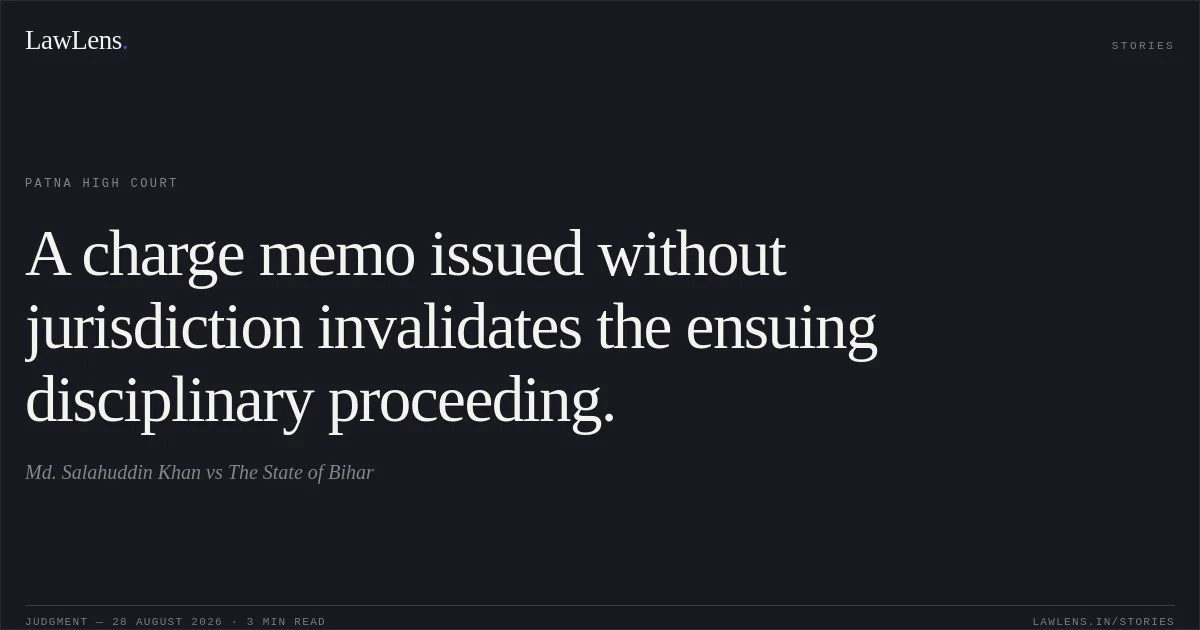
Source reference: pp. 14–15Independently, the Court held that the charge memo itself was jurisdictionally defective because the petitioner was a Gazetted Officer and the Collector who issued the memo was neither his appointing authority nor disciplinary authority.
Source reference: p. 15Since the foundation of the disciplinary proceeding was invalid, the Court considered remand inappropriate.
Source reference: pp. 15–16The failure to comply with the earlier judicial direction and the absence of jurisdiction in initiating the proceeding together rendered the penalty unsustainable.
Source reference: pp. 15–16Holding
The High Court allowed the writ petition and quashed Resolution No. 4693 dated 25/28.03.2022, by which 5% of the petitioner’s pension had been withheld for five years.
The Court declined to remand the matter for fresh consideration because the charge memo itself was without jurisdiction.
Source reference: p. 15The State respondents were directed to ensure payment of all dues payable to the petitioner within three months from receipt or production of a copy of the judgment.
Source reference: p. 16Original Court PDF
Md. Salahuddin KhanvsThe State of Bihar
Click to open original judgment
Original judgment, available to read, download and summarize on LawLens.in
![Courts will not interfere with transfers absent mala fides or violation of statutory rules.. M Ramya vs EMPLOYEES STATE INSURANCE CORPORATION (ESIC). CAT - ['Chennai']. LawLens](/stories/thumbnails/courts-will-not-interfere-with-transfers-absent-mala-fides-or-violation-of-statutory-rules-a6845e9ca6f548fca284c51c8351957f.webp)
![Courts cannot direct one-time recruitment age relaxation absent authority in the governing rules or advertisement.. UT OF PUDUCHERRY vs M ANDAL. CAT - ['Chennai']. LawLens](/stories/thumbnails/courts-cannot-direct-one-time-recruitment-age-relaxation-absent-authority-in-the-governing-895d78fde47143e2a8ed0207c4b6a44f.webp)
![A review cannot correct an allegedly erroneous decision absent an error apparent on the record.. Ajit Kumar Jha vs RAILWAY BOARD. CAT - ['Delhi']. LawLens](/stories/thumbnails/a-review-cannot-correct-an-allegedly-erroneous-decision-absent-an-error-apparent-on-the-re-8ac952fd4eba470c92f7da20af72a220.webp)