Facts
On 9 January 1997, a collision occurred between a Maruti car and a truck, resulting in the death of the Maruti car’s driver. His wife and parents filed a motor accident claim petition.
Source reference: p.1; paras. 1–3The Motor Accident Claims Tribunal attributed negligence in the ratio of 10:90 to the Maruti car driver and the truck driver respectively, assessed the deceased’s annual income at ₹3,60,000, deducted ₹36,000 towards income tax, and awarded ₹46,89,720 as compensation.
Source reference: p.1; paras. 1–3In a connected claim concerning damage to the Maruti car, the Tribunal awarded a lump sum of ₹3,60,000 based on a surveyor’s report.
Source reference: p.1; paras. 4–5Both the claimants and the insurer challenged the respective awards, disputing negligence, quantum of compensation, future prospects, house-rent entitlement, and the amount awarded for vehicle damage.
Source reference: p.2; paras. 7–9Issues
Whether the deceased driver of the Maruti car was negligent to the extent of 10%, or whether the truck driver alone was responsible for the accident?
Source reference: p.3; para. 10Whether the Tribunal correctly assessed the deceased’s income and whether house-rent benefits under his employment agreement and future prospects were includible in the computation of loss of dependency?
Source reference: pp.3–4; paras. 11–16What amount were the claimants entitled to under the heads of loss of future income, consortium, loss of estate and funeral expenses?
Source reference: p.4; paras. 15–17Whether the award of ₹3,60,000 for damage to the Maruti car was sustainable in the absence of proof of repairs or expenditure incurred by the claimants?
Source reference: pp.4–5; paras. 18–20Law Applied
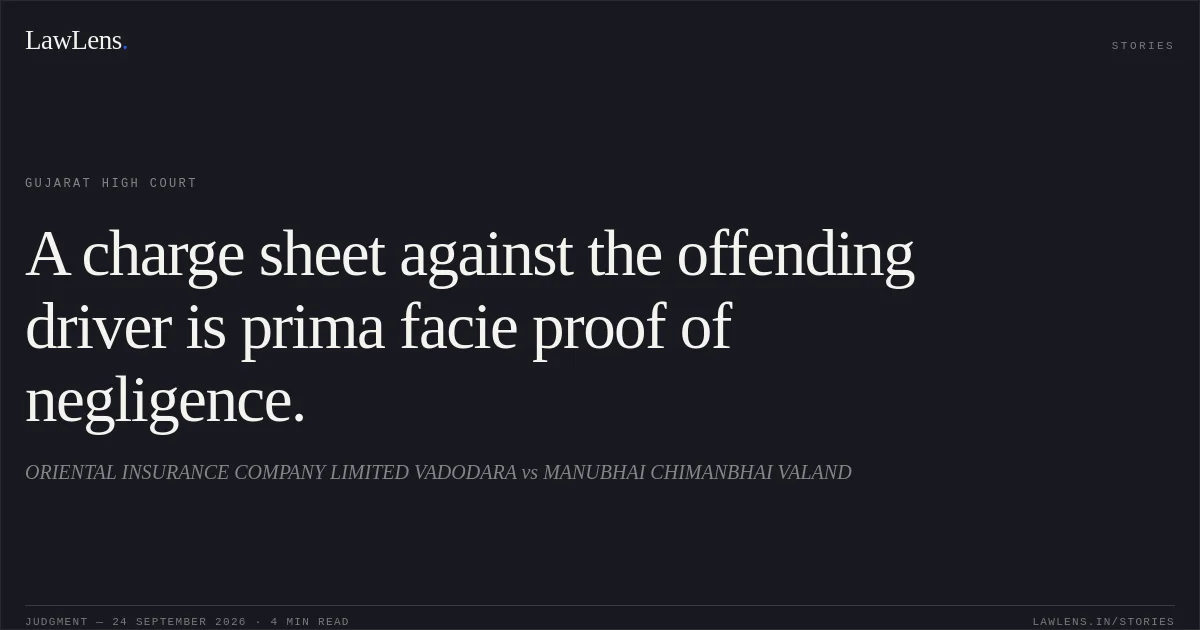
The Court applied the principle in Mangla Ram v. Oriental Insurance Company, 2018 (5) SCC 656, that filing of a charge-sheet against the driver of the offending vehicle constitutes prima facie proof of negligence.
Source reference: p.3; para. 10For computation of compensation, it applied National Insurance Co. Ltd. v. Pranay Sethi, AIR 2017 SC 5157, under which a deceased having a permanent job and aged below 40 years is entitled to 40% addition towards future prospects, along with the applicable multiplier and conventional heads of compensation.
Source reference: p.4; paras. 15–17It also relied on Reena v. Managing Director, Karnataka State Road Transport Corporation, 2026 (0) AIJEL-SC 77486, for the amounts payable towards consortium and other non-pecuniary damages.
Source reference: p.4; para. 17The compensation for property damage was governed by the requirement that the claimant establish actual loss or expenditure, while permitting a reasonable assessment based on the proved circumstances of the vehicle’s ownership and loss.
Source reference: pp.4–5; paras. 18–20Reasoning
The Court held that the charge-sheet against the truck driver constituted prima facie evidence of his negligence, and the insurer failed to rebut that inference because the truck driver was not examined to establish negligence on the part of the deceased Maruti driver. Accordingly, the 10% contributory negligence attributed to the deceased was set aside and the truck driver was held solely responsible.
Source reference: p.3; para. 10The Court upheld the annual income of ₹3,60,000 and the 10% income-tax deduction, arriving at a net income of ₹3,24,000; however, it rejected the claim for house-rent benefits because neither actual payment by the deceased nor payment by the company was proved.
Source reference: pp.3–4; paras. 11–14Since the deceased was 28 years old and in permanent employment, 40% future prospects were added, producing an annual income of ₹4,53,600. After deducting one-third for personal expenses and applying a multiplier of 17, loss of future income was calculated at ₹51,40,800.
Source reference: p.4; paras. 15–16The Court further awarded ₹1,56,000 for consortium and other non-pecuniary losses, ₹19,500 for loss of estate and ₹19,500 for funeral expenses.
Source reference: p.4; para. 17Regarding the car, the Tribunal’s lump-sum award was rejected because there was no proof that the vehicle had been repaired or that the claimants had incurred repair expenses; nevertheless, considering the car’s ownership, purchase in 1995 and the payments made towards it, the Court awarded ₹1,50,000 as reasonable compensation for its loss.
Source reference: pp.4–5; paras. 18–20Holding
The appeals were disposed of by holding that the truck driver alone was responsible for the accident.
The claimants were held entitled to ₹53,35,800 for the death claim, comprising ₹51,40,800 for loss of future income, ₹1,56,000 for consortium, ₹19,500 for loss of estate and ₹19,500 for funeral expenses.
Source reference: p.5; para. 21This resulted in an enhancement of ₹6,46,080 over the Tribunal’s award of ₹46,89,720.
Source reference: p.5; para. 21The award of ₹3,60,000 for damage to the Maruti car was substituted with ₹1,50,000; the Registry was directed to refund the balance amount after disbursing that sum to the claimants.
Source reference: p.6; paras. 23–24Interest at 9% per annum was maintained, and the insurer was directed to deposit the enhanced compensation with interest within eight weeks of receiving the judgment.
Source reference: p.6; paras. 22, 25Original Court PDF
ORIENTAL INSURANCE COMPANY LIMITED VADODARAvsMANUBHAI CHIMANBHAI VALAND
Click to open original judgment
Original judgment, available to read, download and summarize on LawLens.in