Facts
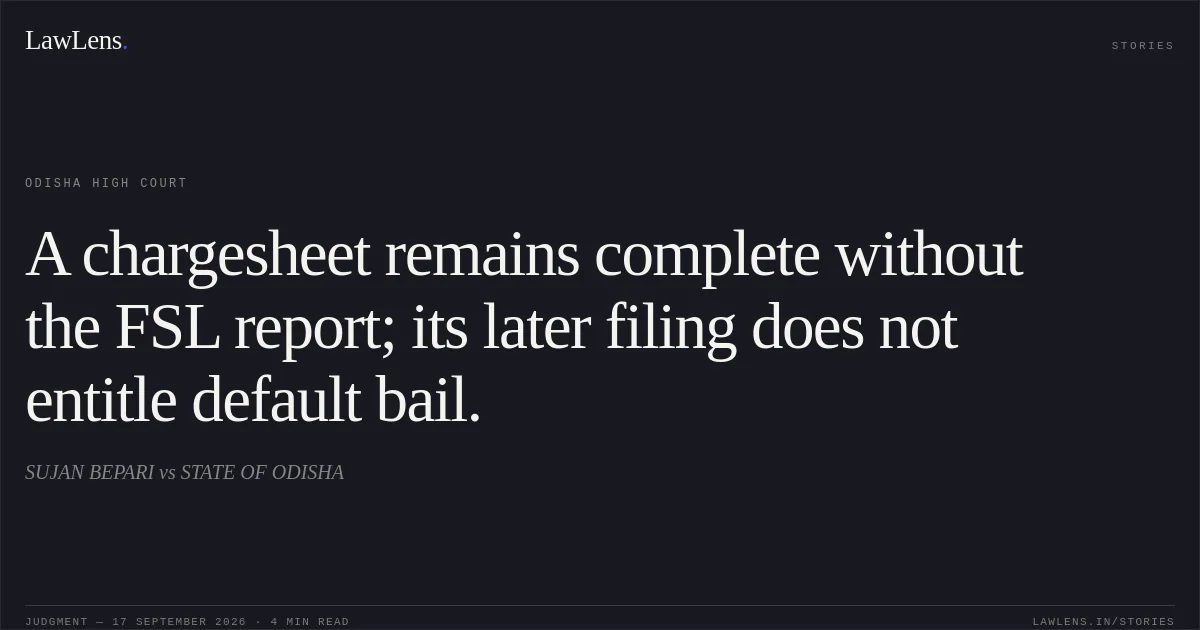
The petitioner was arrested in Malkangiri P.S. Case No. 248 of 2025 for alleged offences under Sections 20(b)(ii)(C), 25 and 29 of the NDPS Act, 1985, after approximately 1,000 kg of ganja was allegedly recovered from vehicles intercepted during a motor-vehicle check.
Source reference: p.2The petitioner was alleged to be the driver of one of the vehicles and remained in judicial custody from 20 May 2025.
Source reference: p.2A preliminary chargesheet was filed on 14 November 2025, one day before expiry of the 180-day period prescribed for investigation in a commercial-quantity NDPS case. However, the chargesheet was not accompanied by the chemical examination/FSL report.
Source reference: pp.2–3The petitioner consequently sought default bail under Section 187(3) of the BNSS, contending that the investigation remained incomplete without the forensic report. The Special Court rejected the application on 15 November 2025.
Source reference: pp.2–3During the revision proceedings, the State produced a final chargesheet filed in May 2026 and the subsequently received chemical examination report, which confirmed that the seized substance consisted of flowering and fruiting tops of the cannabis plant, namely ganja.
Source reference: pp.3–4, 14–15Issues
1. Whether a chargesheet filed within the prescribed statutory period, but without the FSL/chemical examination report concerning seized contraband, constitutes an incomplete chargesheet and entitles the accused to default bail under Section 187(3) of the BNSS read with Section 36-A(4) of the NDPS Act?
Source reference: pp.4–8, 10–142. Whether the petitioner was entitled to interim bail merely because the question of default bail in cases involving a chargesheet filed without a forensic report was pending consideration before a Larger Bench of the Supreme Court?
Source reference: pp.4–5, 10, 14–15Law Applied
The Court applied Section 187(3) of the BNSS, corresponding to the default-bail mechanism under Section 167(2) of the CrPC, under which an accused acquires a statutory right to bail if the investigation is not completed and the chargesheet is not filed within the prescribed period.
Source reference: pp.8–9Section 36-A(4) of the NDPS Act governs the extended period for investigation in commercial-quantity cases.
Source reference: pp.8–9The Court relied on Ritu Chhabaria v. Union of India, which held that investigation must be completed before filing the chargesheet within the statutory period; Union of India v. Thamisharasi, holding that continued custody beyond the prescribed period without offering default bail violates Article 21; and Sanjay Dutt v. State, concerning the accrual and loss of the default-bail right after filing of the chargesheet.
Source reference: pp.8–9It also considered Dablu Kujur v. State of Jharkhand, concerning non-compliance with the requirements of Section 173(5) CrPC, but followed the principle in CBI v. Kapil Wadhawan that a chargesheet is not invalid merely because further investigation remains pending or some documents are filed later, provided the material accompanying it enables the Court to take cognizance.
Source reference: pp.9–10The Court further relied on State of Maharashtra v. Saradchandra Vinayak Dongre and Sharif Ahmed v. State of U.P. for the proposition that cognizance may be taken on the basis of the material filed with the chargesheet, even where a particular scientific or serological report is subsequently supplied.
Source reference: pp.6–7, 9–10Reasoning
The Court held that the absence of the FSL report did not, on the facts of the case, render the preliminary chargesheet non est or legally incomplete.
Source reference: pp.10–12The chargesheet had been filed within the prescribed 180-day period and was accompanied by other relevant investigative materials sufficient for the Special Court to form a prima facie opinion and take cognizance of the alleged offences.
Source reference: pp.10–12Although the chemical report was important, particularly because it confirmed that the seized substance was ganja and therefore attracted the NDPS Act, its later submission did not retrospectively invalidate the chargesheet or prevent cognizance from being taken.
Source reference: pp.11–14The Court distinguished the statutory right to default bail from the evidentiary sufficiency required at later stages, observing that the FSL report could be considered at the stage of framing of charge and trial rather than being treated as an indispensable precondition to cognizance.
Source reference: pp.11–13It also declined to grant interim bail, reasoning that the Supreme Court’s pending consideration of the issue did not amount to a direction that all similarly situated accused must be released, and that the petitioner could not claim interim release as a matter of right.
Source reference: pp.4–5, 14–15Holding
The Court answered both issues against the petitioner.
It held that the preliminary chargesheet filed on 14 November 2025 was a valid chargesheet for the purpose of defeating the claim for default bail, notwithstanding the absence of the FSL report.
Source reference: pp.14–15The subsequent receipt of the chemical examination report and filing of the final chargesheet further supported the conclusion that the investigation had been completed and that the seized substance was ganja.
Source reference: pp.14–15The petitioner was therefore held not entitled either to default bail under Section 187(3) of the BNSS or to interim bail.
Source reference: paras. 14–16The criminal revision was dismissed and the order of the Special Court dated 15 November 2025 was left undisturbed.
Source reference: paras. 14–16Acts & Sections Cited
7 provisions across 3 statutes referred to in this judgment. Each provision opens on LawLens.
Bharatiya Nagarik Suraksha Sanhita, 20232
Narcotic Drugs and Psychotropic Substances Act, 19853
Code of Criminal Procedure, 19732
Original Court PDF
SUJAN BEPARIvsSTATE OF ODISHA
Click to open original judgment
Original judgment, available to read, download and summarize on LawLens.in