Facts
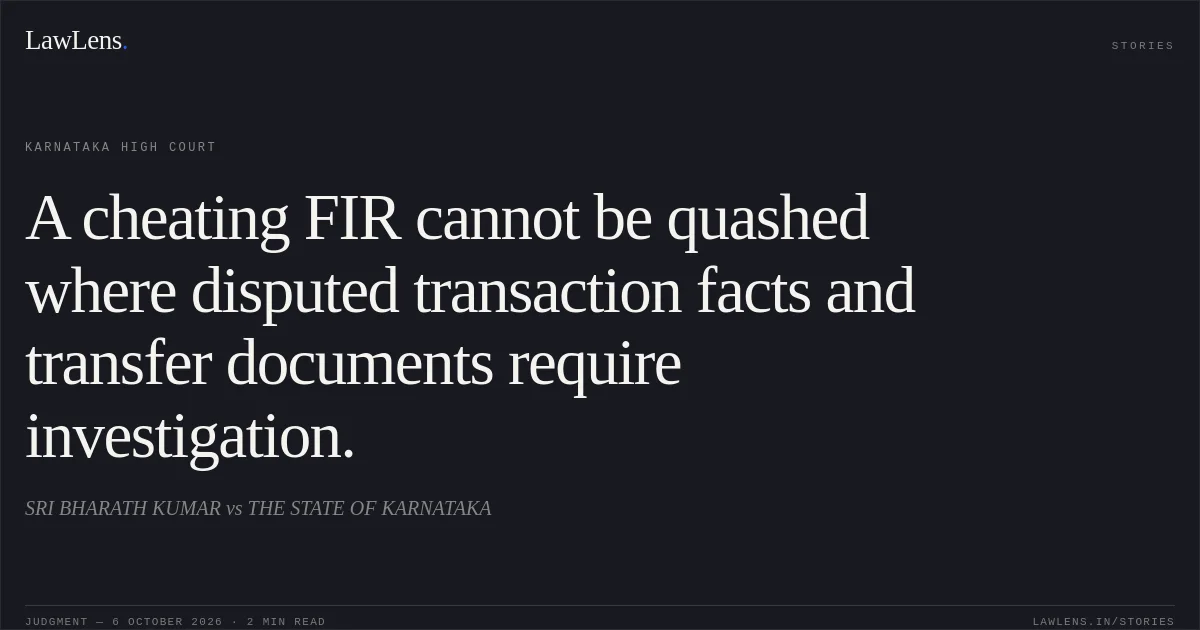
Respondent No. 2 alleged that the petitioner obtained her car on the pretext of taking his unwell mother to hospital, failed to return it despite demand, and later claimed it had been sold to him.
Source reference: para. 3–4, 23The petitioner relied on payments of ₹2 lakh and ₹3 lakh made in March 2020 and Forms 29 and 30 to assert that the vehicle had been sold to him. Respondent No. 2 disputed the purpose of the payments and alleged that her signatures on the forms were forged; the RTO had also rejected the transfer application.
Source reference: para. 5–9Following a private complaint, Madanayakanahalli Police registered Crime No. 702/2024 under Sections 406 and 420 IPC. In the High Court, respondent No. 2 submitted that the prosecution would be confined to Section 420 IPC.
Source reference: para. 2, 13, 28The petitioner sought quashing of the proceedings under Section 482 CrPC (Section 528 BNSS).
Source reference: para. 1–2Issues
Whether the complaint and material available at the threshold ruled out an offence under Section 420 IPC, warranting quashing of the proceedings.
Source reference: para. 12Whether the disputed transaction, payment purpose, and authenticity of Forms 29 and 30 could be determined in a quashing petition, or required investigation.
Source reference: para. 19–24Law Applied
The Court considered Section 420 IPC and the High Court’s quashing jurisdiction under Section 482 CrPC (Section 528 BNSS).
Source reference: para. 1, 12–14At the quashing stage, the Court examines whether the allegations, taken at face value, disclose an offence and whether continuation of the investigation would amount to an abuse of process; it does not decide which of competing factual versions is correct.
Source reference: para. 24The existence of a civil or contractual dispute does not, by itself, exclude criminal liability where the ingredients of an offence may otherwise be disclosed.
Source reference: para. 26Reasoning
The petitioner’s account—that the payments were consideration for the vehicle and that the forms evidenced a sale—could bear on whether he had dishonest intent from the outset, but the complainant disputed both the payment purpose and the genuineness of the forms.
Source reference: para. 16–20The timing of Form 29, the alleged forgery, the rejected transfer application, and the circumstances in which the petitioner obtained and retained the vehicle raised factual questions requiring investigation.
Source reference: para. 17–23As those matters could not be resolved on the limited record, the allegations were neither inherently impossible nor so improbable as to make investigation an abuse of process.
Source reference: para. 25, 29–31Holding
The Court held that the petitioner had not established grounds to quash the proceedings under Section 420 IPC at that stage.
It dismissed the petition and directed that the investigation proceed in accordance with law; if a charge sheet is filed, the petitioner may challenge it or seek discharge.
Source reference: para. 32–33Acts & Sections Cited
6 provisions across 3 statutes referred to in this judgment. Each provision opens on LawLens.
Code of Criminal Procedure, 19731
Bharatiya Nagarik Suraksha Sanhita, 20233
Indian Penal Code, 18602
Original Court PDF
SRI BHARATH KUMARvsTHE STATE OF KARNATAKA
Click to open original judgment
Original judgment, available to read, download and summarize on LawLens.in