Facts
The appellant was awarded a contract in 1988 to execute balance work at Wangat Weir.
Source reference: p. 3–10The contract was terminated in 1998, after which the appellant claimed, among other amounts, payment for restoration work and flood damages, the final bill, and refund of security and earnest money deposits.
Source reference: p. 3–10A sole arbitrator awarded several sums, including those claims; an interim award for escalation charges had separately attained finality.
Source reference: p. 3–10On the respondents’ application under Section 34 of the Arbitration and Conciliation Act, the Single Judge set aside the final award, except for the arbitrator’s fee, holding the claims time-barred, while preserving the appellant’s entitlement under the interim award.
Source reference: p. 3–10The appellant challenged that decision under Section 37.
Source reference: p. 3–10He argued, among other things, that a 2000 departmental communication deferred payment pending civil litigation, and that the dismissal of that litigation and preparation of a final bill in 2011 gave rise to a fresh cause of action.
Source reference: p. 10–14Issues
Whether the claims set aside by the Single Judge were barred by limitation, including whether the 2000 communication deferred accrual of the cause of action until the civil suit ended in 2011.
Source reference: p. 8–9, 16–22Whether preparation of the final bill in 2011 amounted to an acknowledgment of liability that began a fresh limitation period.
Source reference: p. 22–23Whether the respondents waived their limitation objection by not raising it in the Section 11 proceedings or before the arbitrator, or by failing to invoke Section 16 of the Act.
Source reference: p. 24–26Law Applied
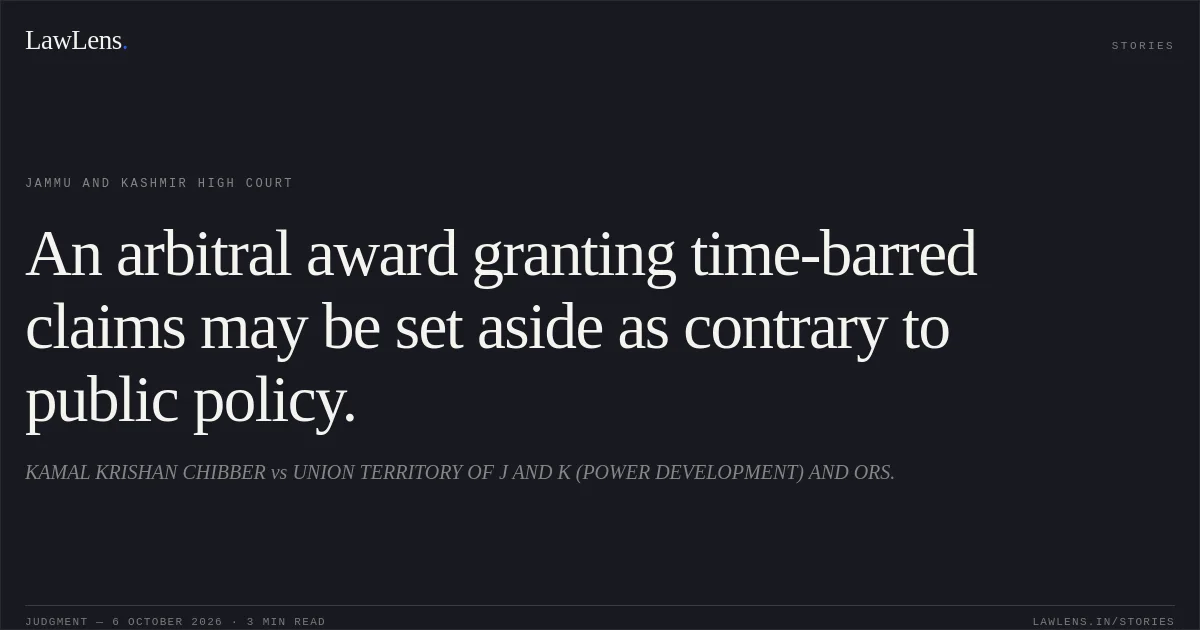
Section 43 of the Arbitration and Conciliation Act, 1997 applies the Limitation Act to arbitration proceedings; entertaining a time-barred claim may render an award vulnerable to challenge under Section 34(2)(b)(ii) as contrary to public policy.
Source reference: p. 23–24Under Section 19 of the J&K Limitation Act, Samvat 1995, a fresh limitation period runs from a written acknowledgment of liability only if the acknowledgment is made before expiry of the prescribed period.
Source reference: p. 22In Bharat Sanchar Nigam Ltd. v. Nortel Networks India Pvt. Ltd., (2021) 5 SCC 738, the Supreme Court distinguished a limitation objection, which concerns the admissibility or maintainability of a claim, from an objection to the arbitral tribunal’s jurisdiction; limitation is for the tribunal to decide, and failure to raise it under Section 16 does not, by itself, amount to waiver.
Source reference: p. 24–26The Court also considered M/s B&T AG v. Ministry of Defence, (2023) 7 SCR 599, and M/s Arif Azim Co. Ltd. v. M/s Aptech Ltd., 2024 INSC 155, in upholding the Single Judge’s approach.
Source reference: p. 26Reasoning
The Court read the 12 September 2000 communication as rejecting the claims for restoration work and diversion bunds, while stating only that the final bill and certain outstanding amounts would be considered after the civil proceedings. It therefore did not defer the entire set of claims.
Source reference: p. 17–20Further, the appellant had obtained clarification in 2005 that no court order restrained payment, yet did not invoke arbitration until 2013; even on the appellant’s account, the claims were then out of time.
Source reference: p. 20–22The 2011 bill did not revive the claims: its preparation, without approval by the competent authority, was not an acknowledgment of liability, and in any event occurred after the claims had become time-barred.
Source reference: p. 22–23Applying BSNL v. Nortel, the Court rejected the waiver arguments: the limitation objection was not a jurisdictional challenge requiring invocation of Section 16, and the respondents’ participation did not waive it.
Source reference: p. 24–26Holding
The Court held that the claims set aside by the Single Judge were time-barred and found no error warranting interference under Section 37.
It dismissed the appeal without costs, leaving undisturbed the appellant’s entitlement to Rs. 21,43,536 under the finalised interim award and the arbitrator’s fee as preserved by the Single Judge.
Source reference: p. 9–10, 26–27Acts & Sections Cited
1 provisions across 1 statute referred to in this judgment. Each provision opens on LawLens.
Indian Contract Act, 18721
Original Court PDF
KAMAL KRISHAN CHIBBERvsUNION TERRITORY OF J AND K (POWER DEVELOPMENT) AND ORS.
Click to open original judgment
Original judgment, available to read, download and summarize on LawLens.in