Facts
On 10 April 2013, police searched a pick-up van owned by the petitioner and allegedly recovered about two tonnes of iron ore concealed beneath 500 kg of iron scrap.
Source reference: no citationThe petitioner and the van’s driver were charged under Section 414 of the Indian Penal Code (IPC) and Sections 4/21 of the MMDR Act; the trial court convicted the petitioner under Section 414 IPC but acquitted the driver.
Source reference: para. 3, p. 2The Sessions Judge dismissed the petitioner’s appeal and affirmed his conviction and sentence of two years’ rigorous imprisonment and a fine of Rs. 1,000.
Source reference: paras. 2, 4, pp. 1–2In revision, the petitioner challenged the recovery evidence, arguing that the seizure witnesses did not support the alleged seizure and that the conviction rested on police testimony alone.
Source reference: para. 5, p. 2The State relied on the limited scope of revisional review and the concurrent findings below.
Source reference: para. 6, p. 3Issues
1. Whether the concurrent conviction under Section 414 IPC warranted interference in revision where the seizure witnesses did not support the alleged seizure, but police witnesses testified to it.
Source reference: paras. 5, 9–15, pp. 2–3, 5–72. Whether the substantive sentence should be modified in light of the time elapsed since the occurrence and the petitioner’s period in custody.
Source reference: para. 16, p. 7Law Applied
Section 414 IPC criminalises voluntarily assisting in concealing, disposing of, or making away with property known or reasonably believed to be stolen; conviction does not require the principal thief to be identified or convicted, provided the prosecution establishes that the property was stolen and that the accused assisted in its concealment or disposal (Ajendranath v. State of M.P., 1963 SCC OnLine SC 69).
Source reference: para. 14, pp. 6–7Under State of Kerala v. Puttumana Illath Jathavedan Namboodiri, (1999) 2 SCC 452, revisional jurisdiction is supervisory, not a second appeal, and ordinarily does not permit reappreciation of evidence absent a glaring feature resulting in gross miscarriage of justice.
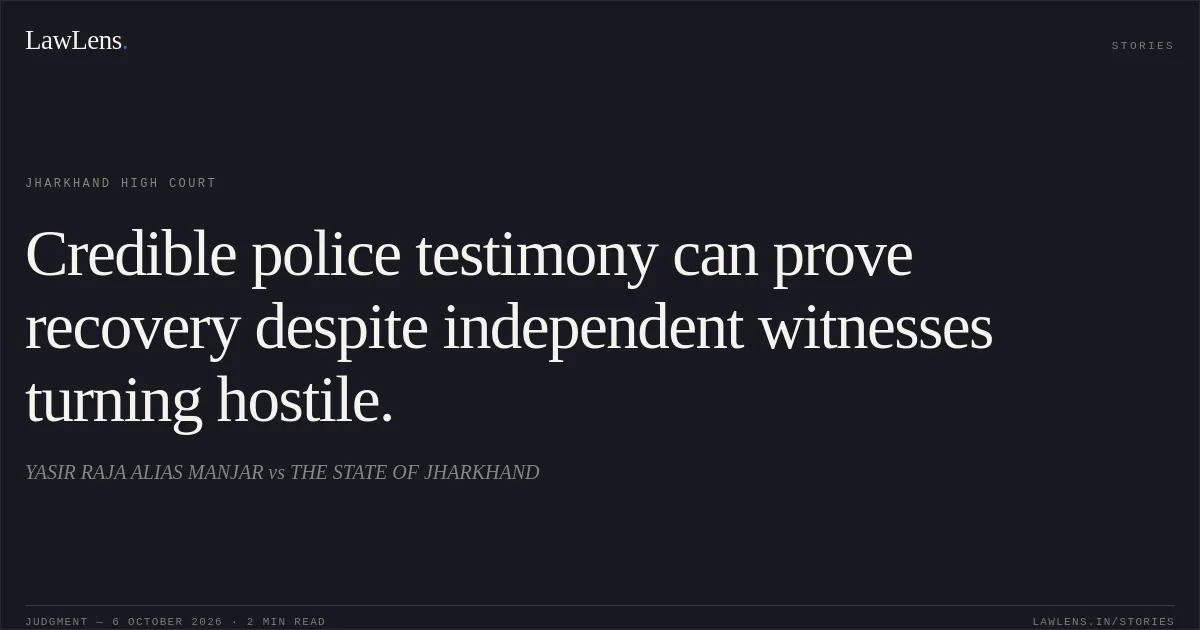
Source reference: para. 9, pp. 3–4Police testimony is not inherently unreliable merely because it lacks independent corroboration and may be relied upon if credible (Kripal Singh v. State of Rajasthan, (2019) 5 SCC 646).
Source reference: para. 13, pp. 5–6Reasoning
The Court found that the seizure witnesses proved their signatures on the seizure list but did not support the prosecution account of the search and seizure; the police witnesses, however, consistently testified to the recovery and preparation of the seizure list.
Source reference: paras. 10–12, pp. 4–5Applying Kripal Singh, the Court held that the police evidence could not be rejected solely because independent witnesses turned hostile.
Source reference: para. 13, pp. 5–6It also noted that the petitioner’s ownership of the vehicle was admitted, the recovery was not specifically denied in cross-examination, and no evidence supporting his plea of alibi had been produced.
Source reference: paras. 13–15, pp. 5–7Finding no basis for revisional interference with the concurrent findings, the Court nevertheless considered the 2013 occurrence, the more than 13 years of litigation, and the petitioner’s custody when determining sentence.
Source reference: paras. 15–16, p. 7Holding
The Court upheld the conviction under Section 414 IPC but partly allowed the revision by modifying the substantive sentence to the period already undergone.
The fine of Rs. 1,000 and the default sentence remained unchanged; the petitioner was directed to pay the fine within ten weeks if unpaid, and, being on bail, was discharged from his bail bonds.
Source reference: paras. 17–19, pp. 7–8Acts & Sections Cited
4 provisions across 3 statutes referred to in this judgment. Each provision opens on LawLens.
Indian Penal Code, 18601
Mines and Minerals (Development and Regulation) Act, 19572
Code of Criminal Procedure, 19731
Original Court PDF
YASIR RAJA ALIAS MANJARvsTHE STATE OF JHARKHAND
Click to open original judgment
Original judgment, available to read, download and summarize on LawLens.in