01Facts
The complainant alleged that he lent the accused ₹9,00,000 on 18 May 2019—₹7,44,000 in cash and ₹1,56,000 by cheque—and that the accused subsequently issued four cheques, the last dated 27 June 2022 for ₹9,00,000.
¶ 3–5The cheques were dishonoured, and the complainant issued a statutory notice before filing a complaint under Section 138 of the Negotiable Instruments Act, 1881 (NI Act).
¶ 3–5The Magistrate convicted the accused and ordered payment of a fine of ₹9,05,000, including ₹9,00,000 as compensation.
¶ 7On the accused’s appeal, the Sessions Court set aside the conviction and acquitted him.
¶ 8The complainant appealed to the High Court, seeking restoration of the Magistrate’s judgment.
¶ 1, 802Issues
i.1. Whether the Appellate Court failed to properly appreciate the evidence and erred in setting aside the Magistrate’s conviction and sentence
¶ 9ii.2. Whether the complainant established grounds for the High Court to interfere with the acquittal and convict the accused under Section 138 of the NI Act
¶ 903Law Applied
Section 138 of the NI Act applies where a cheque is issued in discharge of a legally enforceable debt or liability and the statutory requirements for dishonour, notice, and non-payment are met.
¶ 29Section 139 creates a rebuttable presumption in favour of the cheque holder; the accused may rebut it on a preponderance of probabilities, including by relying on the complainant’s evidence, and need not necessarily adduce defence evidence.
¶ 13, 31–33The Court referred to Rangappa v. Mohan, (2010) 11 SCC 441; Rajaram v. Maruthachalam, 2023 LiveLaw (SC) 46; MMTC Ltd. v. Medchi Chemicals & Pharma (P) Ltd., (2002) 1 SCC 234; and Kumar Exports v. Sharma Carpets, (2009) 2 SCC 513, in considering the presumption and its rebuttal.
¶ 30–33It also applied the requirement that the debt be legally recoverable when the cheque is issued.
¶ 28–29Provisions in the judgment · 9 · Linked ones open on LawLens
Bharatiya Nagarik Suraksha Sanhita, 2023 Section 419
Code of Criminal Procedure, 1973 Section 378Section 200Section 313Section 357
Negotiable Instruments Act, 1881 Section 138Section 139Section 20Section 87
04Reasoning
The High Court concluded that the complainant’s own testimony supported the defence that the accused had borrowed only ₹2,00,000, had given a promissory note and six blank cheques for that transaction, and had received ₹1,56,000 by cheque after deduction of interest.
¶ 15–16, 26, 32The complainant admitted that the cheque contents were in his handwriting, which the Court considered consistent with the cheques having been filled in later.
¶ 17The Court also regarded the repeated alleged lending and cheque exchanges, the absence of a loan agreement, and the complainant’s account of advancing further cash after earlier cheques had been dishonoured as undermining the asserted ₹9,00,000 loan.
¶ 14, 19–20Further, it found the alleged later cheques drawn on the State Bank of Hyderabad implausible because that bank had merged with the State Bank of India in 2017.
¶ 21, 27, 36On these circumstances, it held that the accused had rebutted the Section 139 presumption.
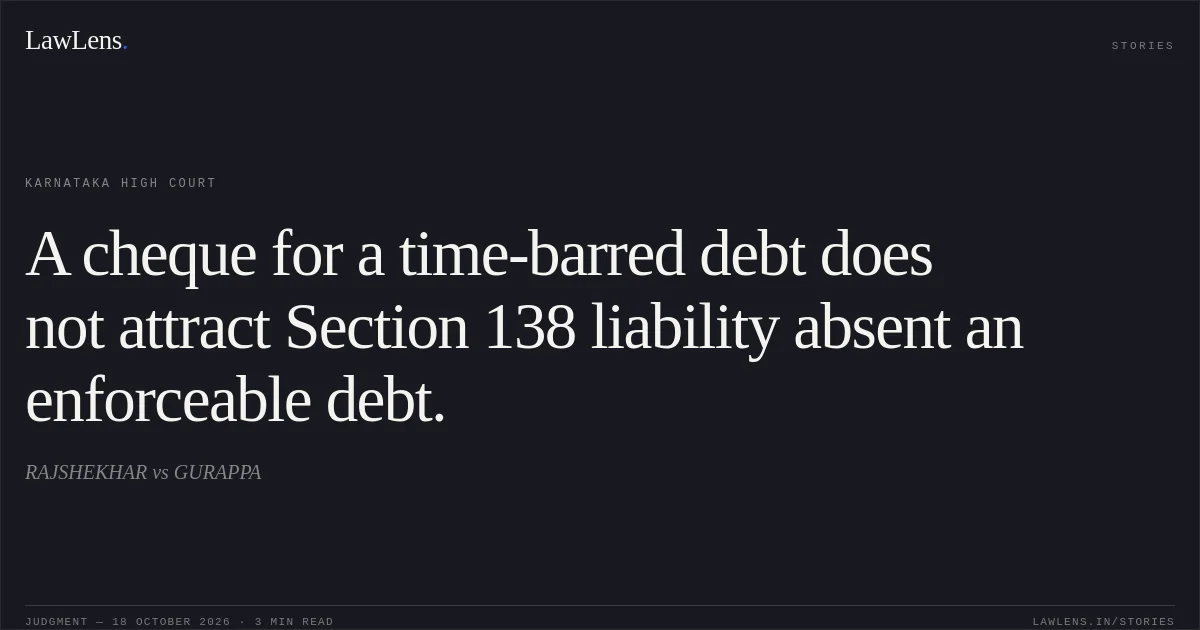
¶ 28–29, 33, 38It additionally found that the alleged debt was time-barred by the date of the final cheque and therefore not legally recoverable.
¶ 28–29, 33, 3805Holding
The High Court answered both issues in the negative, holding that the complainant had shown no error in the Appellate Court’s assessment and no basis to disturb the acquittal.
¶ 39–40It dismissed the criminal appeal, confirmed the Sessions Court’s judgment, set aside the Magistrate’s conviction and sentence, and affirmed the accused’s acquittal under Section 138 of the NI Act.
¶ 40Original Court PDF
RAJSHEKHARvsGURAPPA
Click to open original judgment
Original judgment, available to read, download and summarize on LawLens.in