Facts
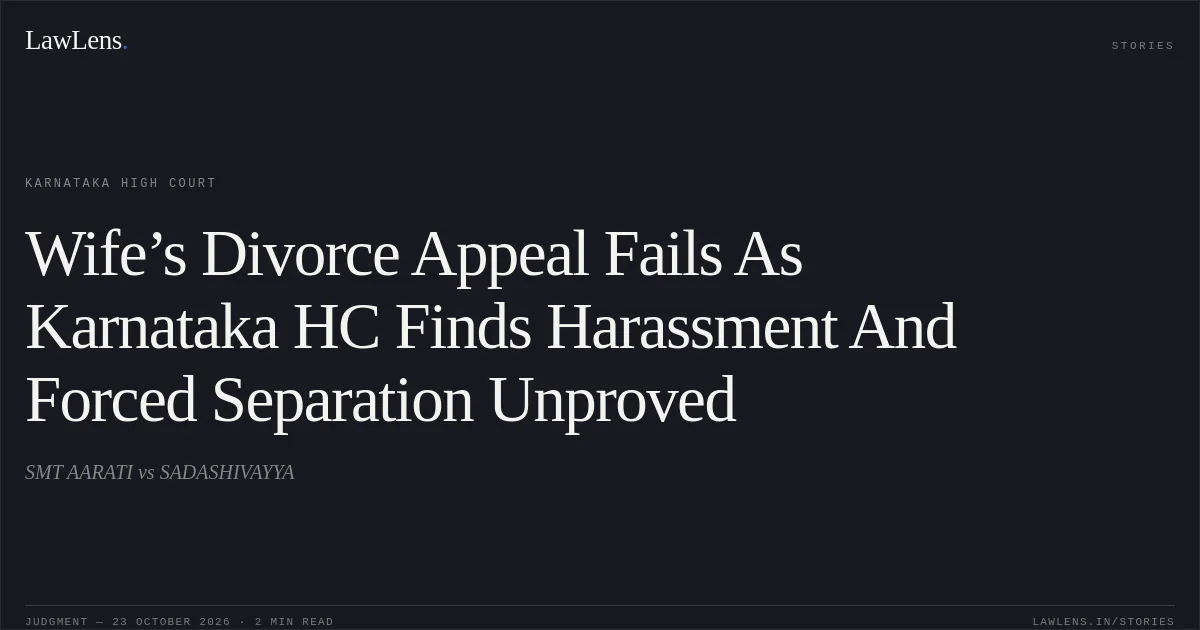
The wife filed a petition under Section 13(1)(ib) of the Hindu Marriage Act, 1955, seeking divorce on the ground of desertion.
Source reference: para. 4–7, 18She alleged that her husband harassed her, demanded money and gold, took her salary, and refused to resume cohabitation; the parties have a son.
Source reference: para. 4–7, 18The husband denied the allegations and maintained that the parties had lived together and that he had supported the wife.
Source reference: para. 8–11The Family Court dismissed the petition.
Source reference: no citationOn appeal under Section 19(1) of the Family Courts Act, the wife challenged that decision.
Source reference: para. 1, 13–14Issues
1. Whether the Family Court properly appreciated the materials available on record.
Source reference: para. 172. Whether the Family Court’s judgment dismissing the divorce petition warranted interference.
Source reference: para. 17Law Applied
Under Section 13(1)(ib) of the Hindu Marriage Act, desertion must be established for a continuous period of at least two years immediately preceding presentation of the petition.
Source reference: para. 22The Court stated that matrimonial pleadings must be considered by their substance, not merely by the statutory provision cited; allegations of harassment may be relevant to whether a spouse had reasonable cause to live separately.
Source reference: para. 20–22However, a decree on cruelty as an independent ground ordinarily requires adequate pleadings and a fair opportunity for the opposing party to meet that case.
Source reference: para. 23–26Oral evidence of matrimonial abuse must be assessed with care; lack of corroboration alone does not justify rejecting otherwise credible testimony, and delay in making a complaint is not, by itself, a basis to disbelieve the complainant.
Source reference: para. 32–33, 39–42Reasoning
The Court considered the pleaded desertion claim alongside the wife’s allegations of harassment, which the husband had denied.
Source reference: para. 21–27It found material allegations in her examination-in-chief—including suspicion of infidelity and an assault after a panchayat—had not been pleaded, and therefore treated those improvements cautiously.
Source reference: para. 29–33The Court also weighed the delayed police complaint, the absence of testimony from family members said to have been told of the incident, and the photographs, whose timing and circumstances were not established; it did not treat any one of these matters as conclusive.
Source reference: para. 36–44, 49–50It further considered inconsistencies in the wife’s account of the fixed deposit, evidence that the husband had held work-related positions and owned agricultural land, and the lack of supporting bank records for the alleged withdrawal of her salary.
Source reference: para. 54–62, 67–72On the record as a whole, the Court found the allegations of harassment and the claim that the wife had been compelled to leave the matrimonial home insufficiently established.
Source reference: para. 73–76Holding
The High Court answered the first issue in the affirmative and the second in the negative.
It held that the Family Court was justified in dismissing the petition and dismissed the wife’s appeal, leaving the judgment and decree dated 16 April 2025 undisturbed.
Source reference: para. 77–78Acts & Sections Cited
2 provisions across 2 statutes referred to in this judgment. Each provision opens on LawLens.
Family Courts Act, 19841
Hindu Marriage Act, 19551
Original Court PDF
SMT AARATIvsSADASHIVAYYA
Click to open original judgment
Original judgment, available to read, download and summarize on LawLens.in