Facts
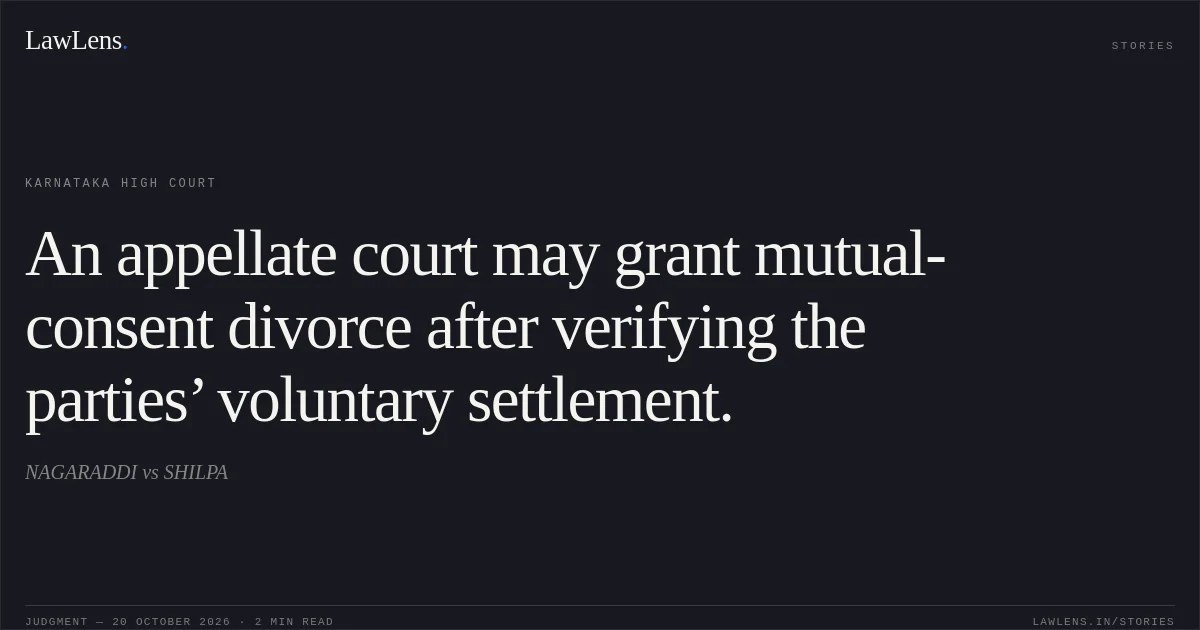
The husband appealed under Section 19(1) of the Family Courts Act, 1984, against the Family Court’s judgment dated 19 January 2023 dismissing his petition for divorce under Sections 13(1)(ia) and 13(1)(ib) of the Hindu Marriage Act, 1955.
Source reference: p. 1; para. 1During the appeal, the parties filed a joint settlement providing, among other terms, for payment of ₹30,00,000 as permanent alimony and the wife’s withdrawal of cases pending against the husband.
Source reference: p. 3; para. 2They then jointly sought dissolution of their marriage by mutual consent under Section 13B, stating that they had lived separately for about ten years and that the marriage had irretrievably broken down.
Source reference: pp. 4–5; para. 3The parties appeared before the Court, confirmed the settlement and consented to divorce voluntarily.
Source reference: p. 6; para. 4Issues
Whether the parties’ joint petition for divorce by mutual consent under Section 13B of the Hindu Marriage Act could be accepted and the marriage dissolved in the appeal.
Source reference: pp. 5–6; paras. 3–5Whether the Family Court’s judgment should be substituted by a decree dissolving the marriage in accordance with the parties’ compromise.
Source reference: p. 7; para. 6Law Applied
Section 13B of the Hindu Marriage Act, 1955 provides for divorce by mutual consent.
Source reference: p. 6; para. 5The Court also referred to Amardeep Singh v. Harvin Kaur, (2017) 8 SCC 746, concerning waiver of the statutory waiting period for a mutual-consent divorce; it found no legal impediment to accepting the parties’ petition in light of that decision.
Source reference: p. 6; para. 5The parties’ compromise petition was filed under Order XXIII Rule 3 of the Code of Civil Procedure, read with Section 13B of the Act.
Source reference: pp. 4–5; para. 3Reasoning
The Court recorded that both parties were present, had signed the compromise petition with their counsel, and confirmed that their consent was voluntary and free from coercion.
Source reference: p. 6; para. 4Having accepted the petition’s contents and considered the parties’ request for mutual divorce, the Court concluded that the petition could be allowed under Section 13B, with no legal impediment in view of Amardeep Singh.
Source reference: p. 6; para. 5The Court did not decide the merits of the husband’s original cruelty and desertion grounds.
Source reference: no citationHolding
The Court allowed the petition under Section 13B and dissolved the marriage solemnised on 29 May 2011 by a decree of divorce.
It substituted its judgment for the Family Court’s judgment and order, disposed of the appeal in terms of the compromise, and directed that a decree be drawn accordingly.
Source reference: p. 7; para. 6Acts & Sections Cited
2 provisions across 2 statutes referred to in this judgment. Each provision opens on LawLens.
Family Courts Act, 19841
Hindu Marriage Act, 19551
Original Court PDF
NAGARADDIvsSHILPA
Click to open original judgment
Original judgment, available to read, download and summarize on LawLens.in