Facts
The petitioner and respondent married on 20 September 2015.
Source reference: no citationAfter marital disputes, the petitioner left the matrimonial home and alleged that the respondent had subjected her to physical and mental harassment.
Source reference: pp. 2–3, 7The respondent’s petition for restitution of conjugal rights under Section 9 of the Hindu Marriage Act, 1955, was allowed; the petitioner did not return to the matrimonial home.
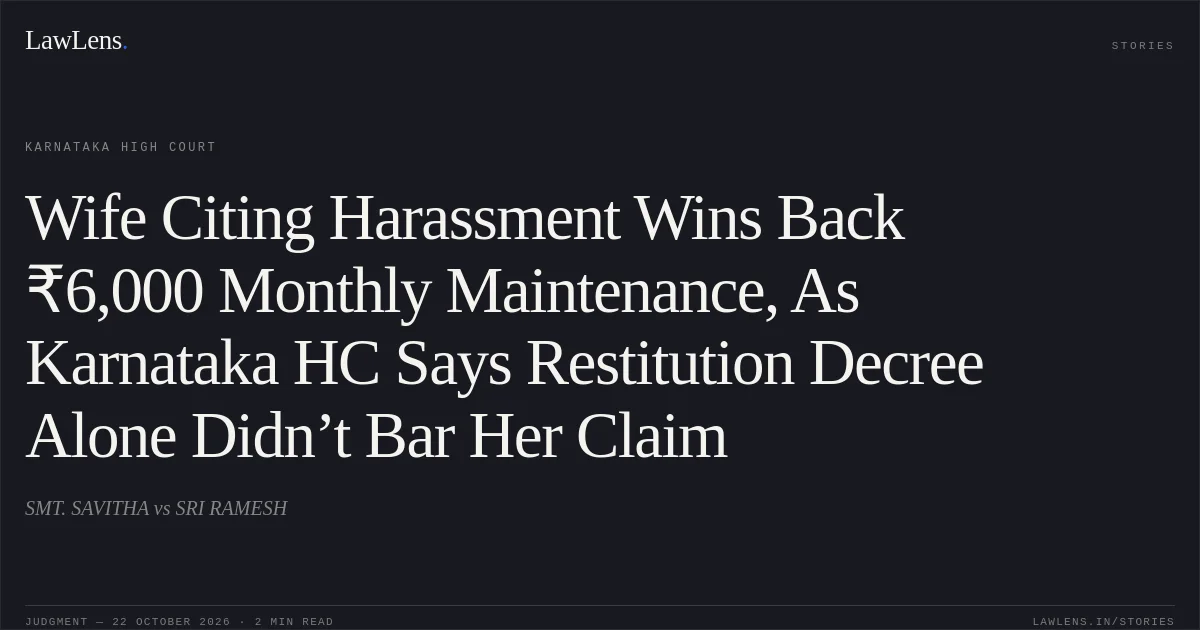
Source reference: pp. 2–3, 7The petitioner later sought maintenance under Section 125 Cr.P.C. The Trial Court awarded her ₹6,000 per month from the date of the petition.
Source reference: p. 3On the respondent’s revision, the First Appellate Court set aside that award, holding that the petitioner was disentitled to maintenance under Section 125(4) Cr.P.C. because she had refused to live with the respondent.
Source reference: pp. 3–4, 7The petitioner challenged that revisional order under Section 482 Cr.P.C.
Source reference: p. 2Issues
Whether the petitioner’s failure to comply with the decree for restitution of conjugal rights, by itself, disentitled her to maintenance under Section 125(4) Cr.P.C.
Source reference: pp. 7–9Whether the First Appellate Court was justified in setting aside the Trial Court’s maintenance award on the evidence and circumstances of the case.
Source reference: pp. 7–10Law Applied
Section 125 Cr.P.C. provides for maintenance to a wife who is unable to maintain herself, subject to the statutory conditions; under Section 125(4), a wife is disentitled to maintenance if, without sufficient reason, she refuses to live with her husband.
Source reference: no citationA decree for restitution of conjugal rights, and the wife’s non-compliance with it, do not by themselves establish that disqualification; the court must assess the facts and evidence to determine whether she had valid and sufficient reason to live apart.
Source reference: pp. 8–9The Court relied on Rina Kumari @ Rina Devi @ Reena v. Dinesh Kumar Mahto @ Dinesh Kumar Mahato and Another, 2025 INSC 55, para 29.
Source reference: pp. 8–9Reasoning
The petitioner was residing with her parents, was unemployed, and depended on them for her expenses; the respondent’s assertion that she was employed was unsupported by documentary evidence.
Source reference: pp. 7, 9Although the restitution decree had been granted and she had not returned, she attributed her separation to harassment by the respondent.
Source reference: pp. 7–9In light of that explanation, non-compliance with the decree did not, without further assessment, establish a wilful refusal to live with him under Section 125(4) Cr.P.C.
Source reference: pp. 7–9The Trial Court had considered the relevant evidence, while the First Appellate Court set aside its award without sufficient and cogent reasons.
Source reference: p. 9Holding
The High Court held that the First Appellate Court’s order warranted interference.
It allowed the petition, set aside the order dated 22 February 2024 in Crl.R.P. No. 6/2023, and affirmed the Trial Court’s order awarding the petitioner maintenance of ₹6,000 per month.
Source reference: p. 10Acts & Sections Cited
3 provisions across 2 statutes referred to in this judgment. Each provision opens on LawLens.
Code of Criminal Procedure, 19732
Hindu Marriage Act, 19551
Original Court PDF
SMT. SAVITHAvsSRI RAMESH
Click to open original judgment
Original judgment, available to read, download and summarize on LawLens.in