Facts
The petitioners comprised M/s. B.S. Enterprises, a partnership firm, and its two partners, arrayed as accused Nos.1 to 3.
Source reference: no citationThe respondent, a proprietorship concern, alleged that the petitioners purchased groceries on credit and issued Cheque No.544041 dated 19 May 2025 for ₹80,30,106 towards discharge of the alleged liability.
Source reference: pp.3–4; para.3The cheque was drawn on Syndicate Bank, which had merged with Canara Bank with effect from 1 April 2020.
Source reference: pp.8–12; paras.7–9When presented through Union Bank on 19 May 2025, it was returned unpaid on 12 June 2025 with the endorsement that Syndicate Bank had merged with Canara Bank.
Source reference: pp.8–12; paras.7–9The complainant issued a statutory demand notice on 19 June 2025, which was served on the petitioners.
Source reference: no citationFollowing their failure to pay within fifteen days, the complainant filed a private complaint under Section 223 of the Bharatiya Nagarik Suraksha Sanhita, 2023, invoking Sections 138 and 142 of the Negotiable Instruments Act, 1881.
Source reference: no citationThe XII Additional Chief Judicial Magistrate, Bengaluru, registered PCR No.13298 of 2025, took cognizance, and proceedings were numbered C.C.No.40325 of 2025.
Source reference: no citationThe petitioners approached the High Court under Section 482 of the Cr.P.C./Section 528 of the BNSS seeking quashing of the proceedings, principally on the ground that the cheque was invalid on the date of presentation.
Source reference: pp.3–4, 10–11; paras.3, 7Issues
1. Whether a cheque drawn on Syndicate Bank, presented after the bank’s merger with Canara Bank and after the expiry of the permitted validity period for such cheques, constitutes a valid instrument capable of attracting liability under Section 138 of the Negotiable Instruments Act?
Source reference: pp.6–7; para.62. Whether continuation of the proceedings under Sections 138 and 142 of the Negotiable Instruments Act, on the basis of such an invalid cheque, amounts to an abuse of the process of law warranting exercise of the High Court’s inherent jurisdiction?
Source reference: p.22; para.12Law Applied
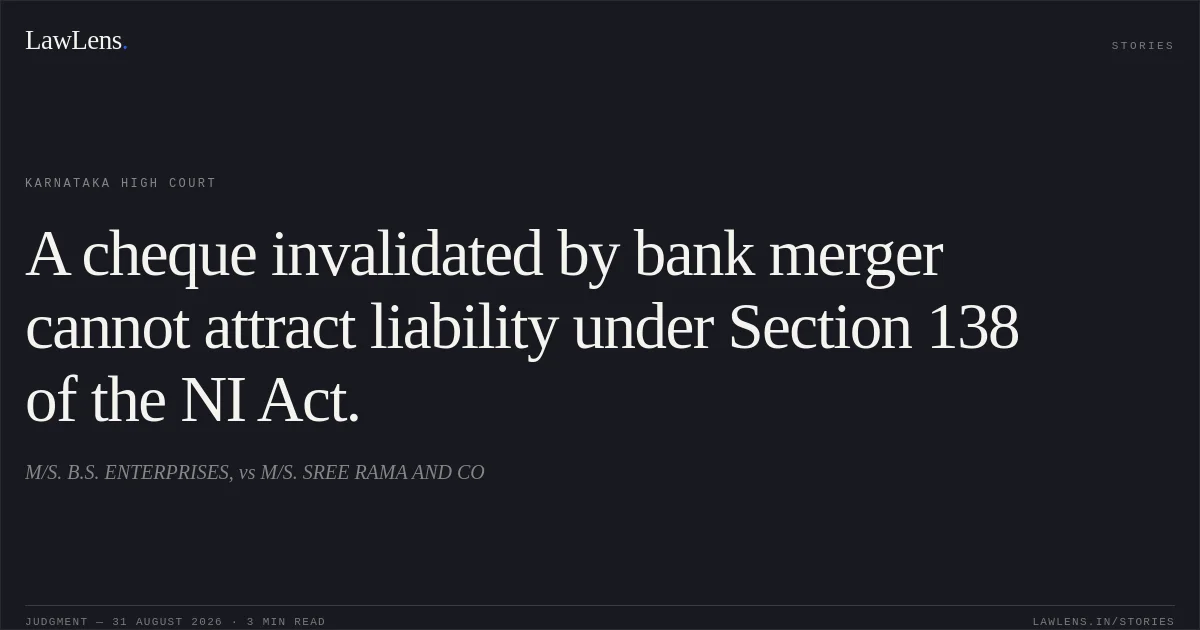
Section 138 of the Negotiable Instruments Act, 1881, applies only where a cheque drawn on an account is returned unpaid in the circumstances contemplated by the provision and is presented within six months from its date or within its period of validity, whichever is earlier; an invalid cheque cannot attract Section 138 liability.
Source reference: pp.15–17, 19–21; paras.10.2–10.3Section 142 governs cognizance of offences under Section 138.
Source reference: no citationThe Court applied the inherent jurisdiction under Section 482 Cr.P.C./Section 528 BNSS to prevent abuse of process and secure the ends of justice.
Source reference: pp.18–19; para.10.3Relying on Shrikant v. Laxman, Criminal Petition No.101615 of 2023, decided on 6 February 2025, and Smt. Archana Singh Gautam v. State of U.P., 2024 SCC OnLine All 4599, together with Ganta Kavitha Devi v. State of Andhra Pradesh, 2024 SCC OnLine AP 5115, the Court held that cheques issued on banks that had merged and presented after the notified validity period were invalid, and their dishonour did not attract Section 138.
Source reference: pp.14–21; paras.10.1–10.3Reasoning
Syndicate Bank merged with Canara Bank on 1 April 2020, and the merger-related directions permitted presentation of Syndicate Bank cheques only up to 30 June 2021; thereafter, the old IFSC and MICR particulars were disabled and such cheques became invalid.
Source reference: p.13; para.9The cheque in question was presented only on 19 May 2025—nearly four years after the final permitted date—and was returned specifically because Syndicate Bank had merged with Canara Bank.
Source reference: pp.11–13; paras.8–9Since presentation of a valid cheque within its validity period is a foundational requirement under the proviso to Section 138, the Court held that dishonour of this instrument did not satisfy the statutory ingredients of the offence.
Source reference: no citationAlthough the complainant alleged that the petitioners deliberately issued the cheque in 2025 despite knowing of the merger, the Court considered continuation of the prosecution on an admittedly invalid instrument to be an abuse of process.
Source reference: no citationIt also observed that, for a 2025 transaction, the complainant could have obtained a fresh cheque.
Source reference: p.22; para.12Holding
The High Court answered the issues in favour of the petitioners and held that the Syndicate Bank cheque was invalid on the date of presentation and that its dishonour could not create criminal liability under Section 138 of the Negotiable Instruments Act.
The criminal petition was allowed, and proceedings in C.C.No.40325 of 2025 before the XII Additional Chief Judicial Magistrate, Bengaluru, were quashed.
Source reference: pp.22–23; para.13The complainant was granted liberty to pursue any other remedy available in law, excluding the remedy under Section 138 based on the cheque in question.
Source reference: pp.22–23; para.13I.A.No.1 of 2026 was disposed of consequentially.
Source reference: p.23; para.13Acts & Sections Cited
7 provisions across 3 statutes referred to in this judgment. Each provision opens on LawLens.
Code of Criminal Procedure, 19731
Bharatiya Nagarik Suraksha Sanhita, 20233
Negotiable Instruments Act, 18813
Original Court PDF
M/S. B.S. ENTERPRISES,vsM/S. SREE RAMA AND CO
Click to open original judgment
Original judgment, available to read, download and summarize on LawLens.in