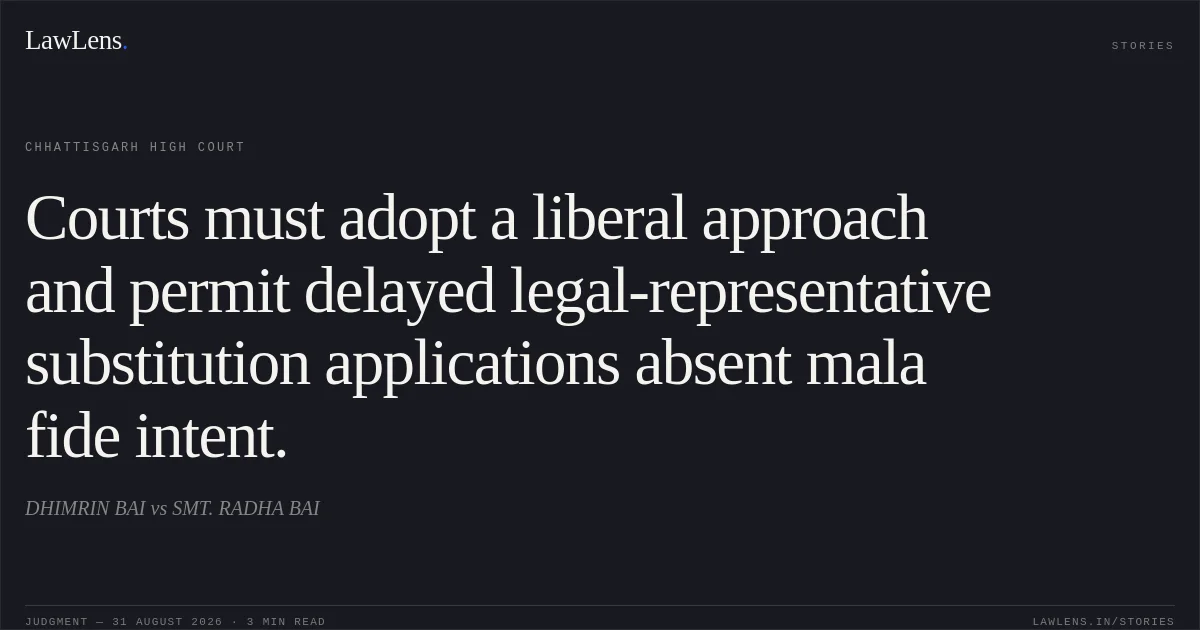
Facts
Dhimrin Bai filed Civil Suit No. 28-A/2011 seeking declaration of title and permanent injunction in respect of the suit property against Smt. Radha Bai.
Source reference: para. 2After dismissal of the suit, she preferred First Appeal No. 58A/2018 before the appellate court.
Source reference: para. 2During the pendency of the appeal, Dhimrin Bai died on 22 April 2019, leaving the present appellant, Ratan Chandel, as her proposed legal representative.
Source reference: para. 2, para. 7Ratan Chandel filed an application under Order 22 Rule 3 CPC for substitution, along with an application under Section 5 of the Limitation Act for condonation of delay, on 7 January 2020—approximately eight months after Dhimrin Bai’s death.
Source reference: para. 2, para. 7The Upper District Judge rejected the applications on 3 February 2020, holding that the appeal had abated under Order 22 Rule 3(2) CPC and that no application under Order 22 Rule 9 CPC for setting aside the abatement had been filed.
Source reference: para. 2Ratan Chandel challenged that order under Order 43 Rule 1 CPC in the present miscellaneous appeal.
Source reference: para. 1Issues
Whether the appellate court erred in rejecting the application for substitution and the application for condonation of delay without granting the proposed legal representative an opportunity to file an application under Order 22 Rule 9 CPC for setting aside the abatement?
Source reference: paras. 7–10Whether the delay in seeking substitution could be condoned by adopting a liberal approach where the proposed legal representative was an illiterate villager, allegedly unaware of the pending appeal and procedural requirements, and there was no apparent mala fide intention?
Source reference: paras. 8–10Law Applied
The Court applied Order 22 Rule 3 CPC, under which the legal representative of a deceased sole plaintiff or appellant may be brought on record, and failure to apply within the prescribed period ordinarily results in abatement under Order 22 Rule 3(2) CPC.
Source reference: paras. 5–6Order 22 Rule 9 CPC provides the remedy for setting aside such abatement. Section 5 of the Limitation Act permits condonation of delay upon sufficient cause. The appeal was maintainable under Order 43 Rule 1 CPC.
Source reference: paras. 5–6Relying on N. Balakrishnan v. M. Krishnamurthy, (1998) 7 SCC 123, the Court reiterated that “sufficient cause” must receive a liberal construction where the delay is not deliberate or mala fide, since limitation rules are intended to prevent dilatory conduct and not to destroy substantive rights.
Source reference: paras. 5–6Reasoning
The Court found that although the application for substitution was filed after the prescribed period and was not accompanied by an application under Order 22 Rule 9 CPC, the appeal had continued to remain pending and had not been finally dismissed as abated.
Source reference: para. 8Ratan Chandel’s explanation that he was an illiterate villager, unaware of the pendency of the appeal and unfamiliar with procedural requirements, was considered bona fide.
Source reference: para. 8The Court held that the failure to file an application under Order 22 Rule 9 CPC should not be attributed exclusively to him, particularly since the counsel also had a duty to advise him regarding the necessary procedural applications.
Source reference: para. 8In light of the absence of mala fide intention and the settled preference for adjudication on merits rather than on technical grounds, the appellate court’s strict approach was held to be unjustified.
Source reference: paras. 5, 9–10Holding
The miscellaneous appeal was allowed, and the order dated 3 February 2020 rejecting the applications was set aside.
The appellate court was directed to restore Civil Appeal No. 58A/2018 to its original number upon filing of the certified copy of the High Court’s order.
Source reference: para. 12Thereafter, Ratan Chandel was permitted to file an application under Order 22 Rule 9 CPC within 15 days from restoration, and the appellate court was directed to decide afresh the applications under Order 22 Rule 3 CPC, Section 5 of the Limitation Act, and Order 22 Rule 9 CPC after affording due opportunity of hearing.
Source reference: para. 12The parties were directed to remain present before the trial court on 21 September 2026.
Source reference: para. 13Acts & Sections Cited
2 provisions across 2 statutes referred to in this judgment. Each provision opens on LawLens.
Limitation Act, 19631
Code of Civil Procedure, 19081
Original Court PDF
DHIMRIN BAIvsSMT. RADHA BAI
Click to open original judgment
Original judgment, available to read, download and summarize on LawLens.in
![Judicial review cannot reappreciate disciplinary evidence absent procedural illegality or findings based on no evidence.. AWADHESH KUMAR vs D/o Post. CAT - ['Allahabad']. LawLens](/stories/thumbnails/judicial-review-cannot-reappreciate-disciplinary-evidence-absent-procedural-illegality-or-0d13f16bd29b4af4a5971c203a4bdf4a.webp)