Facts
The plaintiffs, claiming to be co-owners, instituted a partition suit concerning the suit property.
Source reference: no citationThe defendants applied under Order VII Rule 11 read with Section 151 of the Code of Civil Procedure, 1908 (“CPC”), contending that the suit was barred by res judicata, Order IX Rule 9 CPC, non-joinder of a necessary party, and undervaluation under Section 7(viii) of the West Bengal Court Fees Act, 1970.
Source reference: paras. 6–15The defendants relied on an alleged arbitral award dated 9 February 2002 arising from an earlier partition suit and arbitration between the parties’ predecessors.
Source reference: paras. 6–15The Trial Court returned the plaint for presentation before the proper forum on the ground of gross undervaluation and dismissed the plaintiffs’ application under Order XL Rule 1 CPC for appointment of a Receiver.
Source reference: paras. 1–3The plaintiffs appealed.
Source reference: no citationThe defendants’ separate appeal challenging the refusal to reject the plaint had earlier been dismissed as not maintainable, but they were permitted to urge their grounds in the present appeal under Order XLI Rule 33 CPC.
Source reference: para. 4Issues
Whether the plaint was liable to be rejected or returned on the grounds of suppression of material facts, res judicata, the bar under Order IX Rule 9 CPC, non-joinder of a necessary party, or undervaluation.
Source reference: para. 41(i)Whether the alleged arbitral award dated 9 February 2002 constituted a valid and binding adjudication capable of operating as res judicata against the plaintiffs.
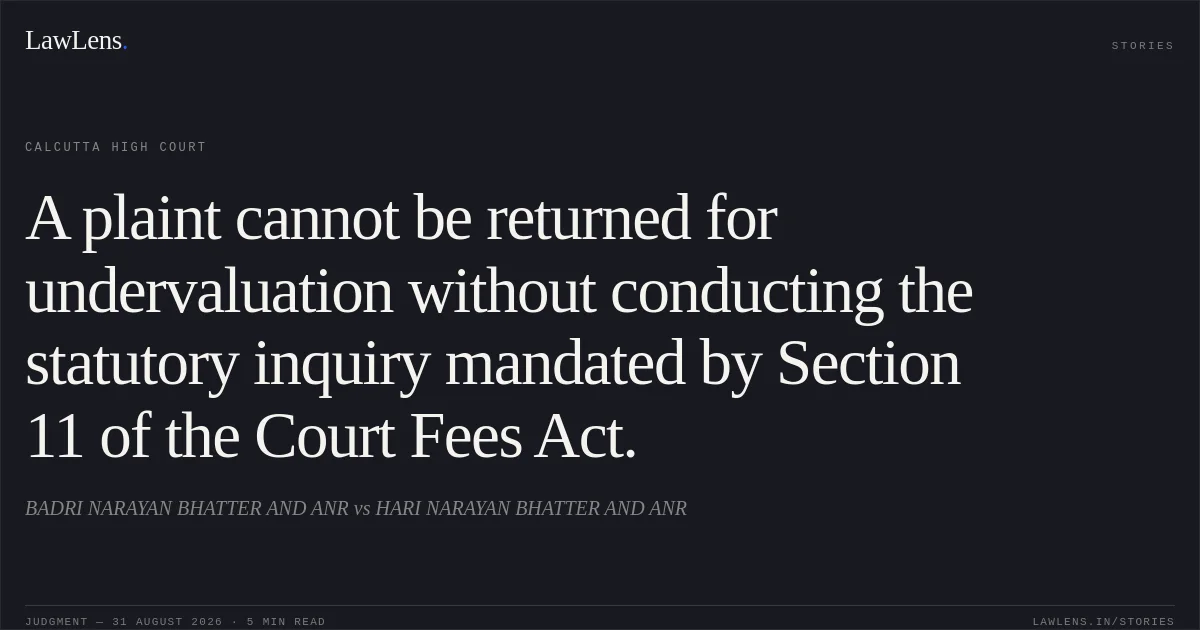
Source reference: paras. 56–66Whether the suit was improperly valued under Section 7(viii) of the West Bengal Court Fees Act, 1970, and whether the Trial Court could return the plaint without conducting an inquiry under Sections 11–13 of that Act.
Source reference: paras. 67–77Whether the plaintiffs’ application for appointment of a Receiver under Order XL Rule 1 read with Section 151 CPC ought to have been allowed.
Source reference: para. 41(ii)Law Applied
Under Order VII Rule 11 CPC, the court must ordinarily examine only the averments in the plaint and documents relied upon by the plaintiff; disputed factual matters requiring evidence cannot ordinarily be decided at that stage.
Source reference: paras. 43–45Order IX Rule 9 CPC bars a fresh suit on the same cause of action only where the earlier suit was dismissed in circumstances attracting Order IX Rules 8 and 9; the Court held that a partition cause of action is continuing.
Source reference: paras. 46–55A purported arbitral award must satisfy the requirements of the Arbitration and Conciliation Act, 1996, including a valid mandate, publication, stamping, and reasons under Section 31(3); an invalid award cannot operate as res judicata.
Source reference: paras. 56–66Section 7(viii) of the West Bengal Court Fees Act applies where separate possession of a share is claimed by a coparcener or co-owner excluded from possession, and valuation is to relate to the claimed share; questions of valuation must be examined through the statutory inquiry contemplated by Sections 11–13.
Source reference: paras. 67–77Under Order XL Rule 1 CPC, a Receiver may be appointed where necessary for the preservation, management, or protection of disputed property; the court may mould the relief and grant a limited receivership.
Source reference: paras. 80–83The Court also considered Narayan Prasad Lohia v. Nikunj Kumar Lohia, (2002) 3 SCC 572, concerning arbitration by an even number of arbitrators, and Sharada Sanhi v. Asha Agarwal, 2026 SCC OnLine SC 480, concerning the consequences of dismissal of a suit for default.
Source reference: paras. 46–65Reasoning
The Court held that the defendants’ allegations of suppression, the effect of the earlier proceedings, the validity of the alleged award, and the status of the defendants’ mother as a necessary co-owner involved disputed matters not properly determinable under Order VII Rule 11 CPC.
Source reference: paras. 43–45The earlier suit had been referred to arbitration under Section 8 of the Arbitration Act; consequently, its later dismissal for default was treated as merely procedural and did not attract the bar under Order IX Rule 9 CPC. In any event, the plaintiffs were not shown to have been parties to the earlier arbitration or to claim through its parties.
Source reference: paras. 51–56The alleged award was found prima facie incapable of creating res judicata because it had not been shown to have been published, was unstamped, lacked reasons contrary to Section 31(3), and was otherwise not established as a valid award.
Source reference: paras. 57–66On valuation, the Trial Court had relied solely on an e-assessment slip procured by the defendants, which described the property as commercial and bastu. The Court found that this unilateral document could not establish undervaluation, particularly when the plaint and defendants’ own materials indicated a primarily residential property.
Source reference: paras. 67–75The Trial Court had also failed to conduct the inquiry required by Sections 11–13 of the Court Fees Act.
Source reference: paras. 67–75Regarding receivership, the plaintiffs had made specific allegations that the defendants and their spouses were inducting tenants, collecting undisclosed salami and rents, and impairing the property. The defendants’ denials were evasive and did not effectively controvert those allegations.
Source reference: paras. 78–86The Court therefore found a limited receivership appropriate for collection of rents, maintenance of accounts, and preservation of the property.
Source reference: paras. 78–86Holding
The appeal was allowed, and the Trial Court’s order returning the plaint and dismissing the Receiver application was set aside.
The suit was restored to its original file and number, and any action taken pursuant to the return of the plaint was reversed.
Source reference: paras. 88–89The Trial Court was directed to proceed with the suit on evidence after framing appropriate issues, without being unduly influenced by the appellate court’s tentative observations.
Source reference: para. 90The plaintiffs’ application under Order XL Rule 1 CPC was partially allowed: the Trial Court was directed to appoint a Receiver to collect rents and usufructs, maintain the property from the income received, and submit regular income-and-expenditure accounts.
Source reference: paras. 91–92The plaintiffs were to bear the initial remuneration, while subsequent remuneration could be deducted from the property income.
Source reference: paras. 91–92CAN 1 of 2025 was disposed of consequentially, with no order as to costs.
Source reference: paras. 93–94Operation of the judgment was subsequently stayed for thirty days from the date of the order.
Source reference: post-judgment orderActs & Sections Cited
21 provisions across 4 statutes referred to in this judgment. Each provision opens on LawLens.
Code of Civil Procedure, 19082
Arbitration and Conciliation Act, 19966
west bengal court-fees act, 1970
Commercial Courts Act, 20151
Original Court PDF
BADRI NARAYAN BHATTER AND ANRvsHARI NARAYAN BHATTER AND ANR
Click to open original judgment
Original judgment, available to read, download and summarize on LawLens.in