Facts
The deceased, who was married but living separately from her husband, was allegedly in a relationship with the appellant, who operated a mobile-phone shop.
Source reference: paras. 2.1–2.5According to the prosecution, the deceased asked the appellant to marry her, but he refused. On 6 September 2017, she allegedly went to the appellant’s shop with her parents and brother and remained there after they left. Later, her body was found inside the shop, allegedly placed in a tied gunny bag. The prosecution alleged that she had been strangulated with a thuppatta.
Source reference: paras. 2.1–2.5The appellant was arrested on 8 September 2017, and the alleged confession led to recovery of the thuppatta.
Source reference: paras. 2.1–2.5The post-mortem doctor opined that death resulted from shock and haemorrhage with hypoxia following strangulation.
Source reference: para. 2.4The Sessions Court convicted the appellant under Section 302 IPC and sentenced him to life imprisonment, a fine of ₹50,000, and three months’ simple imprisonment in default.
Source reference: paras. 1, 6The appellant challenged the conviction in the present appeal under Section 374(2) Cr.P.C.
Source reference: para. 1Issues
1. Whether the prosecution proved beyond reasonable doubt that the appellant caused the deceased’s death and was guilty under Section 302 IPC on the basis of circumstantial evidence.
Source reference: paras. 9–10, 21–222. Whether the prosecution established a complete and reliable chain of circumstances sufficient to invoke the evidentiary burden under Section 106 of the Indian Evidence Act, 1872.
Source reference: para. 203. Whether the medical and investigative evidence reliably established strangulation, rather than the possibility of hanging or suicide.
Source reference: paras. 13–20Law Applied
The Court applied Section 302 IPC, which criminalises murder, and the settled rule that in a case based on circumstantial evidence the prosecution must prove every incriminating circumstance beyond reasonable doubt and establish a complete chain pointing only to the accused’s guilt.
Source reference: para. 21Sections 101 and 106 of the Indian Evidence Act, 1872 were considered: the primary burden remains on the prosecution under Section 101, while Section 106 applies only to facts “especially” within the accused’s knowledge and does not relieve the prosecution of proving foundational facts.
Source reference: para. 20The Court relied on Anees v. State (NCT of Delhi), (2024) 15 SCC 48, for the limited scope of Section 106.
Source reference: para. 20The Court relied on Gour Acharjee v. State of Tripura, 2026 SCC OnLine SC 931, concerning the medical characteristics relevant to distinguishing hanging from strangulation.
Source reference: para. 19Section 374(2) Cr.P.C. provided the appellate jurisdiction, while the compensation direction under Section 357A(3) Cr.P.C. was separately considered.
Source reference: paras. 1, 23Reasoning
The Court found that the prosecution evidence did not establish a consistent or complete chain connecting the appellant with the homicide.
Source reference: para. 21P.W.1 gave conflicting accounts about whether the deceased first came to the family home or instead telephoned him from the shop, and his delay in lodging the complaint was unexplained.
Source reference: para. 10The timing of the discovery of the body, the arrival of the police and the removal of the body was inconsistent across the testimonies of P.Ws.1, 5 and 6.
Source reference: paras. 10–12Although the prosecution alleged that the body had been placed in a tied gunny bag, the bag was absent from the photographs, the rope was not recovered, and the bag was not subjected to forensic examination.
Source reference: paras. 11–12, 14, 22The brother who allegedly accompanied the deceased to the shop and other shop employees were not examined, while P.W.12 did not support the prosecution’s account that the deceased and appellant were together in the shop.
Source reference: paras. 11, 20The alleged recovery of the thuppatta two days after the occurrence was also considered artificial, particularly in view of evidence suggesting that the appellant had been taken into custody on the date of occurrence.
Source reference: paras. 15, 21The medical evidence was rendered doubtful by corrections in the post-mortem certificate, failure to examine the hyoid bone, inconsistency between the photographs and the certificate, and the unexplained presence of froth or saliva at the mouth—features which, in the circumstances, left open the possibility of hanging or suicide.
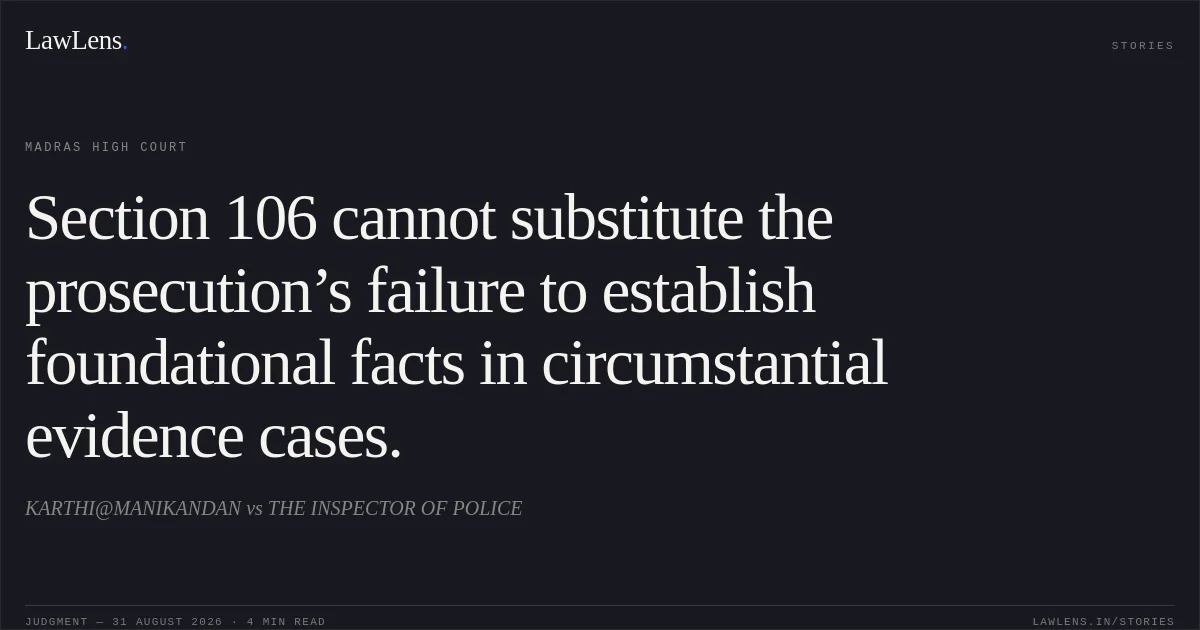
Source reference: paras. 13–18Since the prosecution failed to prove the foundational facts, the Court held that no adverse burden could be placed on the appellant under Section 106.
Source reference: para. 20Holding
The Court answered the issues in favour of the appellant, holding that the prosecution had failed to prove the charge under Section 302 IPC beyond reasonable doubt and had not established a complete chain of circumstantial evidence.
The appeal was allowed, the conviction and life sentence dated 13 December 2019 were set aside, and the appellant was acquitted.
Source reference: para. 23Any fine paid was directed to be refunded, and the bail bond was discharged.
Source reference: para. 23However, the trial court’s direction awarding ₹2,00,000 as compensation under Section 357A(3) Cr.P.C. for the welfare of the deceased’s child was sustained.
Source reference: para. 23Acts & Sections Cited
4 provisions across 2 statutes referred to in this judgment. Each provision opens on LawLens.
Code of Criminal Procedure, 19733
Indian Penal Code, 18601
Original Court PDF
KARTHI@MANIKANDANvsTHE INSPECTOR OF POLICE
Click to open original judgment
Original judgment, available to read, download and summarize on LawLens.in