Facts
Smt. Kusum Mehta and three others purchased agricultural land measuring 26 bighas in Village Paprawat, Delhi, under four registered Sale Deeds dated 29 March 1985, with each purchaser holding a one-fourth undivided share.
Source reference: para. 2–4; pp. 2–3The Appellant, Bhisham Mehta, was appointed as Kusum Mehta’s attorney under General Powers of Attorney dated 29 March 1985 and 7 April 1995.
Source reference: para. 11; p. 4Acting as attorney for three co-owners, he sold the property to M/s Agile Properties Ltd. for Rs. 6,95,11,500/- under a registered Sale Deed dated 11 April 2011.
Source reference: para. 5–7; pp. 3–4Kusum Mehta’s one-fourth share was Rs. 1,73,77,875/-, but the Appellant transferred only Rs. 71,99,801/- to her account and retained Rs. 1,01,78,074/-.
Source reference: para. 7–9; pp. 3–4After Kusum Mehta’s death intestate on 25 December 2013, her three daughters instituted a recovery suit for the balance amount and interest.
Source reference: para. 2, 9; pp. 2, 4The Appellant denied liability, asserting that the property had been acquired from his and his wife’s funds and that the amount credited to Kusum Mehta was an interest-free friendly loan, not sale consideration.
Source reference: para. 10–14; pp. 4–5He also filed a counterclaim for recovery of Rs. 72,00,000/-.
Source reference: para. 14; p. 4The Trial Court decreed the suit under Order XII Rule 6 CPC for Rs. 1,01,78,074/- with interest at 8% per annum from 11 April 2011 until realization, and awarded interest on Rs. 72,00,000/- from 11 April 2011 to 30 March 2012.
Source reference: para. 18–20; p. 6The Appellant challenged the decree on the grounds of absence of unequivocal admissions, pendency of the counterclaim, validity of the GPAs, and limitation.
Source reference: para. 22–25; pp. 6–7Issues
Whether the Appellant’s statements in the registered Sale Deed, police reply, pleadings, and surrounding record constituted clear, unambiguous, and unequivocal admissions warranting judgment under Order XII Rule 6 CPC?
Source reference: para. 22, 29, 39–48; pp. 6–14Whether the General Powers of Attorney executed in favour of the Appellant transferred Kusum Mehta’s title or proprietary interest in the suit property to him?
Source reference: para. 24, 33–36; pp. 7, 10–11Whether the Appellant, having acted as Kusum Mehta’s agent in selling the property, was legally bound to account for and pay her share of the sale consideration?
Source reference: para. 26–29, 37–38; pp. 7–11Whether the pendency or separate registration of the Appellant’s counterclaim barred the Trial Court from decreeing the respondents’ suit?
Source reference: para. 23, 49–50; pp. 6–7, 14Whether the respondents’ suit was barred by limitation, having been filed more than three years after the Sale Deed dated 11 April 2011?
Source reference: para. 25, 51; pp. 7, 14–15Law Applied
The Court applied Order XII Rule 6 CPC, under which judgment may be entered on clear, unambiguous, and unequivocal admissions.
Source reference: para. 18, 47–48; pp. 6, 14Under Section 218 of the Indian Contract Act, 1872, an agent must pay to the principal all sums received on the principal’s account.
Source reference: para. 37–38; p. 11The Court relied on Sections 91 and 92 of the Indian Evidence Act—corresponding to Sections 94 and 95 of the Bharatiya Sakshya Adhiniyam, 2023—which restrict proof of oral or collateral assertions contrary to the terms of a written and registered instrument.
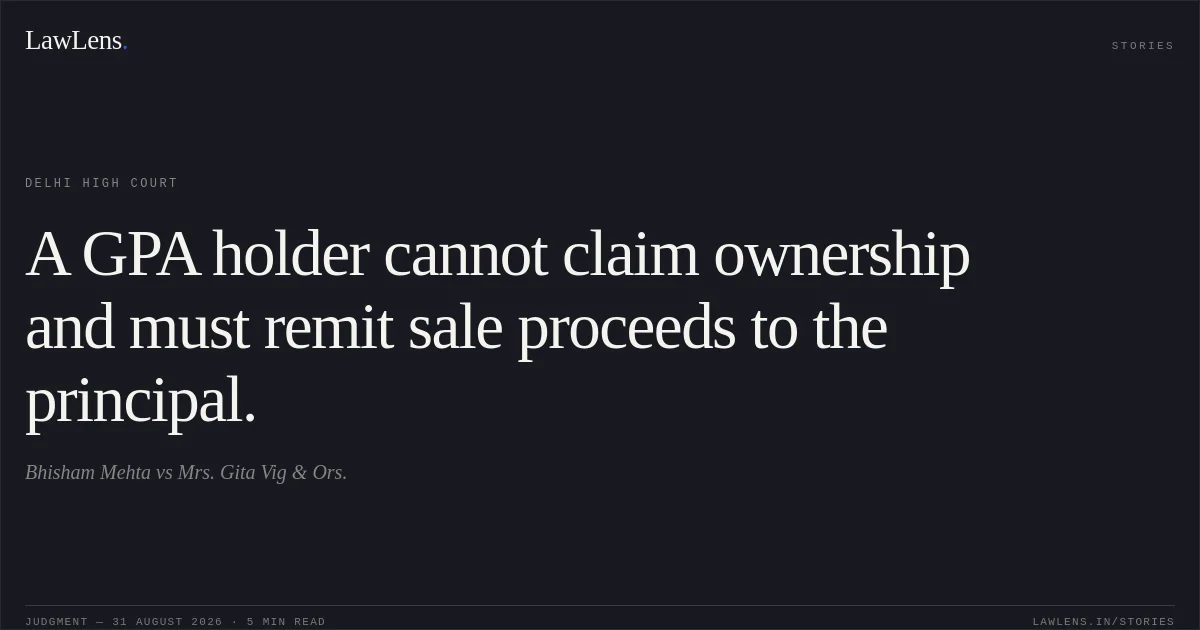
Source reference: para. 31; p. 9Relying on Suraj Lamp & Industries Pvt. Ltd. v. State of Haryana, (2012) 1 SCC 656, the Court held that a General Power of Attorney, including an irrevocable one, is an instrument of agency and does not by itself transfer title or proprietary interest in immovable property.
Source reference: para. 34–36; pp. 10–11Under Order VIII Rule 6-A(2) CPC, a counterclaim ordinarily has the effect of a cross-suit; however, where it constitutes an independent cause of action and is separately registered as a distinct suit, its pendency does not prevent adjudication of the original claim on admissions.
Source reference: para. 23, 49–50; pp. 6–7, 14Limitation begins when the cause of action accrues or, where material facts were unknown, when the claimant acquires knowledge of the relevant transaction and liability.
Source reference: para. 51; pp. 14–15Reasoning
The registered Sale Deed expressly described Kusum Mehta as one of the four vendors and absolute owners/bhumidars, and the Appellant as her General Attorney; it also recorded the property as the self-acquired property of all four vendors.
Source reference: para. 28–30; pp. 7–9The Court held that the Appellant could not displace these categorical recitals through unsupported assertions that he and his wife were the real owners, particularly when no evidence showed that they had paid the original purchase consideration.
Source reference: para. 30–32; pp. 9–10The GPAs authorised the Appellant to manage and sell the property on Kusum Mehta’s behalf but were neither instruments of transfer nor coupled with any proprietary interest.
Source reference: para. 33–36; pp. 10–11The Appellant’s police reply admitted that he had deposited identical amounts of Rs. 72,00,000/- into the accounts of all three co-owners after the property transaction, without asserting that the deposits were loans.
Source reference: para. 40–43; pp. 11–13The identical deposits, Kusum Mehta’s income-tax return treating Rs. 71,99,801/- as long-term capital gains, and the absence of any loan documentation contradicted the alleged friendly-loan defence.
Source reference: para. 43–45; pp. 12–13The inconsistent pleadings regarding whether the amount was paid by cheque or RTGS further undermined that defence.
Source reference: para. 46; p. 13These circumstances established admissions sufficient for a decree under Order XII Rule 6 CPC.
Source reference: para. 47–48; p. 14Since the Appellant received the sale consideration as agent, Section 218 of the Contract Act required him to remit Kusum Mehta’s one-fourth share; after crediting the amount already paid, Rs. 1,01,78,074/- remained due.
Source reference: para. 37–38; p. 11The counterclaim was based on an independent loan theory and had been separately registered as another suit, so it did not prevent judgment in the respondents’ suit.
Source reference: para. 49–50; p. 14Finally, limitation commenced when Kusum Mehta learned of the sale and the retention of the balance, which occurred in April 2012; the suit filed on 15 April 2014 was therefore within time.
Source reference: para. 51; pp. 14–15Holding
The Delhi High Court dismissed the appeal and affirmed the judgment and decree dated 7 February 2020.
It held that the Appellant’s admissions established his liability to pay the respondents, as Kusum Mehta’s legal heirs, the balance of Rs. 1,01,78,074/- from her share of the sale consideration, together with interest at 8% per annum from 11 April 2011 until realization.
Source reference: para. 19, 52–53; pp. 6, 15The respondents were also entitled to interest on Rs. 72,00,000/- for the period from 11 April 2011 to 30 March 2012, along with costs; pending applications were disposed of.
Source reference: para. 19, 52–53; pp. 6, 15Acts & Sections Cited
5 provisions across 3 statutes referred to in this judgment. Each provision opens on LawLens.
Code of Civil Procedure, 19082
Bharatiya Sakshya Adhiniyam, 20232
Indian Contract Act, 18721
Original Court PDF
Bhisham MehtavsMrs. Gita Vig & Ors.
Click to open original judgment
Original judgment, available to read, download and summarize on LawLens.in