Facts
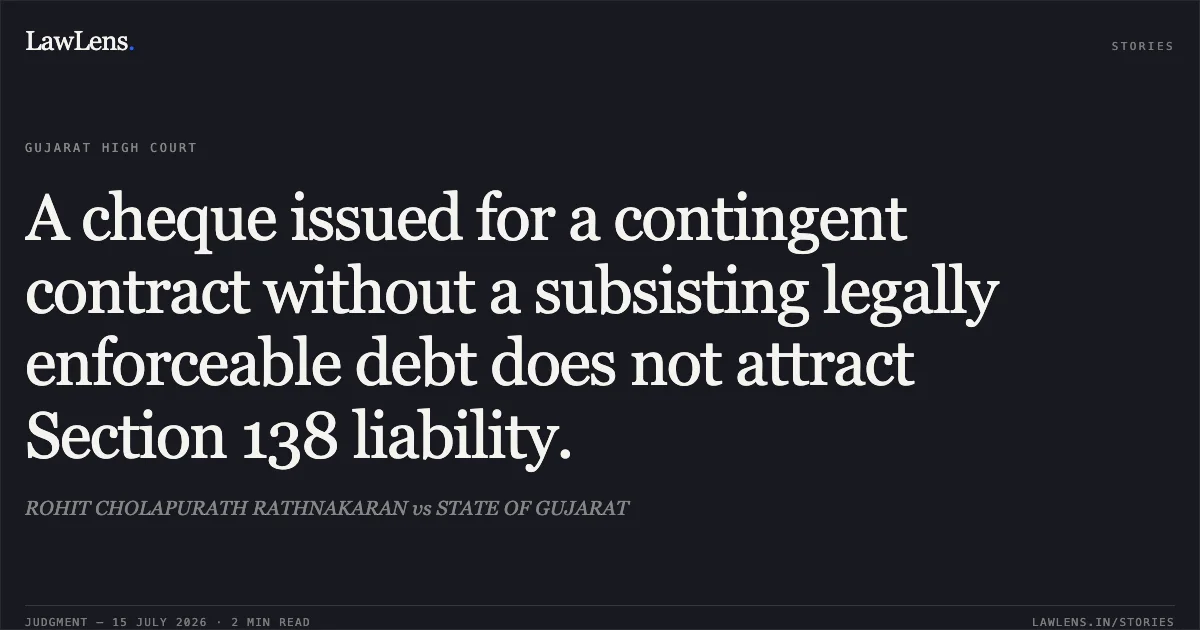
The petitioners (partners in M/s. Builtman Realty and Infrastructure LLP) sought to quash a complaint under Section 138 of the Negotiable Instruments Act (NI Act).
Source reference: no citationThe complainant (Respondent No. 2) had purchased land from a third party and entered into an agreement with the petitioners’ firm to construct a villa.
Source reference: p. 10-11Due to project delays, the parties executed a Memorandum of Understanding (MoU) dated 02.01.2018, wherein the firm agreed to "repurchase" the land/cancel the contract for ₹14,17,000/-.
Source reference: p. 11A cheque issued for this purpose was dishonored with the remark "Payment Stopped by Drawer".
Source reference: p. 3The petitioners argued that as the complainant still held title to the land, there was no subsisting "legally enforceable debt" when the cheque was issued.
Source reference: p. 5Issues
1. Whether a cheque issued for the repurchase of property under a contingent cancelled contract constitutes a discharge of a "legally enforceable debt or liability" under Section 138 of the NI Act.
Source reference: p. 132. Whether the partners of an LLP can be held vicariously liable under Section 141 of the NI Act when the debt itself is not established as legally enforceable at the time of issuance.
Source reference: p. 5-6 / para. 3.3Law Applied
Section 138 of the Negotiable Instruments Act, 1881, which requires that a cheque be issued for the discharge, in whole or in part, of any debt or other liability.
Source reference: p. 13Indus Airways Private Limited v. Magnum Aviation Private Limited (2014), which establishes that if there is no legally enforceable debt or liability subsisting on the date the cheque is drawn (such as in the case of advance payments for unexecuted contracts), Section 138 is not attracted.
Source reference: p. 13-14Section 27 of the Limited Liability Partnership Act, 2008, regarding the liabilities of partners.
Source reference: p. 6Reasoning
The court reasoned that the transaction was a contingent contract. The MoU stipulated that the complainant would transfer the land title to the LLP only after receiving the refund.
Source reference: p. 12Since the land remained in the name and possession of the complainant at the time the cheque was presented, the LLP did not owe a "debt" in the legal sense; rather, the situation represented a breach of a reciprocal promise.
Source reference: p. 13The court found no evidence that the complainant had paid the firm for the construction, meaning the cheque was issued for a "repurchase" that had not yet occurred. Consequently, there was no past adjudicated or existing liability at the time of issuance.
Source reference: p. 13Holding
The court held that the complaint was not maintainable as the essential ingredient of a "legally enforceable debt" under Section 138 was missing at the time the cheque was drawn.
The court allowed the petition and quashed Criminal Complaint No. 59095 of 2019 pending before the Additional Chief Metropolitan Magistrate, Ahmedabad.
Source reference: p. 17Acts & Sections Cited
4 provisions across 3 statutes referred to in this judgment. Each provision opens on LawLens.
Code of Criminal Procedure, 19731
Negotiable Instruments Act, 18812
Limited Liability Partnership Act, 20081
Original Court PDF
ROHIT CHOLAPURATH RATHNAKARANvsSTATE OF GUJARAT
Click to open original judgment
Original judgment, available to read, download and summarize on LawLens.in