Facts
A four-and-a-half-year-old minor girl was murdered in Sakra, Muzaffarpur, and the petitioner’s name emerged during investigation, although he was not named in the FIR.
Source reference: paras. 3; p. 2The petitioner, a child in conflict with law (CICL), was in the remand home from 4 November 2025 and was accused in Sakra P.S. Case No. 446 of 2025 for offences under Sections 103(1) and 238 of the Bharatiya Nyaya Sanhita, 2023.
Source reference: paras. 2, 4; p. 1The Juvenile Justice Board rejected his bail application on 11 December 2025 in J.J.B. Case No. 342 of 2025.
Source reference: para. 4; p. 2His appeal was dismissed by the 1st Additional Sessions Judge, Muzaffarpur, on 10 February 2026.
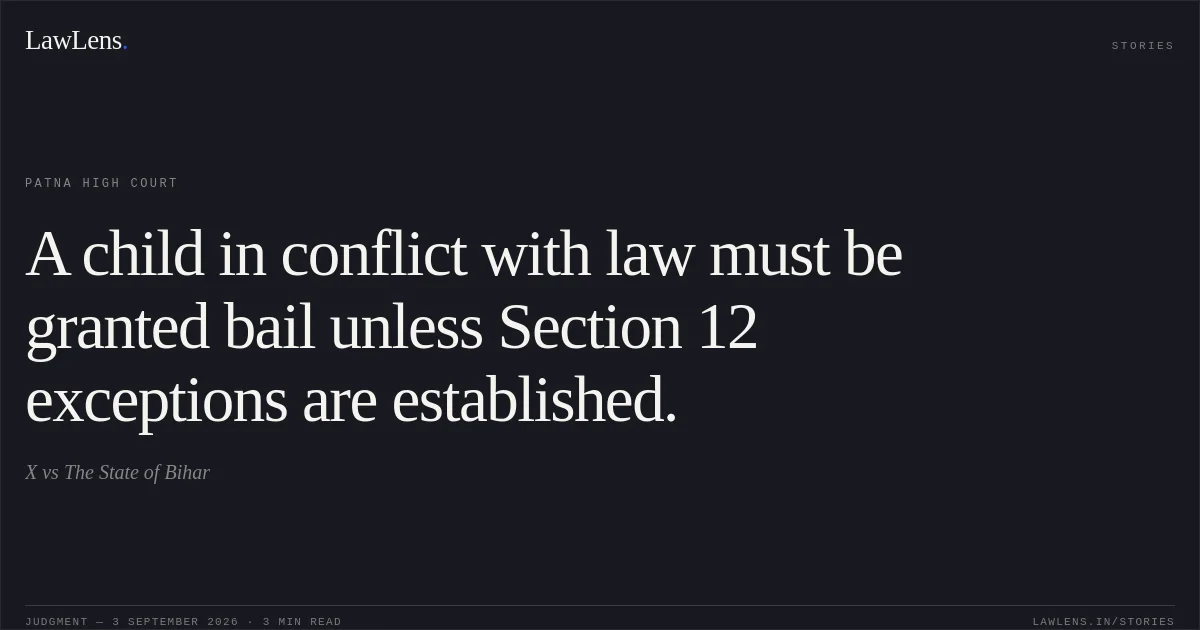
Source reference: para. 5; p. 2The petitioner thereafter filed the present criminal revision, contending that bail under Section 12 of the Juvenile Justice (Care and Protection of Children) Act, 2015, was the rule and that none of the statutory exceptions applied.
Source reference: paras. 6–7; pp. 2–4Issues
Whether the petitioner, as a child in conflict with law, could be denied bail under Section 12 of the Juvenile Justice (Care and Protection of Children) Act, 2015, in the absence of material showing that his release would bring him into contact with known criminals, expose him to moral, physical, or psychological danger, or defeat the ends of justice?
Source reference: paras. 7, 10, 12; pp. 3–5Whether the Juvenile Justice Board and the appellate court erred in rejecting bail without properly applying the child-friendly and rehabilitative principles under the Juvenile Justice Act, 2015?
Source reference: paras. 11–13; pp. 4–6Law Applied
The Court primarily applied Section 12 of the Juvenile Justice (Care and Protection of Children) Act, 2015, under which bail to a child in conflict with law is the rule and may be refused only where release is likely to bring the child into association with a known criminal, expose the child to moral, physical, or psychological danger, or defeat the ends of justice.
Source reference: para. 10; p. 4The Court also relied on Section 3(iv), embodying the best-interest principle; Section 3(xii), treating institutional care as a measure of last resort; and Section 3(xiii), concerning restoration and reintegration of the child with the family and social background, subject to the child’s best interests.
Source reference: para. 11; pp. 4–5These provisions reflect the rehabilitative, reformative, and child-friendly object of the Act, with institutionalisation being a last resort.
Source reference: paras. 11–12; pp. 4–5Reasoning
The Court examined the Social Investigation Report and found no material indicating that the petitioner would come into contact with any known criminal or that he lacked guardianship and family support.
Source reference: para. 13; p. 5The seriousness of the alleged offence, the petitioner’s implication during investigation, and the absence of direct evidence were not treated as independent grounds for denying bail under Section 12.
Source reference: paras. 3, 7, 10; pp. 2–4Applying the best-interest and last-resort principles under Section 3, the Court held that continued institutional custody could not be justified merely on the assumption that it would promote the petitioner’s welfare; reformation and rehabilitation were better pursued under proper parental or family guardianship.
Source reference: paras. 11–13; pp. 4–6Since none of the statutory grounds for refusing bail was established, the subordinate courts had erred in rejecting the petitioner’s application.
Source reference: para. 13; p. 6Holding
The High Court allowed the criminal revision and set aside both the appellate order dated 10 February 2026 and the Juvenile Justice Board’s order dated 11 December 2025.
The petitioner was directed to be released on bail on furnishing a bond of Rs. 10,000 with two sureties of the like amount to the satisfaction of the Juvenile Justice Board, Muzaffarpur, subject to the conditions that one surety be a parent, the other be a relative without criminal antecedents who undertakes to provide proper care and upkeep, and that the petitioner appear before the Board on every date fixed in the case.
Source reference: para. 15; p. 7Acts & Sections Cited
5 provisions across 2 statutes referred to in this judgment. Each provision opens on LawLens.
Bharatiya Nyaya Sanhita, 20232
Juvenile Justice (Care and Protection of Children) Act, 2015.3
Original Court PDF
XvsThe State of Bihar
Click to open original judgment
Original judgment, available to read, download and summarize on LawLens.in