01Facts
The petitioners comprised the directors and employees of C-Quel Management Services Pvt. Ltd.
¶ 2–5The opposite party no. 2 was appointed as a Legal Retainer pursuant to an offer dated 28 December 2022, at a monthly retainer fee of ₹35,000, and commenced work on 2 January 2023.
¶ 2–5Following concerns regarding his performance and the scope of legal work, the opposite party no. 2 stopped attending the office and the company communicated that the retainership stood discontinued with effect from 16 February 2023.
¶ 6–7He claimed ₹20,712 for services rendered in February 2023 and subsequently raised further invoices totalling ₹70,000, alleging breach of the retainership agreement and non-payment of fees.
¶ 8–10A police case was thereafter registered as Electronics Complex Police Station Case No. 126 of 2023, giving rise to G.R. Case No. 767 of 2023, under Sections 406, 420 and 120B of the Indian Penal Code, 1860.
¶ 1, 13–15The petitioners sought quashing of the criminal proceeding, contending that the dispute was contractual and civil in nature.
¶ 1, 13–1502Issues
i.Whether the allegations in the complaint and the materials in the case diary prima facie disclosed the offences of criminal breach of trust, cheating and criminal conspiracy under Sections 406, 420 and 120B of the IPC.
¶ 10–12, 24–28ii.Whether the criminal proceeding was essentially a dispute concerning termination of a contractual retainership and therefore liable to be quashed under the High Court’s inherent jurisdiction to prevent abuse of process and secure the ends of justice.
¶ 22–2803Law Applied
The Court applied Sections 406, 420 and 120B of the IPC, requiring, respectively, the essential ingredients of criminal breach of trust, dishonest or fraudulent inducement amounting to cheating, and an agreement to commit an illegal act or a legal act by illegal means.
It relied on the principles governing quashing of criminal proceedings under Section 482 of the Code of Criminal Procedure, including the categories identified in State of Haryana v. Bhajan Lal, 1992 Supp. (1) SCC 335, particularly where the allegations, even if accepted in their entirety, do not constitute an offence or where the uncontroverted allegations and supporting materials disclose no offence.
¶ 21The Court also relied on Hridaya Ranjan Prasad Verma v. State of Bihar, (2000) 4 SCC 168; Hira Lal Hari Lal Bhagwati v. CBI, (2003) 5 SCC 257; Vesa Holdings (P) Ltd. v. State of Kerala, (2015) 8 SCC 293; Indian Oil Corporation v. NEPC India Ltd., (2006) 6 SCC 736; Ramesh Chandra Gupta v. State of Uttar Pradesh, 2022 LiveLaw (SC) 993; and Randheer Singh v. State of Uttar Pradesh, (2021) 14 SCC 626, for the proposition that a civil dispute cannot be given a criminal colour in the absence of the essential ingredients of the alleged offences.
¶ 14, 19–23It further noted the principle in Delhi Race Club (1940) Ltd. v. State of Uttar Pradesh, (2024) 10 SCC 690, that the ingredients of criminal breach of trust and cheating must be independently established.
¶ 20Provisions in the judgment · 9 · Linked ones open on LawLens
Indian Penal Code, 1860 Section 34Section 405Section 406Section 415Section 418Section 420
Code of Criminal Procedure, 1973 Section 155Section 156Section 482
04Reasoning
The Court found that the admitted relationship between the parties arose from a legal retainership agreement and that the dispute originated from the company’s dissatisfaction with the opposite party no. 2’s work and its consequent decision to discontinue the engagement.
¶ 24–27Non-payment of allegedly due retainership fees and the legality of unilateral termination could give rise to a civil claim for contractual compensation, but the complaint did not disclose any initial dishonest intention, fraudulent inducement, entrustment or subsequent dishonest conversion necessary to constitute cheating or criminal breach of trust.
The allegations of converting the complainant’s “intellectual property” and conspiring among the petitioners were found to be conclusory and unsupported by the case diary.
¶ 10–12, 24Applying the Bhajan Lal categories, the Court held that even if the complaint were accepted at face value, it did not prima facie establish the offences alleged and that continuation of the prosecution would amount to abuse of the criminal process.
¶ 21–2805Holding
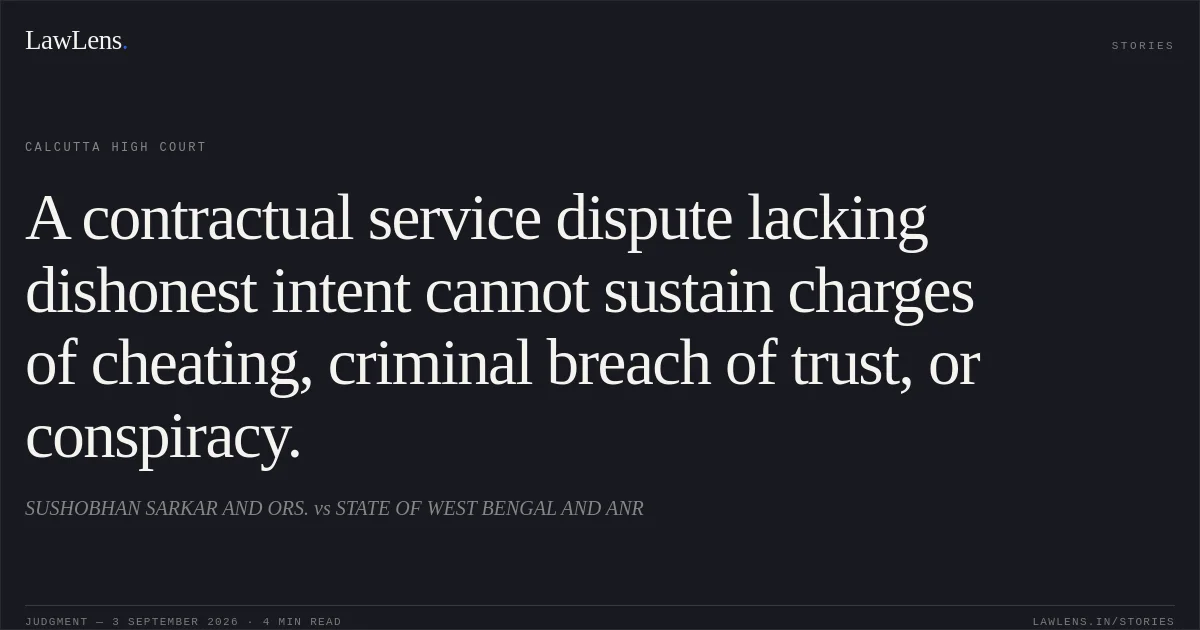
The Court answered the issues in favour of the petitioners and held that the complaint disclosed, at most, a contractual dispute concerning termination of the legal retainership and payment of fees, not the offences under Sections 406, 420 or 120B of the IPC.
¶ 24–28CRR 4734 of 2023 was allowed, and G.R. Case No. 767 of 2023 arising out of Electronics Complex Police Station Case No. 126 of 2023 was quashed against Sushobhan Sarkar, Nandini Sarkar, Abhijit Bhattacharya and Poulomi Kumari.
¶ 28–30Connected applications were disposed of, and any interim order was vacated.
¶ 31–32Original Court PDF
SUSHOBHAN SARKAR AND ORS.vsSTATE OF WEST BENGAL AND ANR
Click to open original judgment
Original judgment, available to read, download and summarize on LawLens.in