Facts
Baikunthpur P.S. Case No. 394 of 2024 was registered under Sections 126(2), 115(2), 118(1), 109, 303 and 103 read with Section 3(5) of the Bharatiya Nyaya Sanhita, 2023, alleging that the petitioner and other accused assaulted the informant’s family, resulting in the death of one person and serious injuries to another.
Source reference: para. 5–6The petitioner was arrested on 24 June 2025 and claimed juvenility. The Juvenile Justice Board determined that he was aged 15 years, 6 months and 27 days on the date of the alleged occurrence and declared him a child in conflict with law (CICL).
Source reference: para. 7The Board rejected his bail application on 5 August 2025, and the appellate court dismissed his appeal on 29 August 2025.
Source reference: para. 8–10The petitioner contended that the case arose from a land dispute, that a counter-case had been lodged by his side, and that the courts below had denied bail without demonstrating any statutory ground under Section 12 of the Juvenile Justice (Care and Protection of Children) Act, 2015.
Source reference: para. 11The identity of the CICL was anonymised as “XX” in accordance with Section 74 of the Act.
Source reference: para. 3–4Issues
Whether the petitioner/CICL was entitled to bail under Section 12 of the Juvenile Justice (Care and Protection of Children) Act, 2015, in the absence of material showing that his release would expose him to criminal elements, moral, physical or psychological danger, or defeat the ends of justice?
Source reference: para. 14, 16Whether the fact that the petitioner’s family members were co-accused was, by itself, sufficient to deny restoration to the family and refuse bail?
Source reference: para. 17Whether the orders of the Juvenile Justice Board and the appellate court refusing bail were sustainable in light of the Act’s principles of best interest, rehabilitation, restoration and institutional care as a last resort?
Source reference: para. 15–18Law Applied
The Court exercised revisional jurisdiction under Section 102 of the Juvenile Justice (Care and Protection of Children) Act, 2015.
Source reference: para. 5Section 12 mandates release of a CICL on bail unless there are reasonable grounds for believing that release would bring the child into association with a known criminal, expose the child to moral, physical or psychological danger, or defeat the ends of justice.
Source reference: para. 14Section 3 embodies the Act’s guiding principles, including the best-interest principle, under which decisions must promote the child’s development and full potential; the principle that institutional care is a measure of last resort after reasonable inquiry; and the principle of repatriation and restoration to the family unless such restoration is contrary to the child’s best interest.
Source reference: para. 15The Court also applied Section 74, which prohibits disclosure of the identity of a child in conflict with law.
Source reference: para. 3Reasoning
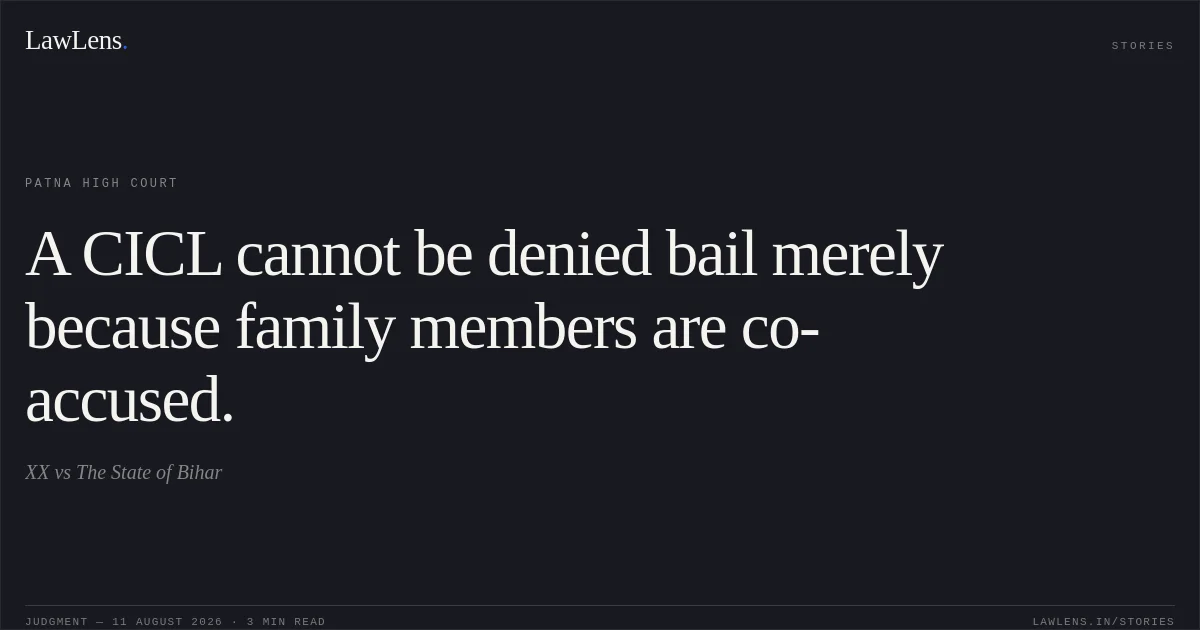
The Court held that the subordinate courts had denied bail principally because the petitioner’s family members were co-accused and, consequently, assumed that restoration to the family would not be in his best interest.
Source reference: para. 17The Court found this reasoning unsupported by the record: the allegations against the petitioner were non-specific, the occurrence arose in the context of a case and counter-case relating to a land dispute, and there was no material showing that the petitioner or his family members had criminal antecedents, were habitual offenders, or posed a danger to the petitioner’s welfare.
Source reference: para. 11, 17Since none of the statutory exceptions under Section 12 was established, bail could not lawfully be refused.
Source reference: para. 14, 16Applying the Act’s child-friendly and rehabilitative framework, the Court emphasised that institutionalisation is a last resort and that family restoration ordinarily serves the child’s best interests where no specific risk is demonstrated.
Source reference: para. 15–17Holding
The Court allowed the revision petition and set aside the appellate order dated 29 August 2025 and the Juvenile Justice Board’s order dated 5 August 2025 rejecting bail.
The petitioner/CICL was directed to be released on bail on furnishing a bond of ₹10,000 with two sureties of the like amount to the satisfaction of the Juvenile Justice Board or the concerned court.
Source reference: para. 19One surety was required to be a parent and the other a relative without criminal antecedents; the petitioner was also required to undertake not to engage in unlawful activities or associate with anti-social elements and to remain present before the Board on every date fixed in the case.
Source reference: para. 19Acts & Sections Cited
12 provisions across 2 statutes referred to in this judgment. Each provision opens on LawLens.
Juvenile Justice (Care and Protection of Children) Act, 2015.4
Bharatiya Nyaya Sanhita, 20238
Original Court PDF
XXvsThe State of Bihar
Click to open original judgment
Original judgment, available to read, download and summarize on LawLens.in